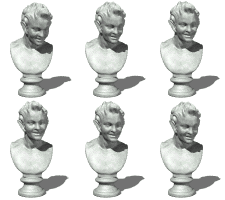
According to Raven Grimassi, in his book Ways of the Strega; Italian Witchcraft, Pano is the Tuscan deity that corresponds with Pan, Lord of the Wood. Likewise Losna corresponds with Diana aka Luna, the goddess of the moon. Both of these are considered to be minor deitites by most.
In the text that follows you will see a great conflageration of names that seem to twist and turn around themselves. This is especially true in the case of the names of the Etruscan/Tuscan deities. The reason there are so many different names for the same deity in Etruscan mythology is that the Etruscan language has not yet been completely decoded so translations now available are in large part speculative. It has been speculated that the difficulty with translating Etruscan is that each community or town had it's very own dialect, making distictive each city's speech. This conclusion on my part is drawn from the discussion on the LaVecchia egroups list and from Mythography; Etruscan Gods and Goddesses.
Other sources give different names for the Tuscan gods. One example is the Encyclopedia Mythica, which lists Faflon as Fufluns and Silviano as Selvans, though gives no listing at all for Pano.
There is shown a correspondence between Faunus and Pan in "Roman Mythology Today". Faunus is also represented in the iconography (pictures and statues) as being the horned and hooved God of the Wild, satyr-like in appearance as Pan is also.
It should be noted however, that some images from Greek antiquity which are now described as satyrs, do not wear the horns, but are instead depicted more closely as vegetative icons in that a plant headress is worn instead. An example of this may be found at this url, which shows a coin that is a part of the Perseus Classics Collection. In fact, it seems that any strong male figure might be classified as a satyr. Click here or here for other examples.
Pan is also shown being given grapes over which Faflon/Bachus would seem to rule, thus illustrating the connection between the two of attributes of fruitfulness and the vine. The bald head and horse's tail identifies he who presents the grapes as Silvanus, most often simply described as a satyr though lacking in the hoof and horn attributes. It is he who gives the grapes to Pan and he also who's counterpart, Silenus, was teacher and drinking-buddy to the Greek Dionysus.
Faunus is equated with Pan, however, within the Tuscan pantheon as presented by Raven Grimassi, he is seen as seperate and equating with Fanio rather than Pano. Determining who is who is a difficult task because both Fanio and Pano would seem to have the hoof and horn appearance.
It is the Greek Selene, whom was a consort of Pan, who brought forth a herd of white oxen by his issue. The identity of her father has been cited differently among sources as the Titan Pallas, Helios, or Zeus. She is sister to Helios (known also as Sol to the Romans, who corresponds with Aplu/Apollo and who's worship originated in Syria) and Eos (who corresponds with Tesana/Aurora and was called Matuta by the Romans).
Raven Grimassi's Ways of the Strega; Italian Witchcraft lists these correspondences:
Tuscan Greek/Roman
Teramo - Mercury
Nortia - Fortuna
Aplu - Apollo
Losna - Diana/Luna
Turanna - Venus
Pano - Pan
Maso - Mars
Silviano - Silvanus
Esta - Vesta
Faflon - Bacchus
Tesana - Aurora
Spulviero - Aeolus
Fanio - Faunus
Alpena - Flora
Tituno - Vulcan
Verbio - Verbius
Dusio - Eros
Jano - Janus
Meana - Fate
Another lists of correspondences found at Encyclopedia Mythica through Roman Mythology Today shows the following:
Roman/Greek
Aesculapius / Asclepius
Aquilo / Boreas
Aurora / Eos
Auster / Notus
Bacchus / Dionysus
Bellona / Enyo
Ceres / Demeter
Cupid (Amor) / Eros
Decima / Lachesis
Diana / Artemis
Dis Pater, Pluto, Orcus / Hades
Discordia / Eris
Fama / Pheme
Faun / Satyr
Faunus / Pan
Favonius / Zephyrus
Flora / Chloris
Fortuna / Tyche
Furies / Erinyes
Galinthis / Galinthias
Gratiae / Charites (Graces)
Hercules / Heracles
Juno / Hera
Jupiter / Zeus
Justitia / Themis
Juventas / Hebe
Latona / Leto
Lucifer / Phosporus
Luna / Selene
Mars / Ares
Matuta / Eos
Mercury / Hermes
Minerva / Athena
Morta / Atropos
Necessitas / Ananke
Neptune / Poseidon
Nona / Clotho
Parcae / Moirae (Fates)
Pax / Irene
Proserpina / Persephone
Salacia / Amphitrite
Salus / Hygieia
Saturn / Cronus
Silvanus / Silenus
Sol / Helios
Somnus / Hypnos
Stimula / Semele
Tellus / Gaia
Trivia / Hecate
Ulysses / Odysseus
Veiovis / Asclepius
Venus / Aphrodite
Vesper / Hesperos
Vesta / Hestia
Victoria / Nike
Vulcan / Hephaestus
Vulturnus / Eurus