 |
|
|
|
|
|
|
|
|
 |
|
Socrates |
|
|
|
|
|
Socrates (470-399 B.C.) is one of the most mysterious people in the history of philosophy. Even though he never wrote a single line, he is one of the philosophers who have had the greatest influence on Western thought.
He was born in Athens, and spent most of his time in the city�s squares and marketplaces talking with various people. He once said, �the trees in the countryside can teach me nothing.� Often one could find him in the middle of nowhere, lost in thought for hours on end.
Due to the fact that he was very unknowable, after his dramatic death, many widely different schools of thought claimed him as the founder. |
|
|
|
|
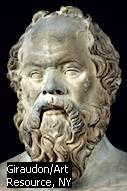
A bust of Socrates.
From: Encarta |
|
|
|
|
|
|
His Method |
|
|
|
The nature of Socrates� art was the fact that he did not appear to want to instruct people. Instead, he appeared to the people he spoke with that he wanted to learn from them. So, instead of giving people sermons, he discussed. He would only ask questions, especially to start a conversation, as if he was totally ignorant of the subject. In the path of the discussion, he would usually get the person to realize the weakness of their arguments, and being forced into a corner, be compelled to acknowledge who was right, and who was wrong. He believed that anyone could grasp philosophical truths if they just use their innate reasoning. His pretended ignorance is called Socratic irony, which means appearing dumber than one actually is.
Not surprisingly, as time went by, people became more and more annoyed by Socrates� revealing their own ignorance, especially the aristocracy. Allegedly, he once said, �Athens is like a sluggish horse, and I am the gadfly trying to sting it into life.�
In 399 B.C. he was accused of introducing new gods and corrupting the youth. With a slender majority a jury found him guilty. He could have lived anywhere else but Athens, but that would not have been his style. Instead, he drank hemlock, a poison, among his friends and died. |
|
|
|
His Philosophical Project |
|
|
|
Socrates� was the first to call himself a �philo-sopher�, a combination of the Greek word philos, meaning love, and sophia, meaning wisdom. (If sophia sounds familiar, it�s probably from the name of the mosque/church/museum in Turkey called the Hagia Sophia. Hagia Sophia means �holy wisdom� in Greek.) In other words, he called himself a �lover of wisdom�. A philosopher was a totally new breed of thinker. A philosopher understands that he knows nothing, and is troubled by this. Socrates said, �One thing only I know, and that is that I know nothing.� Therefore he was a rationalist.
He believed that the right insight leads to the right action. When we do wrong, it�s only because we don�t know any better, and that when we act against our better judgment, it is impossible to be happy. Thus, he who knows what is right, will always do right, because who wants to be unhappy? Therefore, it is important to keep learning, so we know what is right and wrong. |
|