 |
|
|
|
|
|
|
|
|
|
|
|
|
|
|
|
|
|
|
|
Plato |
|
|
|
 |
|
|
Plato (428-347 B.C.) was 29 years old when Socrates drank the hemlock. To Plato, the death of Socrates was a great example of the constant conflict between the actual society, and the true or ideal society.
Plato set up his own philosophical school in a grove in Athens, which was named after the legendary Greek hero Acadamus. Therefore the school was known as an academy. The courses available to students were philosophy, mathematics, and gymnastics. The teaching style was just like Socrates, having a discussion by asking only questions. |
|
|
|
|
|
 |
|
|
|
|
|
|
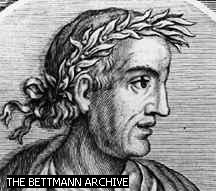
Plato
Courtesy of Encarta |
|
|
|
|
|
|
|
According to Plato, the human body is composed of three parts: the head, the chest and the abdomen. In each of these parts a portion of the soul resides. Reason in the head, will in the chest, and appetite. For each of these parts of the soul, a virtue resides. Wisdom comes from reason, courage comes from will, and temperance curbs the appetite. |
|
|
|
|
|
His Project |
|
|
|
|
|
|
|
Plato was concerned with what was eternal and indisputable in both nature and in morals and society. He thought that all of these things were one in the same. He tried to imagine a reality that was eternal and unchangeable. He believed that everything in nature �flows�. There is no substance that is not able to dissolve. Everything in the material world is made of something that time can erode, but everything is made of a timeless �mold� that is eternal and immutable.
You may be now thinking, �I�ve been to a farm and I have seen dozens of horses, and some are gray, some are brown, some have spots, some have stripes, so they�re all different. How can there be one mold.
Well, Plato would have probably asked you this:
�Have you seen a three legged horse?�
�Have you seen one without a mane or tail?�
�Have you seen one with a round head?�
He would continue asking you these questions until you get that due to the fact that everything material flows, color, shape, and age deviations must occur, but the basic outline of a horse is obvious. You know what a horse should look like and Plato attributed this to the fact that you saw the idea horse in the world of ideas before you were born. I�ll explain this part of the theory later.
Plato believed that everything that we see has one form or mold behind it. Plato called these molds �ideas�. There is an idea horse, an idea human, an idea goldfish etc. From this he came to the conclusion that there must be a reality behind the material world. He called this reality the world of ideas, and in this world all of the molds are stored. This view is called Plato�s theory of ideas. |
|
|
|
|
|
|
|
|
|
Plato envisioned the perfect state built like the body, rulers at the head, auxiliaries the chest, laborers the abdomen. |
|
|
|
|
|
|
|
Plato believed that reality is divided into two regions. One is the world of the senses, where we can only have feelings or opinions about by using our five senses. The other is the world of ideas that we can gain true knowledge of using our senses. Plato believed that the soul existed in the world of ideas before it entered the body. But as soon as it enters the body, it forgets all about the ideas it saw, that is, until it sees an example in the world of the senses. This in turn stirs a faint recollection of the perfect idea. This in turn causes the soul to yearn to returning to its original realm. Plato called this desire eros, which means love.
Plato often used Socrates as his mouthpiece in his dialogues, so keep this in mind as you read the myth below.
Now please read his myth of the cave, which can be found here.
|
|
|
|
|