
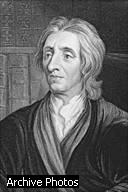
Locke claimed that all of our thoughts and ideas come from what we have taken in from our senses. Before we sense anything, the mind is a �tabula rasa,� or a blank slate. So when we are born, our minds have nothing in them, until we intensively smell, taste, feel, and hear as infants. In this way he said that simple ideas of sense arise. These ideas are then worked on by thinking, reasoning, believing, and doubting, thus giving rise to what Locke calls reflection.
Locke emphasized that the only thing we can perceive are simple sensations. When you eat an apple, you do not sense the apple in a single sensation. You experience a whole series of simple sensations, such as the apple is green, smells fresh, and tastes juicy and sharp. Only after eating an apple many times does one think, �Now I am eating an apple.� Now Locke would have said that you have formed a complex idea of an apple. Locke then would tell you that all the material for our knowledge comes to us from simple sensations. Knowledge that cannot be traced back to simple sensations is therefore false knowledge and must be rejected.
With our senses, Locke said that we perceived two different types of qualities. Primary qualities were extension: weight, motion, number, etc. When it is qualities, such as these, it can be certain that the senses reproduce them objectively. Secondary qualities, such as color, taste, smell, or temperature, are different for each person. For one person an orange could be sweet, and for another, it could be sour.
Locke admitted that there is intuitive knowledge in some areas. Locke believed in natural right, and that it was inherent in human reason to be able to know that God exists, ideas that are both rationalistic. But he didn�t let the God idea rest on faith. He said it was reason that told man so.
Locke was also an advocate of the separation of powers, which is what the United States of America�s constitution is based on.
Courtesy of Encarta