
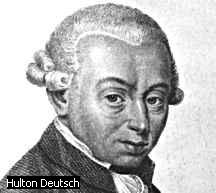
Courtesy of Encarta
Kant thought that both sensing and reason come into play in our conception of the world. He thought that the rationalists went to far in how much reason can contribute and he thought that the Empiricists went to far with their emphasis on sensory experience. He said that all of our knowledge of the world comes from our sensations but in our reason there are factors that determine how we perceive the world around us.
Kant said that whatever we see will first and foremost be perceived as phenomena in time and space. Kant called time and space our two forms of intuition. These two forms, in our minds precede every experience.. In other words, you can know before we experience things that they will happen in time and space. He also said that time and space are part of the human condition and not attributes of the physical world.
The law of causality is eternal and absolute simply because human reason perceives everything that happens as a matter of cause and effect, according to Kant.
We can never know of things in themselves, we can only know how they appear to us.
According to Kant, there are two elements that contribute to a man�s knowledge of the world. One is the external conditions that we cannot know of until we have perceived them through the senses. This is known as the material of knowledge. The other is the internal conditions in a man himself. This is called the form of knowledge.
In big philosophical questions, such as �Is there a God?� human reason operates beyond what we can comprehend. Where both reason and experience fall short, that vacuum can be filled by faith. He believed that it was essential to presuppose that man has an immortal soul, that God exists, and that man has a free will. He called these practical postulates.