
Hume was more interested in the spontaneous experience of everyday life. No philosopher �will ever be able to take us behind the daily experiences or give us rules of conduct that are different from those we get through reflections on everyday life,� he said. An example is the concept of an angel, that is a human figure with wings. People have seen a human figure, and they have seen wings, but they have never seen a human with wings. According to Hume, an angel is a complex idea. It consists of two different experiences that are not related, but are associated with each other in man�s imagination. Therefore, it is a false idea, and must be rejected. Hume thought we must tidy up our thoughts and ideas.
Hume thought that there were two types of human perceptions, impressions and ideas. Impressions are the immediate sensations of external reality, and ideas are the recollection of impressions. If you burn yourself, for example, the immediate pain is the impression. From then on when you see a hot stove, and recollect the pain associated with touching that stove, that is the idea. The difference between the two is that the impression is stronger and livelier than the idea. An idea is basically a paler imitation of an impression.
Hume thought that there was no �I�, much like Buddha. The ego is a constantly changing thing. He also did not accept or deny that man has an immortal soul. He was an agnostic, or someone that holds that the existence of God or a god cannot be proven or disproved.
Hume said that the action of a particular object at one point in time does not dictate how it will act subsequent times. Just because a rock falls to the ground 500 times you drop it, it does not mean that it will fall to the ground the 501st time. It just might as well float to the ceiling. He said that the �unbreakable laws of nature� were simply expectations that humans have come to get used to. For example, if a one-year-old and you saw a rock float in the air, who would be more surprised? You would be. That�s because the one-year old has not yet gotten used to the laws of nature. Hume said that the child has not become a slave to habit, and is therefore more open-minded than you.
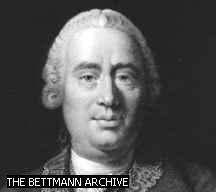
Courtesy of Encarta
Hume also asserted that it is not reason that determines what we say and what we do. He said that it is our sentiments that make us decide to help someone in need. It�s because of our feelings, not our reason. Hume said that everyone has feelings for other peoples� welfare, but it has nothing to do with reason. The idea that �People want to live, therefore you ought not to kill them� is utter nonsense in the view of reason. You could just as easily say, "people cheat at sports, therefore I ought to cheat too.� He said that acting responsibly is not achieved by strengthening our reason, but by deepening our feelings for the compassion of others. � �Tis not contrary to reason to prefer the destruction of the world to the scratching of my finger,� said Hume.