
1. Opposition to Authority
2. Rationalism
3. The Enlightenment Movement
4. Cultural Optimism
5. The Return to Nature
6. Natural Religion
7. Human Rights
The most important names during this period are Montesquieu, Voltaire, and Rousseau. Many of the Enlightenment philosophers traveled to England, which was more liberal than their home country. Locke and his political philosophy inspired them. Once they returned back to France, they became more opposed to the old authority. The opposition to authority was directed against the power of the clergy, the king, and the nobility. These institutions held way more power in France than they had in England. Then came the French Revolution in 1789.
Most of the Enlightenment philosophers were rationalists. This was so characteristic of the French Enlightenment that it was often called the Age of Reason. The Enlightenment philosophers saw it as their duty to lay a foundation for morals, religion, and ethics in accordance with man�s reason. This led to the enlightenment movement.
Now it was time to start enlightening the masses, in order to have a better society. Great attention was therefore focused on the education of children and people. The science of pedagogy was founded at this time. The first encyclopedia was published at this time.
Enlightenment philosophers thought that once the masses were educated, humanity would make great progress. This held up until a few decades ago when it was discovered that not all progress is good.
The new catchphrase was back to nature. By �nature� the enlightenment philosophers meant almost the same as �reason.� Rousseau proposed the catch phrase, �We should return to nature, for nature is good and man is by nature good; it is civilization which ruins him.� Rousseau also believed that the child should stay as innocent has naturally possible.
The Enlightenment thinkers thought that religion should also remain natural. There were many that tried to get what one could call a natural religion. Most of the Enlightenment philosophers thought it irrational to imagine a world without God. It was also considered rational to believe about the immortality of the soul.
Many people professed what was known as Deism. Deism is a belief that God created the world long ago but has not revealed himself to the world since that time. This made God the Supreme Being who only reveals himself to mankind through natural ways and not supernatural ways.
The French Enlightenment was more practical than English philosophy. The philosophers fought actively for what they called the natural rights of the citizen. At first this was a campaign against censorship, but then they expanded to matters of religion, morals, and politics. They also fought for the abolition of slavery and for more humane treatment of criminals.
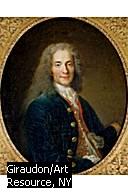
Courtesy of Encarta