
When it came to acquiring certain knowledge, most philosophers at his time voiced total skepticism. They believed that man should just accept the fact that he knew nothing. Descartes asked himself if there was a certain and exact method of philosophic refection, like the scientific method.
On the matter of the mind and body, he wrote, �When I consider this carefully, I find not a single property which with certainty separates the waking state from the dream. How can you be certain that your whole life is not a dream?� This caused him to doubt everything. But while most philosophers get stuck here, he kept going. He realized that if he could doubt, then he was a thinking human being. Or, as he put it, �Cogito, ergo sum.� Translated from Latin, this means, �I think, therefore I am.�
Descartes also maintained that there were two realities. One is thought, or the mind; the other is extension, or matter. The mind is only conscious; it takes up no space and therefore cannot be divided into smaller parts. Matter is purely extension, it takes up room in space, and therefore can be divided into smaller and smaller parts, but it has no consciousness. Although both come from god, the two substances have no contact with each other. This means that Descartes was a dualist. Dualism means that there is a sharp division between the reality of thought and the extended reality. Descartes did not reject the possibility that animals could think, but if they can, the same rules must apply to them.
He did not deny that the mind and the body were in constant interaction. He said the goal for humans was to get reason to assume control. The fact that humans have the ability to rise above bodily needs and behave rationally meant that the mind was superior to the body.
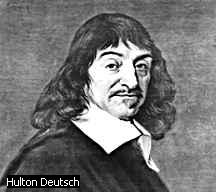
Courtesy of Encarta