
Aristotle agreed that everything flows, and that the form of a organism is unchangeable. But he believed that the �idea� of a certain organism was something that humans formulated after seeing many examples of that organism. For Aristotle the �idea� organism was composed of the organism�s characteristics � which is the definition of today�s term species. He pointed out that nothing exists in the consciousness that has not first been experienced by the senses. He also believed that reason is man�s most distinguishing characteristic.
According to Aristotle, reality consisted of two things, form and substance. Form is what something does, and when it dies, what is left is substance. He also said that every change in nature was from it�s potential to its actual state. For example, a snake egg has the potential to become a snake, but not all will, for some lizards will come and find some and eat them. Those eggs did not reach their actual state to become snakes. But the ones that hatch and become snakes are in their actual state. But a snake egg cannot produce an alligator, so it�s form puts up some limitations on what it can become.
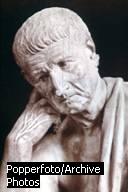
Courtesy of Encarta
The material cause is that the moisture was there at the exact moment the air cooled. The efficient cause is that the moisture cools, and the formal cause is that the form, or nature, of water is to fall to the earth. The final cause is that it rains because plants and animals need the rain in order to grow.
He also believed that everything in nature belongs to different categories and subcategories. He founded the science of logic, which is illustrated below:
All Brunos are Italian. Antonio is a Bruno. Therefore Antonio is Italian.
When Aristotle started organizing things, he first pointed out that all things are living or nonliving. Nonliving things can only change through external influence. Only living things have the potential for change.
Living things are then divided into two subcategories, plants and creatures. The creatures can be then divided into two sub-subcategories, animals and humans.
When he divided natural phenomena, he used the objects characteristics, or more specifically, what it does or can do.
Aristotle believed in a �first mover� that started all movement that governs the Earth. In other words, he believed in God.
1. A life of pleasure and enjoyment.
2. A life as a free and responsible citizen.
3. A life as a thinker and philosopher.
With relationships, Aristotle said that we must be neither cowardly nor rash, but courageous.
Aristotle also said that man is by nature a �political animal�. He said that there were three good forms of constitution: A monarchy, an aristocracy, and a democracy.
His view of women was what was the accepted view during the middle ages, so it�s worth mentioning. He believed that a woman was an �unfinished man�. He said that the man provides the �form� and the woman the �substance�.