Dallas
Austin
The first people to find their way to Texas were Native Americans: Some of the ancient groups that migrated into present-day Mexico and Central America likely crossed Texas soil in the process. In time, a diverse collection of tribes came to dwell in the area. The Tonkawas and ancestors of the Lipan Apaches roamed over most of central and northwest Texas. The most advanced of all cultures in Texas, the mound-building Caddo, farmed fertile portions of east Texas. On the north Texas plains, Native Americans followed bison herds and lived in tepees. The first Europeans to see Texas were Spaniards Cabeza de Vaca in 1528 and Francisco Coronado in 1541. Later, Spanish missions were established to Christianize the Indians and help secure the territory: The first was established at El Paso in 1681, and others were founded in east Texas and in San Antonio. The raids of the Apache and, especially, the Commanche, left Spain with a very tenuous hold on the area, however. During the early 1800s, more settlers entered Texas, many of them from the U.S. Some, like those led by Stephen Austin, had official permission; some didn't. After Mexico became independent of Spain, residents of the Texas territory lobbied for greater autonomy, but the Mexican government failed to enact reforms. In 1835, Texans revolted. Their efforts led to bloody defeat at the Alamo, but independence was won at the battle of San Jacinto (near Houston) in 1836. Texas existed as an independent republic for nine years -- even accepting consuls from Europe -- but chose to join the United States in 1845. Texas became an important economic force with the discovery of its vast oil reserves early in the 1900s. Since the rich Spindletop oilfield near Beaumont was found in 1901, Texas has been one of the biggest oil-producing states in the country. (Ownership of oil-producing land made many ranchers rich and gave the University of Texas an endowment second only to Harvard's.) Agriculture and ranching -- and more recently high technology -- have also played an important role in the state's economy.
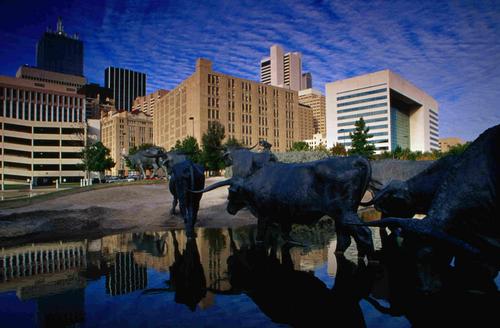
Dallas crackles with the energy of commerce. With its concentration of technology companies, corporate headquarters and wholesale trade markets, the nation's eighth-largest city is a metropolis devoted to business. Residents seem to enjoy spending money with the same passion with which they earn it. The result is a mercantile mecca: The metropolitan area affords shopping opportunities that rival those in New York City. The city of Dallas, along with Fort Worth, its neighbor across the Trinity River, anchors a vast area of north-central Texas known as the "Metroplex." It's a fast-growing region that's become an oasis for entrepreneurs and a fertile ground for young singles and families alike. Dallas itself is a pleasant mix of the Old South and the New Economy. The new urban high-rises are balanced by comfortable family suburbs just minutes away from downtown. People are generally congenial and welcoming, and as with other Texans, Dallasites are proud of their ability to do things "big."
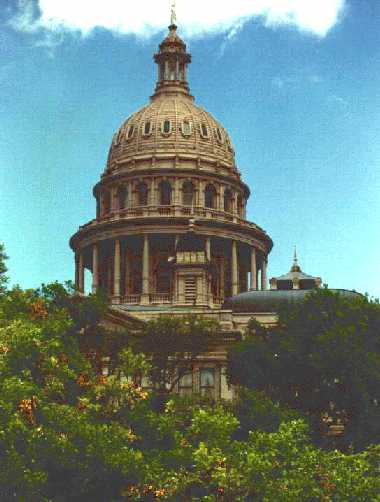
Although it's the capital of the state and the home of the massive University of Texas, Austin has always managed to avoid being just a government or college town. It was long known as a laid-back haven for musicians, hippies, slackers and virtually any other counterculture group. But in the 1990s, it started drawing a crowd of high-tech whiz kids who only added to its reputation. (They made it a cool place to hang out and become a millionaire.) Times have changed, of course, because of the economic downturn, but Austin is still a cool place to hang out.
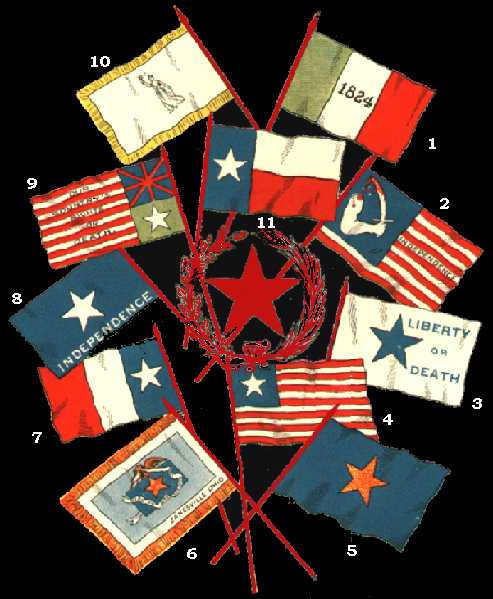
Each of the flags of the Texas Revolution is identified and briefly described below (clockwise, starting with the "1824 flag" at the top right): Flag of the Alamo--Flag generally believed to be the one flown during the Battle of the Alamo; sometimes referred to as the "1824 flag." Flag of Goliad and Velasco--Unfurled at Goliad and Velasco by Captain William Brown on his return from the Siege of Bexar. Flag of Georgia Battalion--Presented by Joanna Troutman to Colonel William Ward's Georgia Battalion prior to its departure for Texas. Naval Flag--Designed by ad interim president David Burnett and adopted by the First Congress of the Republic of Texas. David G. Burnet Flag (12/10/1836-1/24/1839)--Adopted as the first national flag by the First Congress of the Republic of Texas. Captain Burroughs' Flag--Brought to Texas during the summer of 1836 by a company under Captain Burroughs of Zanesville, Ohio. Dodson Flag--Made by Sarah Dodson, wife of Lieut. A. B. Dodson, for a company he helped organize at Harrisburg in September, 1835. McGahey Flag--First displayed at Lynchburg during the fall of 1835; named after James L. McGahey, who later described the flag. San Felipe Flag--Presented to a company of militia at San Felipe on February 29, 1836; made by two ladies, names currently unknown. Flag of San Jacinto--Used at the Battle of San Jacinto; brought to Texas by Newport Volunteers of Kentucky under Sidney Sherman. Lone Star Flag (official flag after 1/24/1839)--Adopted by the Third Congress of the Republic; became state flag after annexation.