
Synchronized swimming, a water sport in which contestants perform choreographed maneuvers set to music. Synchronized swimming requires agility, grace, timing, musical interpretation, and overall body strength.
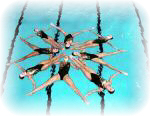 Three competitive synchronized swimming events are recognized internationally: solo, duet, and team (consisting of eight swimmers), although all three events are not always held at each competition. In each event, synchronized swimmers compete in three categories: figures, technical routine, and free routine. All three categories are also not always held at each competition.
In the figures competition, swimmers perform 4 of a possible 20 figures, or combinations of movements. A panel of judges awards points from 0 to 10 based on the accuracy of the performance and the timing, height, stability, and control of the figures. In the technical routine, the swimmers must perform a set list of elements, or combinations of figures and swimming strokes, in a prescribed order. In the free routine, swimmers can create their own choreography of figures and strokes. In the technical and free routines, which can last from two to five minutes each, depending on whether they are in solo, duet, or team competition, a panel of judges awards points from 0 to 10 in the categories of technical merit and artistic impression. Technical merit encompasses the execution, synchronization, and difficulty of the elements. Artistic impression includes the choreography, musical interpretation, and manner of presentation of the performance. Routines are enhanced by swimmers' use of original and expressive movements, patterns, and rhythms. The scores for the figures and the routines are weighted according to a formula and combined for each competitor to determine the winner.
Synchronized swimming was developed from water ballet, which was first performed in the early 20th century. The first synchronized swimming competition in the United States was a meet between Wright Junior College and the Chicago Teacher's College in 1939. In 1941 the sport was recognized by the Amateur Athletic Union of the United States, then the governing body over many amateur sports in the United States. Synchronized swimming became a competitive event in the Pan American Games in 1955 in Mexico City.
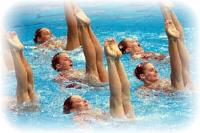 Synchronized swimming debuted at the Olympic Games in 1984 in Los Angeles, California, with solo and duet events. At those Games, American athletes won both events. Tracie Ruiz won the solo gold medal, and she teamed with Candy Costie to win the duet competition. At the 1988 Games in Seoul, South Korea, Canadians won both medals. Carolyn Waldo won the gold medal in the solo event and teamed with Michelle Cameron to win the duet competition. At the 1992 Games in Barcelona, Spain, American Kristen Babb-Sprague won the solo gold medal, while Americans Karen Josephson and Sarah Josephson won the duet competition. Only the solo and duet competitions were held at the 1984, 1988, and 1992 Olympic Games. For the 1996 Games in Atlanta, Georgia, team competition replaced the solo and duet categories, and the United States won the gold medal. For the 2000 Games in Sydney, Australia, synchronized swimming featured duet and team events.
The international governing body for the sport is the F�d�ration International de Natation Amateur (FINA; French for �International Federation of Amateur Swimming�), located in Lausanne, Switzerland. The U.S. governing body is United States Synchronized Swimming, Incorporated, located in Indianapolis, Indiana. The governing body in Canada is Synchro Canada, located in Gloucester, Ontario.
"Synchronized Swimming," Microsoft� Encarta� Online Encyclopedia 2001
http://encarta.msn.com � 1997-2001 Microsoft Corporation. All rights reserved.
Synchronized swimming is basically making different shapes and motions with your body to create formations as a group. Swimmers use the eggbeater kick to keep their upper half above water and creates the illusion that they are standing on the bottom, although the floor is 12 feet below. The eggbeater kick is similar to sitting in a chair and moving your legs (from the knee down) in circular motions, like an eggbeater.
Sculling is also used to keep their entire body above water so they can do ballet legs, pinwheels, etc. To scull, you lay out (legs together, toes pointed, no knees/stomachs showing) and put your arms to your sides at a 90 degree angle and "smooth the sand." Sculling can make you go backward, forward, or to the side.
There are many different moves and formations you can make in synchronized swimming. Most of them require strength, flexibility, and breath control. To learn about them, please visit Figures.