








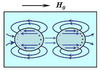
Current Research Interests:
-
Seeking for new electromagnetic (EM) materials with good attenuation properties such as hexagonal ferrite and magnetic alloy which was fabricated as powder, nanowire or thin film.
-
Synthesize magnetic material using different methods to change the magnetic properties as well the shape of materials. The synthesis methods employed are sputtering, chemical method (coprecipitation, electroless and electroplating method), ceramic process, mechanical alloying and molten-salt method et al.
-
Enriching the physical understandings of electromagnetic (EM) loss in materials, such as the influence of the particle shape, volume fraction and magnetocrystalline anisotropy on the attenuation properties in composites.
More results can be found in my Blog!
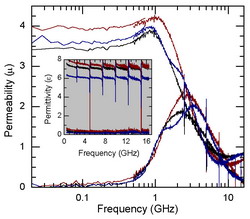
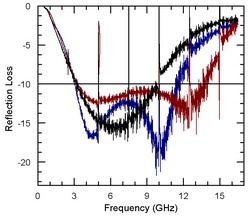
Left picture is the typical complex spectra of permeability and permittivity (inset) for the composites with the filler of Z-type ferrite at 50 % volume fraction, right picture is calculated reflection loss. A large bandwidth is obtained in these kinds of composites. (For details, please refer to my publications.)
Past Research Experience:

-
The investigation of the properties in II-VI semiconductor of barium chalcogenides using first-principles calculations.
-
The theoretical calculations were performed using commercial software of CAmbridge Serial Total Energy Package (CASTEP) under Cerius2.
-
The electronic properties in barium chalcogenides were systemically studied using first-principles calculations based on local-density approximation (LDA) and generalized-gradient approximation (GGA) schemes.
-
The absorption of oxygen on BaTe(111) surface was studied using quantum molecular-dynamics method. The influence of defects in surface was also discussed.
-
II-VI barium chalcogenides can be good candidates for wide-band-gap semiconductors.
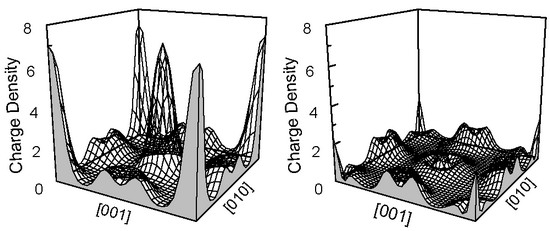
Charge density in (200) plane for BaO (left) and BaTe (right). A high charge density is found near every oxygen atom. (For details, please refer to my publications.)
-
The properties of core-shell Sendust powder (Sendust/Alumina) and its composites for the applications where both high permeability and high resistivity are necessary.
-
The purpose of this project was to produce the magnetic materials with high permeability and resistivity to meet the requirement in high-frequency applications.
-
Sendust and Permalloy are known to be with high permeability and low resistivity. The project was to significantly increase their resistivity while maintain high permeability in their composites.
-
The results indicated that the high resistivity always lead to a much lower permeability, no matter how much the permeability in bulk materials is.
-
The results were attributed to the demagnetizing filed in magnetic particles.
-
Research of sintered Nd-Fe-B using rapidly quenched powder.
-
Usually, rapidly quenched Nd-Fe-B powder was used to synthesize bonded hard magnets. However, it is well known that the composition in rapidly quenched Nd-Fe-B powder is homogeneous and easily controlled. Therefore, this project was conducted as an attempt to find out if the sintered Nd-Fe-B using rapidly quenched powder can provide very good hard magnetic properties.
NUS Home | TL Home | Contact Me @ Last Maintained by Mr. Guo-Qing Lin in Oct. 2005