~The Story of Qwan Yin~
Thi Kinh lived in a village with her parents. Her father, a farmer, owed money to his landlord and was unable to pay. As he could not make good his debt to this rich family, Thi Kinh's father offered his daughter in marriage to their son. The family did not particularly like Thi Kinh, but they took her because she was all they could get. Thi Kinh did not love the young man, but, as Luong says, "in the old days marriage was arranged by the families, and so you were expected to learn to love the husband as time went on." Thi Kinh married the young man, and they lived together, but, to his disappointment, she did not become pregnant and produce a child.
-
The husband had a mole on his cheek with a hair growing in it. One day as Thi Kinh was sitting sewing, she looked over to her husband, who was napping on the couch, and saw the hair in his mole. She was holding scissors, so she reached over to cut off the hair. Just then her husband woke up, and, startled, he accused her of trying to kill him with the scissors. Probably he only told that story to get rid of her because she had not produced a son for him. If she had tried to kill him, she would be sent away, and he could marry someone else.
The rich family threw Thi Kinh out of the house. The neighbors all gossiped that she had tried to kill her husband, and they would not help her. Her own parents did not want to take her back because they believed her quilty of such a crime. "For thousands of years," says Luong, "if a woman was thrown out of her family, what was she to do? Who was going to take her in? How was she to survive?"
Desperate, with no help from any direction, Thi Kinh hit upon an idea to save herself. She dressed in the robes of a monk and shaved off her long hair so that she looked like a man. Then she went to the Buddha temple and asked if she could stay there. She was accepted in the temple as a man, as a monk, and she began to work there and practice Buddhist meditation.
Unfortunately, one of the girls in the village who often saw the monk passing thought "he" was handsome and she developed a crush on "him." The girl, whose father was an important man in the village, longed for Thi Kinh, not knowing she was a woman. One night the girl heard a man passing her house and thought it was the monk; she invited him in and they had sex. When the girl became pregnant, her father was enraged. He beat her so that she would tell him who had fathered the child, and she did not know what to do. She told her father that the monk at the Buddha temple had made her pregnant.
When the people of the village heard this, they set out to punish Thi Kinh. She was thrown out of the temple and was once again homeless.

-
"And in the meantime," Luong explains, "she remained silent. She did not say, 'I am a female, I cannot make her pregnant'; she said nothing. Now if she were to say, 'I am a female, I'm a woman,' then she would bring shame and embarrassment to this girl and her father. I would get her off the hook, but she had promised to Buddha that she would take to heart the Buddhist teaching to forgive and be patient and find peace. So she could not do this to this girl or her father." Silent, Thi Kinh endured the abuse of the whole community.
When the girl gave birth to her baby, the family gave it to Thi Kihn to raise. Now Thi Kinh faced another difficutly; How was she, a homeless monk, to care for a newborn baby: She set out with the child, going from village to village to beg for milk. The pople were outraged at the shame Thi Kinh had supposedly brought on the name of Buddhism, in getting a girl pregnant. They threw mud at her, they threw rotten fruit and rocks at her.
Thi Kinh remained steadfast; she did not flinch before the abuse or renege on her vow of silence but went on trying to care for the baby. Finally, in a particularly vicious attack Thi Kinh was beaten to death, and the baby was taken off to stay at the temple.
When the villagers removed Thi Kinh's clothes to wash her body and bury her, they discovered she was a woman. Finally, they understood that she had been protecting the young girl, not wanting to shame or betray her. They reverd Thi Kinh for the pain she had endured on behalf of another person.
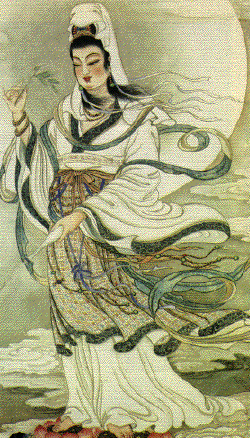
Thi Kihn became a spirit then, and the spirit was Kwan Yin.
- ~Back to A Permanent State of Limmerance~
