Pacific Campaign Continued
In order to prevent Adachi's 18th Army from breaking through the envelopment and also to stop the Jap defenders from having enough time to regroup and reorganize, the 41st Infantry tried to seize Wadke island and some airstrips at Sarmi on the adjacent New Guinea coast. Wadke was a tough nut to crack, the Japanese had to be winkled out of spider caves, Coconut log bunkers and Coral caves during 2 days of bitter, squad sized actions. Because most of the Jap defenders had gone to help stave off the Hollandia landings, the Sarmi airfileds were taken with relative ease. In the subsequent push towards Sarmi village, the 6th Division, with the 158th Regimental Combat Team, fought a bitter battle to clear 'Lone Tree Hill' of the enemy. The Americans suffered 2,299 casualties (437 killed) while the Japanese had a staggering 4,000 killed.
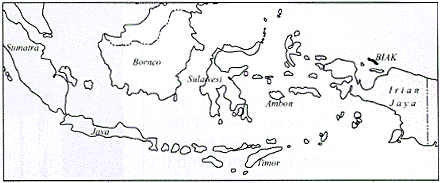
With all these major operations going on at the same time, the allies now turned their attention to Biak. Biak dominates Geelvink Bay and with it's capacity for heavy bombers on it's airstrips it was a powerful lure to MacArthur and Kenney. The 41st Infantry now turned it's attention to Biak, landing there on May 27th, 1944. Being only 60 miles south of the Equator, the steaming heat combined with sudden Jap ambushes to make the advance inland very slow indeed. The fighting continued through June and meant that the amphibious fleet along with Kincaid's 7th fleet were tied up close to Biak and vulnerable to Japanese air and surface attack. The Japanese 16th Cruiser Division tried several attacks on the American ships but thanks to allied code breakers and the 5th Air Force B25's, none of them caused any damage and the Japanese lost one Destroyer in the attempts. The Japanese lost about 4,800 men killed defending Biak, American casualties were about 2,800 killed and wounded.
Because the airfields on Biak were not taken on schedule, the allies also attacked the airstrips on Noemfoor island, begining with a landing on the airfield itself by the 503rd Parachute Regiment. Many Paratroopers had bone-cracking landings as high winds carried them into supply dumps, vehicle parks and wrecked Jap aircraft. None were actually killed in the jump, but 128 were injured in the jump. 411 Americans were casualties during the battle while about 1,759 Japanese were killed. Although an impressive defenseive belt was built around the airstrips, only 3 infantry battalions and 2 understrength cavalry squadrons guarded the Driniumoor river line. On the night of the 10th of July, 10,000 howling Jap troops rushed across the shallow Driniumoor and fell upon the vastly outnumbered Americans. Outnumbered and undermanned, the GI's fired their guns until they were red hot, artillery shells killed and maimed hundreds more Japanese, but the sheer weight of numbers allowed the Japs to prevail. For a month after, a battle of attrition was waged by small squads of GI's mopping up the remaining pockets of Japanese. All 10,000 Japanese were killed and about 440 Americans paid the ultimate price. Meanwhile the Australians were advancing towards Wewak in a move that cost them 451 killed while the Japanese lost 7,200! With these horrendous loss ratios (about 23-1 in favor of the allies) the Japanese forces in the South Pacific were chewed up piecemeal and destroyed. About 110,000 Japanese troops died in eastern New Guinea with another 15,000 killed in western New Guinea with another 40,000 isolated there and left to wither on the vine. With the isolation of another 100,000 Japanese troops on New Britain, the totality of the allied victory in the New Guinea campaign came into sharp focus.
The 5th Airforce lost 1374 aircraft from September 1942 to September 1944 and 4,100 airmen killed or missing. 2,000 Australian airmen also lost their lives in the climactic air battles over New Guinea. Before Hollandia it took 20 months and 24,000 allied battle casualties (17,107 being Australian) to advance 900 miles, with another 70,000 Malaria casualties. After Hollandia it took 9,500 casualties (mostly Americans) to leap 1,500 miles in just 100 days. The allies learnt in eastern New Guinea that the terrain dictated the campaign, so in western New Guinea air power and the sea allowed the allies to simply bypass the jungle, seize the coastal enclaves and leave the isolated Japanese troops trapped in the interior, to be decimated by diseaseand relentless allied pressure.
Postscript:
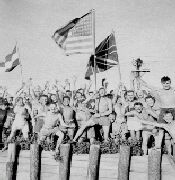
Although hurt by the attack on Pearl Harbor, the American people soon recovered and began the process of gearing their massive industrial capacity to a war footing. The 'sleeping giant' had indeed been awakened. Together with soldiers from Australia, Great Britain, New Zealand, India, Holland and many indiginous island peoples, the might of the American military machine was brought to bear on the the Japanese empire. There would be a few setbacks mingled with the many victories that led ultimately to the defeat of Japan, but, although some long and difficult campaigns lay ahead, the Australian and American men that fought the Japanese to a standstill in the stinking, disease ridden hell hole that was the New Guinea jungle will forever be remembered along with the gallant Marines that fought on Guadalcanal, as the troops that stopped the invincible Japanese juggernaut first and then turned it back on a long, continuous retreat all the way to the Japanese home islands themselves.
You veterans of the Pacific campaign will forever be owed a debt of gratitude by the free nations of the world, your sacrifices brought an end to the imperialist dreams of an empire devoted to the slaughter and enslavement of the people of the Western Pacific. Thank you.