Pacific campaign continued
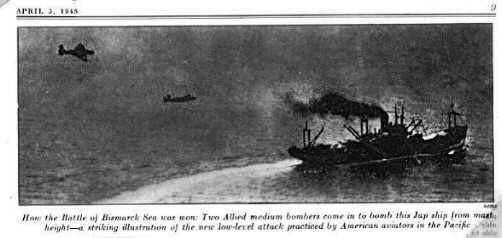
In this clipping from a 1943 newspaper, two B25's attack a Jap ship during the Battle of the Bismarck Sea, March 2-5, 1943. (the caption reads "How the Battle of the Bismarck Sea was won. Two Allied medium bombers come in to attack a Jap ship from mast height--a striking illustration of the new low-level attack practiced by American aviators in the Pacific.)
The Japanese still had air power on two fronts around the allies, Rabaul and Wewak, Kenney decided to concentrate on Wewak. The distance was to great for allied fighters to escort the bombers and unescorted raids would be suicide, so Kenney had a secret staging base built about 60 miles from Lae. On August 17th, the raid by the 5th Air Force left 100 parked planes destroyed or damaged, a follow up raid the next morning left another 28 Japanese planes wrecked. In two days the Japanese Fourth Air Army had lost three quarters of it's aircraft. Two weeks later the allies landed just north of Lae, only a few Jap bombers made any attacks on the beachhead and little damage was done. On September 5th, American Paratroops dropped on Nadzab, twenty miles West of Lae, unchallenged by Japanese aircraft. This move cut of the 51st Division from the rest of Eighteenth Army.
The Japanese had to retreat 50 miles to Finschafen across the 12,000 foot mountain range, of the 8,000 officers and men that started the retreat, about 2,000 were lost in the unforgiving mountains, mostly to starvation. Lt. Gen. Yamada assembled his remaining men on Satelberg ridge which overlooked the entire Finschafen coastline and blocked any further ground push toward Sio.
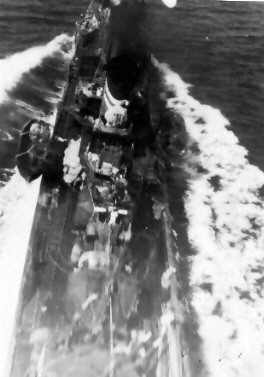
A Jap Destroyer photographed from the attacking 3rd Bomb Group plane's camera. This is proof that low level bombing, really was low level!!
Australian troops landed at Finschafen on Sept 22nd, after quickly clearing the coastal enclave around the port, they started to push up Satelberg ridge. Against entrenched and fanatical defenders, the Australians soon found themselves embroiled in a series of deadly, small unit combats, that found the 9th Australian Division having to clear isolated pockets of resistance one by one. At least 5,000 Japanese perished, but MacArthur's expected 'walkover' advance was held up for two months.
The allied forces in the Southwest Pacific had increased dramatically, in December, 1942, it was just the 32nd and 41st Infantry Divisions, now there were five divisions, three regimental combat teams, three engineer special brigades, five Autralian infantry divisions and three more US divisions on the way. The 5th Air Force had about 1,000 combat aircraft and the 7th fleet increased in size with more transports and landing being added. The Japanese on the other hand, had lost about 3,000 aircraft in the Southwest Pacific and 18th army had suffered about 35,000 casualties, they could not replace these kind of losses.
The jungle that had claimed so many Japanese lives now sheltered them from a concentrated allied ground offensive. Because of the dense jungle, the allies could not mass their overwhelming firepower against any particular stronghold. Of all the allied forces in the area, few actually fought the Japanese, the amount of logistical effort to sustain the allied forces was staggering. To sustain a single infantry regiment in combat required the equivelant of two divisions of supply personel. Seven out of every eight troops in the area served in support roles, from unloading ships to preventing Malaria, constructing airfields and hauling supplies.