|
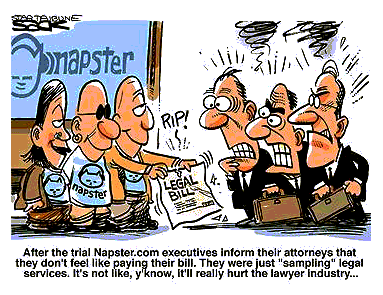
In today's fast pace market, businesses big and small are turning to e–commerce on the Internet to compete for consumers. As potential webmasters, copyright will constantly be an issue for review. Business not only has to be cautious of copyright law infringement, but also regular internet users like you and I have to be aware. The recent legal issues for Napster simply point out the problems. Many people are not aware of the copyright laws that are currently enforced in the United States. Nearly every site you visit on the Internet is copyrighted. Unless the author has given a release no one can take any part of the author's work without their permission. If the name Napster does not ring a bell it is a software company that allows their users to share digital music files over the Internet. Napster users can share any files over their file server unfiltered. This gives Napster users the ability to share copyrighted material which is an infringement of "fair use" according to the copyright law.
Recently in the Napster case, for E–Music, the Justice Department made the decision to have Napster filter their site for about 30,000 files that belong to E–music. E–Music Chief Executive Gene Hoffman said, "In light of this position, Napster's ability to quickly implement such a filtering system over this past weekend shows the company's true motive to unfairly build a business upon the copyrighted works of others." The decision promises important consequences for online copyright law. The fate of Napster is still in the long arm of the law until all possible actions are taken to properly protect themselves from a copyright infringement lawsuit. Current copyright law for the Internet applies much the same as it does for copyright on anything. "Copyright is the legal means of protecting expression" (From Copyright Law for Webmasters by Timothy J. Walton). The keywords are 'protecting expression.' Once you understand the meaning of those two words it is then rather easy to understand that anything — words, music, art, images, designs and more — created by someone are protected by law. Even the HTML code you are writing for your WebPages is protected. If you look at the article, Mr. Walton's comments go to heart of the matter in telling us why — Expression and creation are profit-making incentives. It's the copyright law that protects your right to make a living from your creative work. Copyright is the right to exclude, and not to publish work that has been copyrighted by the owners. It is also just as important to note that because the owner has copyrighted their idea, it does not give them the right to sell or distribute. An example would be libelous email messages. The copyright law was designed to further art and science by giving creators an incentive to create. Businesses and users on the Web need to honor the copyrights of other entities and artists so that their own creations will in turn be respected.
Quite simply, Napster has made a mistake in their right to copy someone else's work. Napster's CEO has made the decision to abide by the court decision. They have even provided a "Q&A on Record Companies Removing Files from Napster" to help answer many of their clients. However, Napster is only one of many file–swapping companies that are being put on trial. The ruling is a major step, and promises important consequences for online copyright law. In the future, e–commerce will play a major role in our lives. The Court of Appeals decision has once again protected our rights. It will continue to help further confidence in our displaying our own copyrighted material, and allow the authors the confidence to let their work be put on the Internet. There seem to be reams of material about copyright available on the Internet. Try: "Copyright on the Internet" or "10 Big Myths about copyright explained" and Timothy Walton's "Copyright Law for Webmasters" (above) is well written and understandable. The Court of Appeals decision above is a summary. The actual decision is much longer and contains legal language only a lawyer can interpret much like the actual copyright laws in the United States Code.
"Bitlaw a resource on technology law" "Web law FAQ" This page was created by Tom Staley and Lillian Yu. © 2001 |