Faery/fairy
|
Misty, I will be happy to post lore of the Fae for you and for anyone interested. Also I will be happy to answer any questions or to discuss any opinions I post. Anyone should feel free to communicate with me here in the club, by email or by Yahoo messenger. I will be drawing information from W. B. Yeats, Brian Frond, Claire Nabmad, Lewis Spence, Ted Andrews, Kisma Stepanich and others along with personal experiences with the Fae. You will note I use two spellings of Faery/fairy. Faery is the formal spelling used when referring to the Tuatha De Danann, the Spirit Race of Light Beings who founded the Faery-Faith, while fairy is the common spelling used when referring to the literary creatures, the diminutive beings with gossamer wings who abound in children's fairytale books. The first thing I will ask anyone interested in the realm of Faery to do is to think of Faeries at the same time you visualize your own closet. Think of the clothes that you like to wear, and think of clothes that you wear to impress, to create an impression. Work with this concept until you are adept at relating Faeries to your own array of personal hygiene, dress and behavior to impress or create image. This is my first lesson of finding or understanding Faeries. August 24, 2001 for the moment imagine the universe as infinity, seemingly to have no boundaries or shape, just an immense universe composed of elemental dust. Throw in the names that few of us truly comprehend such as atoms, neutrons, protons, fusion, iron, zinc, hydrogen, oxygen and all those words that nerdy science teachers used to prove just how dumb we really are. Now, one thing that we remember from the fog is the fact that atoms of various elements are going to be drawn together in a mass, much like children in the park, they all seem to gather in a central location and some blend, some agitate .More confusing is the concept of density and states of mass, solid, liquid or gaseous. Yes, I know this is the place where drowsiness usually defeated me also, but you get the drift of what I am talking about. Isn't this simple. These are concepts that we accept and comprehend, even if we never really think that much about them. Of course from time to time the great thinkers have had to rethink facts accepted as absolute truth, but we muddle along pretty well. Actually that is pretty well until we come to the question of life, soul, spirit or whatever you wish to call it. Now that and this egg and chicken thing, oh well you know, thousands of answers fighting for one question. Our imaginations are warmed up now, let's exercise them a bit. Image an energy form, or forms. Actually that is the difficult part we are trying to imagine something that has no definable form, electricity once it has left the battery or the wire. Some use light as a focus, but light is merely particles of elements activated by the undefinable energy. Yeah, I know easy for me to say, imagine the unimaginable, but you are people that have stepped out of the box and I know that you can do it. Hey, this fun. Sort of like a game of if or p'like, (playlike), from childhood. Just suppose that energy began to experiment with using the various elements to form different shaped forms of mass, much as we do in far simpler forms. But we have been able to manipulate base elements and create artificial flavors and odors. Now suppose that this started on a very simple scale, one cell creatures, then two and soon, a few million years you have recognizable animals and plants as temporary mass shapes for the energy to occupy until it leaves the shape and moves on, leaving the shape to decompose and return to the various elements from which it was composed. August 26, 2001 There is a Faery legend that holds very close to my personal experience with the Fae and that is the legend of the Tuatha De Danann, the Sidhe. The Sidhe were great warriors with mystical powers and survived encounters with other mystical clans but there came a time when they feared that the weapons and skills they had developed were a threat to the world the cherished. When the invasion of man (believed by many to be the Celtic tribes moving into Ireland) threatened the refuge chosen by the Sidhe they attempted defending their holdings without the weapons they had hidden away. However at the end of the first day of battle it was evident that this was impossible. When the dawn broke of the second day of battle there was no trace of the Sidhe remaining and no trace of where they went was ever found. And thus was the legend of the Faery, the old gods of Ireland. My experience in the world of Faery leads me to perceive that some point in the evolution of the earth that many of the more dominant spirit or energy forms ceased the procedure of creating stable elemental forms about themselves and relied on quick glamour and thought suggestions. So that one only sees a Faery when the Faery wishes to be seen and many times in form that the mind has created for the word Faery. In the 21 Lessons of Merlin, Arthur is told that Faeries will look like he thinks they will look. As we use our wardrobe to create impressions the Faery uses elements, bits of the environment and perhaps ESP suggestions to create our impressions of them. Success with the Faery Realm requires great trust and belief in our own abilities. If we do not trust the voices and the visions that come to us from our mind, rather than our eyes and ears the Faery will remain mostly imagination. August 31, 2001 Now that Yahoo has settled back to constantly obnoxious instead of totally impossible I will explore the realm of Faery/fairy a bit more, but perhaps now is the best time to do away with a sticky and touchy item of concern. During the past ten years I have been in a few, perhaps even more than a few environments where there were debates, sometimes very heated debates concerning Wicca and Witchcraft and the very meanings of the words Wicca and Witchcraft. And please believe me that this is something that I do not wish to start again, it is merely a part of an explanation. Many are solitary due to a lack of opportunity or choice in the Pagan community, but I am solitary due to the politics of the local Pagan community. I distinguish the word Witch rather than Wicca for my beliefs do not necessarily follow those of Gerald Gardner and I cannot trace my path back to a priest or priestess initiated by him. Many of the things I mention will be from Faery Wicca, but then many of the things will not and for me it is hard to separate these. W. B. Yeats is considered a great knowledge of the legends that comprise both Faery and fairy as well as Lewis Spence and both predate Wicca. Also much of my path was formed when I was a child, and my mother used to sit my carrying basket and blanket beneath the tree and wood-lots that surrounded the cultivated fields in which she did day farm labor. I was in woods from age six months until I moved to town at age 17 and still head for the woods when I can. The "voices" that instruct me are too wild and free to even think of either the word Wicca or Witch, or Faery for that matter. They are "the people" and we are "those with which the people try to live". Much is written about the frivolity and the childlike nature of the Faery/fairy but this is the same prejudice that is used to belittle any other race. The things considered of value differ and the ethics are based on matters of value. This was what I was expressing in the poem I wrote for my soulmate: The Visitors No one can or will say what first drew them there Amused with the Faery games Life for her was to be lived open and free. As her Faery spirit flourished in orderly progression angel� 7-28-99 Our next discussion will begin with the two great classes and the eleven divisions or groups of Irish Fairies. September 2, 2001 CLASSIFICATION OF IRISH FAIRIES Irish Fairies divide themselves into two great classes: the sociable and the solitary. The first are in the main kindly, and the second full of all uncharitableness. The Sociable Fairies These creatures who go about in troops, and quarrel, and make love, much as men and women do, are divided into land fairies or Sheoques (Ir. Sidheog, "a little fairy"), and water fairies or Merrows Ir. Moruadh, "a sea maid"; the masculine is unknown). At the same time I am inclined to think that the term Sheoque may be applied to both upon occasion, for I have heard of a whole village turning out to hear two red-capped water fairies, who were very "little fairies" indeed, play upon the bagpipes. 1. The Sheoques. The Sheoques proper, however, are the spirits that haunt the sacred thorn bushes and the green raths. All over Ireland are little fields circled by ditches, and supposed to be ancient fortifications and sheepfolds. These are the raths, or forts, or "royalties", as they are variously called. Here marrying and giving in marriage, live the land fairies. Many a mortal they are said to have enticed down into their dim world. Many more have listened to their fairy music, till all human cares and joys drifted from their hearts and they became great peasant seers or "Fairy Doctors", or great peasant musicians or poets like Carolan, who gathered his tunes while sleeping on a fairy rath; or else they died in a year and a day, to live ever after among the fairies. These Sheoques are on the whole good; but one most malicious habit have they--a habit worthy of a witch. They steal children and leave a withered fairy a thousand or maybe two thousand years old, instead. Three or four years ago a man wrote to one of the Irish papers, telling of a case in his own village, and how the parish priest made the fairies deliver the stolen child up again. At times full-grown men and women have been taken. Near the village of Coloney, Sligo, I have been told, lives an old woman who was taken in her youth. When she came home at the end of seven years she had no toes, for she had danced them off. Now and then one hears of some real injury being done a person by the land fairies, but then it is nearly always deserved. They are said to have killed two people in the last six months in the County Down district where I am now staying. But then these persons had torn up thorn bushes belonging to the Sheoques. 2. The Merrows. These water fairies are said to be common. I asked a peasant woman once whether the fishermen of her village had even seen one. "Indeed, they don't like to see them at all," she answered, "for they always bring bad weather." Sometimes the Merrows come out of the sea in the shape of little hornless cows. When in our own shape they have fishes tails and wear a red cap called in Irish cohuleen driuth. The men among them have, according to Croker, green teeth, green hair, pigs' eyes, and red noses; but their women are beautiful, and sometimes prefer handsome fishermen to their green-haired lovers. Near Bantry, in the last century, lived a woman covered with scales like a fish, who was descended, as the story goes, from such a marriage. I have myself never heard tell of this grotesque appearance of the male Merrows, and think it probably a merely local Munster tradition. The Solitary Fairies These are nearly all gloomy and terrible in some way. There are, however, some among them who have light hearts and brave attire. 1. The Lepracaun (Ir. Leith bhrogan, i.e. the one shoemaker). This creature is seen sitting under a hedge mending a shoe, and one who catches him can make him deliver up his crocks of gold, for he is a miser of great wealth; but if you take your eyes off him the creature vanishes like smoke. He is said to be the child of an evil spirit and a debased fairy, and wears, according to M'Anally, a red coat with seven buttons in each row, and a cocked-hat on the point of which he sometimes spins like a top. In Donegal he goes clad in a great frieze coat. 2. The Cluricaun (Ir. Clobhair-cean in O'Kearney). Some writers consider this to be another name for the Lepracaun, given him when he has laid aside his shoemaking at night and goes on the spree. The Cluricaun' occupations are robbing wine-cellars and riding sheep and shepherds' dogs for a livelong night, until the morning finds them panting and mud-covered. 3. The Ganconer or Gancanagh (Ir. Gean-canogh, i.e. lovetalker). This is a creature of the Lepracaun type, but unlike him, is a great idler. He appears in lonely valleys, always with a pipe in his mouth, and spends his time in making love to shepherdesses and milkmaids. 4. The Far Darrig (Ir. Fear Dearg, i.e. red man), This is the practical joker of the other world. The wild Sligo story I give of "A Fairy Enchantment" was probably his work. Of these solitary and mainly evil fairies there is no more lubberly wretch than this same Far Darrig. Like the next phantom, he presides over evil dreams. 5. The Pooka (Ir. Puca, a word derived by sotne from poc, a he-goat). The Pooka seems of the family of the nightmare. He has most likely never appeared in human form, the one or two recorded instances being probably mistakes, he being mixed up with the Far Darrig. His shape is usually that of a horse, a bull, a goat, eagle, or ass. His delight is to get a rider, Whom he rushes with through ditches and rivers and over mountains, and shakes off in the grey of the morning. Especially does he love to plague a drunkard: a drunkard's sleep is his kingdom. At times he takes more unexpected forms than those of beast or bird. The one that haunts the Dun of Coch-na-Phuca in Kilkenny takes the form of a fleece of wool, and at night rolls out into the surrounding fields, making a buzzing noise that so terrifies the cattle that unbroken colts will run to the nearest man and lay their heads upon his shoulder for protection. 6. The Dullahan. This is a most gruesome thing. He has no head, or carries it under his arm. Often he is seen driving a black coach called coach-a-bower (Ir. Coite-bodhar), drawn by headless horses. It rumbles to your door, and if you open it a basin of blood is thrown in your face. It is an omen of death to the houses where it pauses. Such a coach not very long ago went through Sligo in the grey of the morning, as was told me by a sailor who believed he saw it. In me village I know its rumbling is said to be heard many times in the year. 7. The Leanhaun Shee (Ir. Leanhaun sidhe, i.e. fairy mistress). This spirit seeks the love of men. If they refuse she is their slave; if they consent, they are hers, and can only escape by finding one to take their place. Her lovers waste away, for she lives on their life. Most of the Gaelic poets, down to quite recent times, have had a Leanhaun Shee, for she gives inspiration to her slaves and is indeed the Gaelic muse-this malignant fairy. Her lovers, the Gaelic poets, died young. She grew restless, and carried them away to other worlds, for death does not destroy her power. 8. The Far Gorta (man of hunger). This is an emaciated fairy that goes through the land in famine time, begging and bringing good luck to the giver. 9. The Banshee (Ir. Bean-sidhe, i.e. fairy woman). This fairy, like the Far Gorta, differs from the general run of solitary fairies by its generally good disposition. She is perhaps not really one of them at all, but a sociable fairy grown solitary through much sorrow. The name corresponds to the less common Far Shee (Ir. Fear Sidhe), a man fairy. She wails, as most people know, over the death of a member of some old Irish family. Sometimes she is an enemy of the house and screams with triumph, but more often a friend. When more than one Banshee comes to cry, the man or woman who is dying must have been very holy or very brave. Occasionally she is most undoubtedly one of the sociable fairies. Cleena, once an Irish princess and then a Munster goddess, and now a Sheoque, is thus mentioned by the greatest of Irish antiquarians. O'Donovan, writing in 1849 to a friend, who quotes his words in the Dublin University Magazine, says: "When my grandfather died in Leinster in 1798, Cleena came all the way from Ton Cleena to lament him; but she has not been heard ever since lamenting any of our race, though I believe she still weeps in the mountains of Drumaleaque in her own country, where so many of the race of Eoghan More are dying of starvation." The Banshee on the other hand who cries with triumph is often believed to be no fairy but a ghost of one wronged by an ancestor of the dying. Some say wrongly that she never goes beyond the seas, but dwells always in her own country. Upon the other hand, a distinguished writer on anthropology assures me that he has heard her on 1st December 1867, in Pital, near Libertad, Central America, as he rode through a deep forest. She was dressed in pale yellow, and raised a cry like the cry of a bat. She came to announce the death of his father. This is her cry, written down by him with the help of a French- man and a violin. 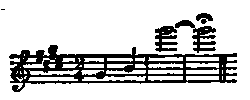 He saw and heard her again on 5th February i871, at z6 Devonshire Street, Queen's Square, London. She carne this time to announce the death of his eldest child; and in 1884 he again saw and heard her at 28 East Street, Queen's Square, the death of his mother being the cause. The Banshee is called badh or bowa in East Munster, and is named Bachuntha by Banim in one of his novels. 10. Other Fairies and Spirits. Besides the foregoing we have other solitary fairies, of which too little definite is known to give them each a separate mention. They are the House Spirits, of whom "Teigue of the Lee" is probably an instance; the Water Sherie, a kind of will-o'-the-wisp; the Sowlth, a formless luminous creature; the Pastha (Piast-bestia), the lake dragon, a guardian of hidden treasure; and the Bo men fairies, who live in the marshes of County Down and destroy the unwary. They may be driven away by a blow from a particular kind of seaweed. I suspect them of being Scotch fairies imported by Scotch settlers. Then there is the great tribe of ghosts called Thivishes in some parts. These are all the fairies and spirits I have come across in Irish folk-lore. There are probably many others undiscovered. W. B. YEATS |
 |  |