Pollutants released directly into the air by cars include nitrogen oxides,
hydrocarbons, carbon dioxide, carbon monoxide, particulates, and low levels
of sulfur dioxide.
Nitrogen oxide, which currently cause breathing problems and respiratory
related diseases, react with other compounds to form GROUND LEVEL OZONE
which traps heat and prevents it from being released out of the earth's
atmosphere.
Ozone, which is highly unstable, breaks down to produce one atom of oxygen
and one molecule of oxygen:
Hydrocarbons and volatile organic compounds such as methane, CFC's, benzene
and gasoline are also known to combine with nitrogen oxides under sunlight
to produce ground-level ozone, which fills the atmosphere with smog.
Scientists estimate that carbon dioxide levels remained relatively constant
from 10,000 years ago until about 100 years ago at approximately 260 parts
per million. However, with industrial deveopments, automobiles and the
energy demands resulting from population explosions, this value rose to
the current level of 350 parts per million. (Tesar 50).
Carbon dioxide threatens the balance between the amount of solar energy
reaching Earth and the heat that radiates out of Earth into space. It allows
heat to be passed through the atmosphere, but prevents the heat from being
released into space. Since carbon dioxide has such a strong ability to
trap heat, its increased presence has played an enormous role in raising
the temperature of the planet.
Humans release carbon dioxide with the burning of fossil fuels (which are
used to produce electricity to run machines and appliances, maintain building
temperature, light rooms, etc.) Approximately 5.6 billion tons of carbon
dioxide are released into the air every year by the burning of fossil fuels
alone. Some scientists estimate that this number could raise to 30 billion
tons per year in the next thirty years.
Most of us don't even realize how much carbon dioxide we, as individuals,
use on a daily basis. Just to give you an idea, please skim the following
chart:
Appliance:
Pounds of CO2
Added to Atmosphere:
Television
Set (Color)
0.64 lbs/hour
Steam
iron
0.85 lbs/hour
Vacuum
Cleaner
1.70 lbs/hour
Air
Conditioner (room)
4.00 lbs/hour
Ceiling
Fans
4.00 lbs/hour
Frost-Free
Refrigerator
12.80 lbs/day
Dishwasher
2.60 lbs/ load
Clothes
Dryer
10 lbs/load
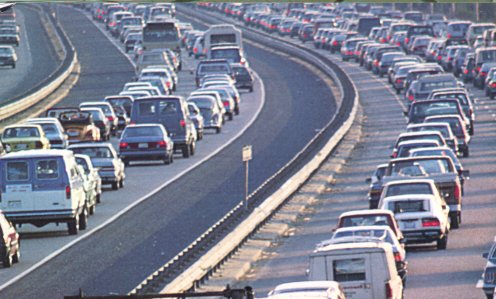 Every
gallon of gasoline that is burned adds 19 pounds of carbon dioxide to the
atmosphere. With a U.S. record of some 17 million vehicles sold in 1999,
and 75.8 million sales in the previous five years, there are a LOT of cars
on the road today. Assuming each car can hold a minimum of 10 gallons at
any given time-- how much carbon dioxide is released every day?
Every
gallon of gasoline that is burned adds 19 pounds of carbon dioxide to the
atmosphere. With a U.S. record of some 17 million vehicles sold in 1999,
and 75.8 million sales in the previous five years, there are a LOT of cars
on the road today. Assuming each car can hold a minimum of 10 gallons at
any given time-- how much carbon dioxide is released every day?
75.8
million cars X 19 pounds of Carbon Dioxide/Gallon =
Assuming
every car purchased in the past five years uses one gallon per day, 1,440,200,000
pounds of carbon dioxide are released every day.
*This
doesn't include cars purchased before five years ago or in other nations,
nor does it include trucks or gasoline usage in other applications! *
Similarly,
high levels of methane exist in the atmosphere. (300 years ago it was 650
parts per million, now 1700). 425-675 tons are added to the atmosphere
annually, and this number is growing. Methane is produced as a waste product
of anaerobic bacteria during the decomposition of carbon-based materials.
For this reason, high levels of methane exist over garbage dumps. Human
activities, however, account for about 60% of the methane that is emitted
each year. The cultivation of rice accounts for an estimated 20% of methane
emissions. Similarly, raising livestock accounts for about 15%, as cattle,
sheep, goats, and other farm animals give off methane in burps and flatulence.
Although carbon dioxide poses a more immediate threat, methane has stronger
heat-trapping abilities. In fact, it is about 20 to 30 times more potent
than carbon dioxide in absorbing the heat radiated from the Earth's surface.
Ouch!