Problem:
Emissions
of harmful gases can be reduced by installing systems to trap pollutants
inside combustion chambers and smoke stacks.
What's
being done: It
is now required in the United States to place "scrubbers" on new utility
and industrial boilers. These scrubbers serve to remove sulfur dioxide
from smoke before it is released into the air. Although it is not very
efficient, as it removes energy and causes an increase in industrial wastes,
95% of sulfur dioxide can be removed before the smoke leaves the building.
Problem:
The
cleaning of computer circuit boards is commonly done with CFC's, which
pose a threat to the ozone layer.
What's
being done: The Digital Equipment corporation
developed a water based process that can clean the boards using a nozzle
that sprays at different angles, reaching areas thought to be only accessible
with CFC's.
 Political
Arena:
Political
Arena:
Problem:
Deforestation contributes greatly to higher
levels of carbon dioxide in the atmosphere.
What's
being done: Politicians have begun to propose
the planting of several new trees in order to absorb the carbon dioxide
that is released into the atmosphere by means of photosynthesis. Proposals
have been made to replant forests in Alaska and to plant millions of trees
in rural and urban communities. Great Britain's Forestry Commission has
planted nearly 5 million acres of threes since 1900 and currently plants
about 82,500 per year.
Problem:
Great Britain's industry is based mainly on fossil fuels such as coal and
gas.
What's
being done: Proposals have been made to use
alternative forms of energy, including tidal power, wind power, and geothermal
heating. Proposals to use waste as a source of fuel are also being explored,
but such plans have not yet been perfected.
Problem:
Forest
regions in Europe are being poisoned by acid rain.
What's
being done: Green Parties have developed to
improve public awareness and to win representation in national governments.
Environmental issues are becoming more established on political agendas
in Germany, Austria, Liechtenstein and Switzerland.
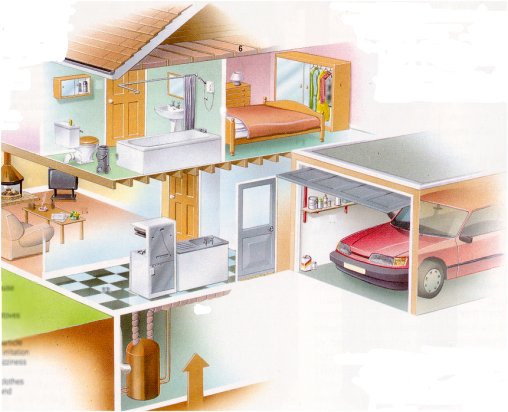
Planting Trees- People are being encouraged to plant trees in their local communities. Some trees can absorb up to 48 pounds annually! For every ton of new wood that grows, 1.47 tons of carbon dioxide are taken out of circulation!
Recycling Paper- People are recycling and reusing materials. If all of our Sunday newspapers were recycled, we could save more than 500,000 trees per week! Any way to save paper is good, as every little bit helps.
Maintaining Air Conditioning- People need to remember to keep air-conditioning levels LOW in their cars and to make sure that they do not leak coolant (Coolants contain CFC's!!!)
Checking Insulation- People need to make sure that their homes are energy efficient-- caulking is maintained, weather-stripping is used when necessary, tight fitting drapes or blinds are hung in the windows, and storm windows and doors are installed.
Conserving Power- Appliances that are not in use, including, but not limited to televisions, stereos, radios, irons, and computers should be turned off when not in use. Also, lights should be turned off in rooms that are not in use.
Conserving Water- Rather than taking baths, people should take short showers. The average person uses about twice as much water during a bath than they would during a shower.
Heating- Thermostats should be as high as possible during the summer and as low as possible during the winter.
What else can you do? Write letters to your government representatives urging them to reduce emissions of carbon dioxide and other industrial gases!