Global
Warming and CFCs:
By Erika Kaeten
-
CFCs are very
stable molecules, and the two most widely used to date, CFC-11 and CFC-12,do
not seem to react at all with anything in the troposphere. They are
non-poisonous andnon-inflammable because they are so stable chemically.
-
Their stability makes them
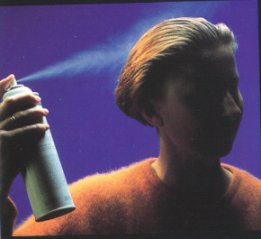
ideal for the working fluid in refrigerators, the propellants in spray
cans, to blow the bubbles in many forms of foamed plastic, and to clean
grease from computer circuitry
-
CFCs are so stable
that they build up in the atmosphere, diffuse around the globe, and have
been found in the troposphere at the South Pole- though the great majority
of releases have occurred in the northern hemisphere.
-
Diffuse upwards through
the atmosphere and eventually reach the stratosphere.
-
UV rays from the
sun, absorbed by the stratospheric ozone, break CFC molecules apart , releasing
atoms of chlorine, which is highly reactive and destroys the ozone.
-
Chlorine from
CFCs has caused a worldwide depletion of ozone in the stratosphere, by
a few percent of the natural concentration, over the past ten to fifteen
years.
-
Hole
in the ozone was caused by chlorine from CFCs.
-
On average, a molecule
of CFC-11 (mostly used in blowing plastic foams and in spray cans) takes
eighty years to reach the stratosphere and be broken upby ultraviolet radiation.
-
One average, a molecule
of CFC-12 (mostly used in spray cans, refrigeration systems and mobile
air conditioning, but also in plastic foams) stays in the air for 170 years
before being broken up.
-
To maintain the present
concentration of CFCs in the air would require a cut in production to one-sixth
of present figures- about 15%
-
To
reduce the build-up of CFCs in the air, production has to be cut still
further- for all practical purposes to zero.
-
Together,
CFC-11 and CFC012 now contribute about the same amount of warming to the
global greenhouse effect is methane, but CFCs are man made so, in terms
of human impact on the greenhouse effect they rank second only to CO2
-