Social
& Cultural Developments
1920's
Flappers
Sports
Entertainment
Jazz
Harlem
Renaissance
Red
Scare
Rise of
the Klu Klux Klan
Immigration
Sacco
and Vanzetti Trial
Prohibition
Scopes-Monkey
Trial
Flappers
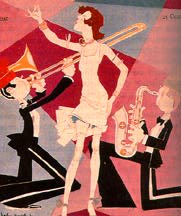 "Flapper"
was the term commonly used to describe the modern woman of the 1920's.
They were looked upon by older generations as rebellious against
the traditional values of women ("Flapper Culture And Style.."). Women's
fashions grew bolder than ever before (Ordinary Americans 175).
"Flapper"
was the term commonly used to describe the modern woman of the 1920's.
They were looked upon by older generations as rebellious against
the traditional values of women ("Flapper Culture And Style.."). Women's
fashions grew bolder than ever before (Ordinary Americans 175).
Defying the tradition
long hair style for women, flappers in the 1920's bobbed their hair. Petticoats
and corsets were abandoned, as modern women now looked at them as a "needless
impediment to free movement" (qtd. 175). Silk and rayon stockings
become popular (175). The lengths of skirts and dresses were chopped
from the ankle to the knee ("A Great Decade") and worn loose. For the first
time, women began wearing dresses that exposed both their arms and legs
("Flapper Culture and Style"...). Sleeves were shortened or removed entirely,
and dresses were made out of much 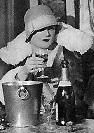 lighter
fabrics to provide comfort (Ordinary Americans 175).
lighter
fabrics to provide comfort (Ordinary Americans 175).
Women also began
to wear makeup in public, which shocked and horrified older generations.
They used bright orange rouges and "kissproof" lipsticks (175). Fortunes
were made selling face creams (176).
Flappers did more than symbolize a
revolution in fashion and morals - they embodied the modern spirit of the
1920's ("Flapper Culture and Style"...). Although looked upon as outrageous
by many, flappers sprouted a cultural revolution in the United States.
Social barriers began to fade; women began to claim new freedoms and prepare
for the future.
Return to Top
Sports
Sports were a huge past time during
the twenties. Even if a person did not play a sport, they were a
spectator. From horse races to wrestling, sports was a huge part
of every day life. Sports expressed American values of dash, discipline,
determination, energy, eagerness, enthusiasm, persistence, spirit, success,
vigor, virility, courage, confidence, and competitiveness. Some of
the best known sports players of the day were Jack Dempsey, Babe Ruth,
Bobby Jones, Calamity Jane, Walter Hagan, Tilden, Bo McMillin, Ernie Nevers,
Red Grange, Benny Friedman, and many others. Dempsey was a famous
boxer and on July 21, 1921, some 91,000 spectators filed into Boyle’s Thirty
Acres in Jersey City to watch “Gorgeous” George Carpentier get knocked
out by Dempsey in the fourth round. Off of this one event, Americans
had spent one million dollars. This record was broken the following
year by fans watching the Yankees’ Babe Ruth hit 59 home runs and the New
York Giants beat the New York Yankees in the World Series. People
such as Red Grange made hundreds of thousands of dollars by playing sports
such as football, and getting endorsements from companies such as real
estate companies, which Grange was offered at the price of $120,000 a year.
There always seemed to be another
publicity item in line, and when they had their “fifteen minutes of fame”
they were forgotten with the finding of another great sports player.
There were also many other figures whom the public worshipped, such as
Gertrude Ederle. Ederle was the first mother to swim the English Channel
as well as Charles Lindbergh, who flew solo across the Atlantic.
Return to Top
Entertainment
During
the twenties, people had more time for leisure. Many learned how to hunt,
played card games at the beach, went ice skating, or played polo. Horse
racing was very popular. People often went to the races, placing bets on
their favorite horses. (Video 11/5/98).
Motion pictures
became very popular during the twenties. At the start of the decade, Hollywood
had become the world's movie capitol, which turned out full length films.
Big movie stars of the day included Rudolph Valentino, Mary Pickford, Theda
Bara, and Charlie Chaplin (Roberts 389).
Amusement Parks,
such as the New York's "Coney Island" began to appear during the twenties.
Roller coasters began to appear, and people visited amusement parks- some,
just for the fun of it- others, for the thrill of the rides.
When they couldn't
leave their homes, Americans got entertainment through the radio, which
grew to become a mass medium during the 1920's. The first radio stations,
WWJ of Detroit and KDKA of Pittsburgh began broadcasting in 1920. Soon,
America's could listen to sports events, get election results, and listen
to variety shows.
Many games grew
to be public crazes during the 1920's. Many people began to learn
how to play the Chinese game "Mah Jong." Crosswords also became a rage.
New magazines, newspapers, and radio stations publicized amusing stories
and fads.
Show businesses
flourished during the twenties. Broadway became popular. There were a lot
of comical productions. Groucho, Harpo, Chico and Zeppo Marx became popular
comedians during the twenties (Pietrusza 56-7).
Some of the
finest theatrical writing ever done was introduced in the 20's. Beyond
the Horizon, Anna Christie, and Strange Interlude,
all by Eugene O'Neill, won Pulitzer prizes.
African Americans
began to appear on Broadway. Stars such as singer Paul Robeson thrilled
Broadway audiences during the 20's.
Some of the The
twenties were also a time of musical enthusiasm and development.. Classical
and popular music was introduced to Americans by the radio. Social dances
became a regular social event. Jazz and ragtime became
the music of the time.
Return to Top
Jazz
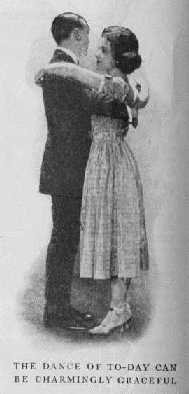 Jazz
became the most distinctive music of the 1920's. No music during
the twenties reflected the spirit of the twenties better than jazz (Davidson
560). Jazz was developed by black Americans in the south, and during the
twenties, it spread from New Orleans, to Kansas City, to Chicago, and to
New York ( Pietrusza 58). Derived from a mixture of black spirituals,
ragtime, European harmonies, and African rhythms, jazz music involved great
improvisation (Ordinary Americans 178). "We would embroider the
melodies with our own ideas and try to develop patterns that had more originality
than those played before us," said Willie Smith, a jazz pianist (qtd. 178).
Musicians improvised on a theme to make jazz flexible, alive, and ever-changing
(Davidson 560).
Jazz
became the most distinctive music of the 1920's. No music during
the twenties reflected the spirit of the twenties better than jazz (Davidson
560). Jazz was developed by black Americans in the south, and during the
twenties, it spread from New Orleans, to Kansas City, to Chicago, and to
New York ( Pietrusza 58). Derived from a mixture of black spirituals,
ragtime, European harmonies, and African rhythms, jazz music involved great
improvisation (Ordinary Americans 178). "We would embroider the
melodies with our own ideas and try to develop patterns that had more originality
than those played before us," said Willie Smith, a jazz pianist (qtd. 178).
Musicians improvised on a theme to make jazz flexible, alive, and ever-changing
(Davidson 560).
The first great
jazz musicians were black, and included composer "Jelly Roll" Morton, trumpet
player, singer, and great improviser Louis Armstrong, and singer Bessie
Smith. Jazz was special because people of all backgrounds accepted it.
Jazz was especially
popular in Harlem, New York. The Cotton Club, the most famous night club,
opened in 1927. Here, African American culture flourished. People
danced to the music of black and white bands playing the high-energy music
of the 20's.
In the beginning,
people had difficulty accepting the music. Some people felt that it was
immoral. Anne Shaw Faulkner, the National Music Chairman of the General
Federation of Women's Clubs, published an essay in the Ladies' Home Journal
of August 1921 deploring jazz music and effects on young people.
".... It is
somewhat of a rude
awakening for many of these parents
to
find that America is facing a most
serious situation regarding its popular
music. Welfare workers tell us that
never in the history of our land have
there been such immoral conditions
among
our young people, and in the surveys
made by many organizations regarding
these conditions, the blame is laid
on
jazz music and its evil influence on
the
young people of to-day. Never before
have such outrageous dances been
permitted in private as well as public
ballrooms, and never has there been
used
for the accompaniment of the dance
such
a strange combination of tone and rhythm
as that produced by the dance orchestras
of to-day."
("Does
Jazz Put the Sin in Syncopation").
It was not until the February 12, 1924, that jazz became respectable. On
that day, at Aeolian Hall in New York, Paul Whiteman and his orchestra
made the first performance of George Gershwins Rhapsody in Blue,
the first major symphonic work to use the jazz from. Significant classical
musicians in the audience liked what they heard- and so did the public
(Pietrusza 59).
Return to Top
Harlem
Renaissance
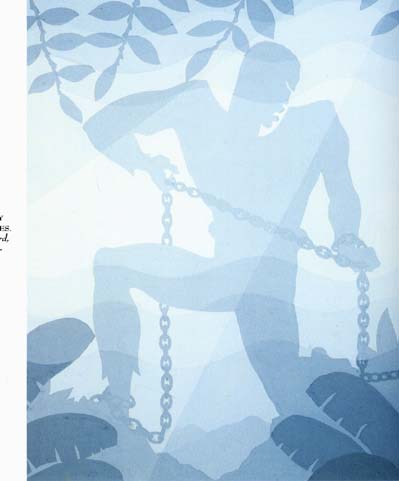
“Harlem is vicious
Modernism. BangClash.
Vicious the way it’s made.
Can you stand such beauty.
So violent and transforming.”
-Amiri Baraka (Le Roi Jones)
(Taken from “Chapter 9:
Harlem Renaissance- An Introduction”)
The Harlem Renaissance marked
an outburst of create activity among African Americans in all fields of
art, including educators, writers, political leaders, and artists (“Harlem
Renaissance”; “Black Jazz of Harlem”). African Americans were encouraged
to celebrate the heritage and to become “The New Negro” (qtd. “Harlem Renaissance”).
For African Americans, the Harlem
Renaissance provided the atmosphere they needed to escape the cruel realities
of segregation and prejudice. It allowed them to indulge in activities
where their desires for liberation and self-expression could be heard (“Black
Jazz of Harlem”). It helped to lift the spirits of the entire black community.
For whites, the Harlem Renaissance
captured attention, forcing whites to recognize, in a sense, as world which
they had tried to contain and suffocate (“Black Jazz of Harlem”).
The white community, which had always been considered the more superior
class, felt its impacts. “In contrast to common American times, jazz brought
forth an era where blacks were the primary creators and whites played the
role of the imitators” (qtd. Black Jazz of Harlem”). It grew more
and more apparent that blacks were just as talented as whites.
Poetry of the Harlem Renaissance
often protested white prejudice. Langston Hughes, the best known
figure of the Harlem Renaissance, often addressed African American heritage
in his works. Countee Cullen, as New York City School teacher; wrote poetry
filled with black pride. Claude McKay wrote powerful verses addressing
discrimination in the U.S. Carter G. Woodson, a black historian,
established the Journal of Negro History in 1916, which published articles
on nearly every aspect of black life and history. W.E.B. Du Bois wrote
about black history and advanced the idea that the fates of blacks in both
the United States and Africa were linked. Marcus Garvey, another dominant
figure of the Harlem Renaissance, published a weekly newspaper entitled
Negro World, which spread the message of racial pride (Davidson 560).
Modernist art of the Harlem Renaissance
was open to fears and instincts. Through the creative styles, blacks were
able to convey recognitions of their heritage, as well as their fight for
civil rights. The Harlem Renaissance provided a safe haven for its black
community by offering numerous opportunities for people to rise in the
artistic world and attempt to put the black community in the spotlight
(“Black Jazz of Harlem”).
Jazz played also played a key
role in the Harlem Renaissance. [Please see JAZZ].
Return to Top
Red
Scare
The Red Scare
began in the spring of 1919 and lasted about a year and a half. It
was named because of a fear of the Reds (or communists). Americans
believed the communists were trying to take over the American government.
American socialists were willing to try new things, and the Russian Revolution
was right around the same time. There was some evidence of the Bolsheviks
in the United States with the creation of the Russian socialist Federation
and the American Communist Party as well as the Communist Labor party.
Karl Marx wrote the book Communist Manifesto, and this book stated
that strikes were a step in turning to communism. In 1919 no fewer
than four million workers walked out on their jobs, and the country was
shaken by the dramatic strikes of 1919. On January 21 of 1919, 35,000
Seattle shipyard workers asked for higher wages and shorter workdays, and
the Seattle Central Labor Council voted to conduct a general strike.
For five days, Seattle was paralyzed. Schools weren't open, streetcars
weren't running, and business came to a stand still. There were similar
strikes by U.S. Steel and the UMW (United Mine Workers). One of the
most threatening strikes was in Boston, when the police force went on strike.
Within twenty-four hours violence broke out and two men were killed in
South Boston and another in Scollay Square. Shop windows were broken
and pedestrians helped themselves to anything in stores. This just
reinforced many people’s belief that radicals were taking over (Leuchtenburg
70-78; Roberts 386).
On April 28, a small brown parcel
arrived at the office of the anti-labor mayor of Seattle, and when opened,
it contained a homemade bomb. Thirty-five other homemade bombs were
found in all. After the Attorney General A. Mitchell Palmer’s house
was bombed, Palmer decided enough was enough. He had begun a campaign
against enemy aliens in March of 1919, and in August he set up an anti-radical
division headed by J. Edgar Hoover. On November 7, 1919, the first
Palmer raids began. Two hundred and fifty members of the Union of
Russian Workers were arrested in a dozen cities. Some were roughly
handled, especially in New York, where they were beaten by the police.
On December 21, two hundred and forty-nine aliens, many who had committed
to offense, were deported back to Russia. Most of the people who
were deported were not communists, but anarchists who had no intention
of using violence (Leuchtenburg 76).
Palmer then secured warrants
for the arrests of 3,000 aliens who were members of the Communist party
or the Communist Labor party. In one night in January of 1920, over
4,000 alleged Communists were arrested in 33 cities. If the persons
arrested were citizens, they were turned over to the state, but if they
were aliens, they were held for deportation (Leuchtenburg 76-7).
The raids were a violation of
American’s civil liberties, and they did next to nothing in the way of
capturing dangerous revolutionaries. They did however, reduce the
membership of the Communist parties by 80 percent and Palmer came out a
hero (Leuchtenburg 78).
The Red Scare ended as quickly
as it began. The end came in New York state when the state legislature
expelled five Socialist members of the Assembly, when the Socialist party
was legally recognized and the members were innocent of any offense.
The media and many public figures such as Senator Warren Harding of Ohio
were quick to denounce this action. A firm stand had been taken on
democracy and at the same time, the New York legislature was made to look
ridiculous because they were scared of five Socialists (Leuchtenburg 78).
Palmer pursued the 1920 presidential
nomination by trying to capitalize on the Red Scare. In April he
stated warnings that on May first there would be a revolutionary plot,
but nothing happened on May Day like the year before, when four hundred
World War One veterans invaded The Call, a socialist newspaper, and brutally
mauled the staff. People began to feel that Palmer “cried wolf” a
little too often, and Congress turned an investigation on him. The
Red Scare was not really over, because people still had a fear of foreigners,
as cases such as Sacco and Vanzetti demonstrated (Leuchtenburg 71, 79-80;
Roberts 386).
Return to Top
Klu
Klux Klan
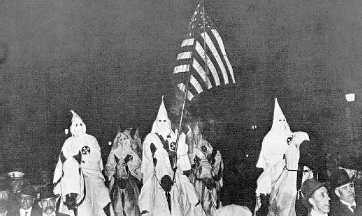 The
Ku Klux Klan began in 1865 to try to drive out carpetbaggers and Yankees,
as well as scare Negroes. When the South was finished with reconstruction,
the KKK’s presence declined. Then, on December 6, 1915, William Simmons
chartered the Knights of the Ku Klux Klan in Atlanta, Georgia. This
was around the time of the movie, “The Birth of a Nation, which was a pro-clan
novel and helped the KKK expand its influence. It was estimated that
by 1924, there were almost five million people in the Klan (Gerlach; Jackson
5; Lowe 9-18; Leuchtenburg 210.
The
Ku Klux Klan began in 1865 to try to drive out carpetbaggers and Yankees,
as well as scare Negroes. When the South was finished with reconstruction,
the KKK’s presence declined. Then, on December 6, 1915, William Simmons
chartered the Knights of the Ku Klux Klan in Atlanta, Georgia. This
was around the time of the movie, “The Birth of a Nation, which was a pro-clan
novel and helped the KKK expand its influence. It was estimated that
by 1924, there were almost five million people in the Klan (Gerlach; Jackson
5; Lowe 9-18; Leuchtenburg 210.
The Klan’s rise was a result
of many things. The emotional letdown after the war as well as the
red scare. There were terrorist bombings and the Palmer raids, which
went against people’s constitutional rights. There were also race
riots when more blacks began moving to the North, and people were scared
with the talk of a ‘new Negro’. There was fear from the growing number
of Catholics in America, and on, Al Smith, running for president.
Foreigners were distrusted during this time, and both foreigners and aliens
were considered un-American. The country in general, distrusted anyone
who was different, and this distrust mixed with these events was the perfect
potion for the KKK to take over (Lowe 17-18).
The Klan gained recognition during
the 1920’s by advertising. It found two organizers; Edward Young
Clarke, and Mrs. Elizabeth Tyler. Simmons turned over the organizational
and fundraising activities to them, and for every person they got to join,
they received eight dollars out of a ten-dollar initiation fee. With
their combined efforts, the KKK gained more than one hundred thousand members
and was still expanding. As many as five thousand enlistment’s were
coming in daily (Leuchtenburg 210; Lowe 16; Allen 54-5).
In 1922, Hiram Evans, a dentist
from Dallas, usurped the position of Imperial Wizard from Simmons and pushed
the clan into southwestern politics. The Klan believed that drinking
was one of the reasons for the moral breakdowns of individuals, and believed
that the Volstead act (a way to enforce the 18th amendment), was not strictly
enforced. The Klan made an appeal, which was summed up saying:
“Every criminal, every gambler,
every thug, every libertine, every girl ruiner, every home wrecker,
every wife beater, every dope peddler, every moonshiner, every crooked
politician, every pagan Papist priest, every shyster lawyer, every
K. of C., every white slaver, every brothel madam, every Rome controlled
newspaper, every black spider --is fighting the Klan. Think it
over, Which side are you on” (Jackson 19)?
For a time, the KKK dominated
Oregon, Oklahoma, Texas, Arkansas, Indiana, Ohio, and California.
Its strongholds were in the New South, the Middle West, and the Pacific
Coast. The Klan was also used as an expedient, political measure.
If a person such as Hugo Black joined (which he did), and ran for office,
he would most likely win because of the Klan’s support (Lowe 19).
The Klan’s strength centered
in small towns and preyed on the poorer and less educated. Farmers
and townspeople that felt desperate with the changes around them, specifically
the move from country life to urban life were encouraged to join.
Being a KKK member was viewed as a badge of respectability and piety (Leuchtenburg
209, Marcus and Burner 183).
The Klan promoted white supremacy.
It was Anti-Catholic, Anti-Semitic, Anti-Negro, Anti-foreigner, Anti-Mormon,
Anti-Jew, and Anti-Oriental. It felt this way because it believed
these other cultures were 100 percent American and that is what they wanted
the United States to be compiled of. Catholics were opposed against
because they worshipped a foreign pope whom dictated orders such as how
to teach their children (Jackson 9; Leuchtenburg 33; Gerlach; Ordinary
Americans 170-1).
Examples of how the Klan would
uphold the law were: If a black man was accused by a white girl that
he made advances toward her, a Klan member would come and beat him, even
if he never did so. If a white man stood up for a black person, he
could be kidnapped and beaten up. “If a colored woman refused to
sell her land at an arbitrary price which she considered too low, and a
Klansman wanted the land, she might receive the KKK ultimatum --sell or
be thorn out” (Allen 56). Although things may not have been as
outrageous as these examples, there was always the threat of something
happening. These acts of violence also paved the way for others to
hid behind the Klan’s name and burn buildings, beat people, etc. (Allen
55-7; Jackson 12).
Return to Top
Immigration
The twenties were a time of isolation
for Americans. They were very wary of foreigners after World War
one and the Red Scare. In 1921, the first quota law in the history
of the United States was passed. It was entitled the Emergency Quota
Act, and its purpose was to limit the number of immigrants allowed into
the United States to 357,000 per year. It also restricted to three
percent the amount of any country’s nationals who were living in the United
States in 1910 (Davidson 546-7; Roberts 379).
When the Emergency Quota Act
was not effective in restricting the amount of immigration into the United
States, specifically from the southern and eastern European countries,
Congress passed the Immigration Act of 1924. This Act lowered each
country’s quote from three to two percent, and changed the base year from
1910, to 1890, when there were less people from Southern and Eastern Europe
living the America. With the help of this act, it reduced immigration
from that area by 85 percent. By 1929 Congress had reduced the annual
quota of immigrants to about 152,000, with only 132,000 coming from northern
Europe, and 20,000 from the rest of world (Davidson 546-7; Roberts 379).
Return to Top
Sacco
and Vanzetti Trial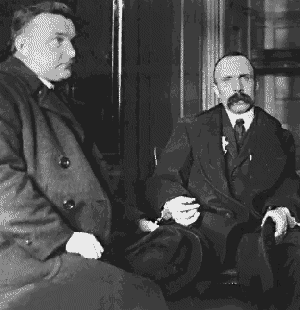 In April 1920 a "typical" crime took place in South Braintree, Massachusetts.
A paymaster was carrying two boxes with the pay-roll of a shoe factory
when he was shot and killed by two men with pistols who stole the money
and ran (Allen 84).
In April 1920 a "typical" crime took place in South Braintree, Massachusetts.
A paymaster was carrying two boxes with the pay-roll of a shoe factory
when he was shot and killed by two men with pistols who stole the money
and ran (Allen 84).
Two weeks later,
two Italian radicals, Nicola Sacco and Bartolmeo Vanzetti were arrested.
One year later, they were tried before Judge Webster Thayer and a grand
jury (Allen 84). The judge, who was obviously biased against any individuals
whose political views were anything different from mainstream, referred
to the defendants as "those anarchist bastards." (Ordinary Americans
167). "We have proved that there could not have been another judge on the
face of the earth more prejudiced and more cruel than you have been against
us," Vanzetti remarked (168).
When the jury found
the defendants guilty and sentenced them to death, many people wondered
whether it was really significant evidence regarding the murder or the
defendants' anarchist views and Italian backgrounds that got them convicted.
When Europeans heard
of the trial, they bombed American buildings, boycotted American products,
and striked (85). As Americans, were, more than ever, taking steps to eliminate
foreign immigration to the United States, Europeans felt that Sacco and
Vanzetti did not receive a fair trial because they were Italian immigrants.
Although Sacco and
Vanzetti tried to appeal the court's decision several times, Judge Thayer
always blatantly refused. Eventually, the case was turned over to the governor
of Massachusetts, who named an advisory committee of well respected men
to make a further study of the case (85). When this committee found the
defendants to be guilty, it was the final decision. Thus, on the night
of August 22, 1927, Sacco and Vanzetti were sent to the electric chair.
Return to Top
Prohibition

The Eighteenth Amendment was placed
into effect in 1919, which was national prohibition. It called for
a ban on manufacture, importation, and sale of all alcoholic beverages.
Unfortunately, many Americans did not want to quit drinking, and continued
to do so even with the law in place. Bootlegging became a common
practice, and if a person did not want to buy from a bootlegger, they could
make their own wine, liquor, and beer at home. This law was extremely
hard to enforce, especially with less than 3,500 agents. Bars called
speakeasies were opened in almost all towns. Prohibition did not
stop people from drinking, but it did make normal people commit a crime
to drink. Many law-abiding citizens who would never have broken the
law in any other way decided to drink. This made the government look
bad, because it could not prevent this from happening, and causing so many
people to break the law (Roberts 388).
Prohibition also incited the
growth of organized crime. Most of the illegal alcohol business was
run by gangsters or “the mob”. People like Al Capone became very
powerful and wealthy and with that power and wealth they invested in legitimate
businesses (Roberts 388).
Return to Top
Scopes-Monkey
Trial
During the Twenties there was a heated
battle between Christian fundamentalists and people who thought that Scientific
theories told the truth of how the earth was made, etc. This battle
was centered in what to teach children in school. Three states where
Fundamentalists were extremely influential passed laws prohibiting the
teaching of evolution in schools. These states were Tennessee, Oklahoma,
and Mississippi (Pietrusza 36-7; Allen 200-1).
Many people did not agree with
these laws and thought they went against separation of church and state.
They felt that it was an assault on academic and intellectual freedom.
To challenge the 1925 law, they needed a teacher to violate the law and
teach the history of evolution to a child. They found such a person
in Dayton, Tennessee and his name was John Scopes (Pietrusza 37-8).
The Scopes trial became a national
sensation, and was popularly known as the monkey trial. Huge crowds
came to Dayton to watch the case and appease their curiosity. There
were stands on the streets with venders selling lemonade and hot-dogs.
The atmosphere was one like that at a carnival (Allen 203; Pietrusza 38).
Much of the publics interest
in the case centered on the opposing lawyers. Clarence Darrow, possibly
America’s foremost defense attorney, headed John Scopes defense, while
William Jennings Bryan, three time presidential candidate and Wilson’s’
Secretary of State headed the prosecution. Darrow was a radical,
a friend of the underdog, and an agnostic. Jennings on the other
hand, was a Fundamentalist, and the perfect embodiment of old fashion American
idealism (Pietrusza 39; Allen 202).
Scopes was clearly guilty of
the charge, but Darrow wanted to get the point across that the law was
unconstitutional due to separation of church and state. Darrow and
Bryan went back and forth, putting people like the child Scopes taught
evolution on the stand, Howard Morgan, to Darrow trying to get experts
on Darwin’s theory, but he was not allowed on the basis of it being irrelevant.
The trial’s climax was when Darrow called Bryan on the stand as an expert
on the Bible. “Darrow showed that the biblical accounts of a whale
that swallowed a man, a human general making the sun stand still at the
Battle of Jericho, or God’s creation of the earth in ‘six days of twenty-four
hours’ could well be interpreted in metaphorical terms for spiritual purposed
but were less easy for people with access to modern scientific knowledge
to regard it literally” (Pietrusza 39; Allen 204-5).
At the end of the trial, the
court found Scopes guilty and fined him $100 dollars. Five days after
the trial ended, Bryan died of a stroke. Many attribute this to the
hot weather, poor physical condition, and Darrow’s attack on his intellect.
Even though Scopes was found guilty, many reporters, etc. began to agree
that the Bible should not be taken as literally as it had been in the past.
Darrow appealed to the Tennessee Supreme Court, but they did not overturn
the law. They did however, reverse Scopes conviction --on the ground
that $100 fine was excessive (Pietrusza 39; Allen 205-6).
Return to Top