Agricultural
Problems
Stock
Market
New
Business Methods
Growth
of Industry
Agricultural
Problems
The great prosperity of the 1920's did not reach everyone.
For farmers, the 20's were hard times. During World War I, farmers
were encouraged by the federal government to buy more land and to
modernize farming methods with the latest in to technology. They also encouraged
farmers to drastically increase their production ("Main Causes of
the Great Depression"). During the war, farm prices had sky-rocketed,
as there was an increased demand in Europe for farm products . Once the
war ended, however, the government was quick to end its policies of aiding
farmers ("Main Causes of.."). By the early 20's, farm prices fell
drastically. The price of wheat, for example, sank from $2.26 a bushel
during the war to less than a $1 a bushel in 1922 (Davidson 545). Farmers
also lost money due to the huge surpluses that were created when the demand
for goods overseas declined (596). As farm prices fell, farm costs
rose. To try to cover costs, farmers planted more crops, which only led
to larger surpluses and bigger debts as a result of the purchasing of seeds
and machinery (596). Like most American families, farm families
wanted to buy the new modern appliances and a car, but their expenses rose
much faster than the prices they received for their products. (576). As
it grew increasingly more expensive to run a farm, and as a result, many
Americans abandoned their farms and went to work in industrial jobs. Between
1919 and 1924, 13 million acres were abandoned and left to brush (Leuchtenburg
101).
Return
to Top
 The
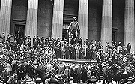
stock market was booming during the 1920's, and for many, it was a way
to "get rich quick!" There were a group of people who dominated the
stock market. They could single handedly raise the stock prices up
and then sell them off making a huge profit. Among them were Jesse
Livermore, William Durant, and Charles Mitchell. They were all millionaires,
who made their money using the stock market. Mitchell was one of
the first people to think to mass market stocks and bonds to the common
person. He had the largest distribution of securities in the world.
Their lifestyle was that of the rich and famous. They owned three
or four houses, owned railroad cars, etc. Jesse Livermore was so
important that street lights would be set so that he could pass without
ever being stopped for a red light. With these type of people making
millions, it made the common people believe that they too, could become
a millionaire over night. People began investing in different stocks
using margin plans, which meant that they would only pay 10 percent of
what the stock cost. They would pay the money back when they made
their "killing" on the market. People did not only speculate with
stocks, but also land. In Florida, there was a huge land boom, but
it stopped with a hurricane in 1926 (Davidson 377-8; The Crash of 1929)
.
The
stock market was booming during the 1920's, and for many, it was a way
to "get rich quick!" There were a group of people who dominated the
stock market. They could single handedly raise the stock prices up
and then sell them off making a huge profit. Among them were Jesse
Livermore, William Durant, and Charles Mitchell. They were all millionaires,
who made their money using the stock market. Mitchell was one of
the first people to think to mass market stocks and bonds to the common
person. He had the largest distribution of securities in the world.
Their lifestyle was that of the rich and famous. They owned three
or four houses, owned railroad cars, etc. Jesse Livermore was so
important that street lights would be set so that he could pass without
ever being stopped for a red light. With these type of people making
millions, it made the common people believe that they too, could become
a millionaire over night. People began investing in different stocks
using margin plans, which meant that they would only pay 10 percent of
what the stock cost. They would pay the money back when they made
their "killing" on the market. People did not only speculate with
stocks, but also land. In Florida, there was a huge land boom, but
it stopped with a hurricane in 1926 (Davidson 377-8; The Crash of 1929)
.
New
Business Methods
The
Twenties were very prosperous for two thirds of the people in America.
During this time, there was an increase in Americans making quick profits
by buying and selling corporate shares. There was a steady increase
in the number of shares traded during the twenties. In 1923, there
were 236 million, and by 1928, there were over one billion. Brokers
began to sell stocks on margins, which meant the investor only had to pay
ten percent of the price of the stock, and then pay them back when the
stock rose. Banks began putting money into stocks, as well as giving
out many loans. People were buying everything on credit, which meant
they had to pay a monthly installment of so much to own a certain item,
but they received this item immediately. Chain stores began rising
in popularity, and rising incomes brought an increase in consumer activity.
Buying on installments meant the common person could afford to own cars,
radios, etc. (Pietrusza 15-17).
Return
to Top