
It was also a time when women started to make strides towards equality. Amy Johnson became the first woman to complete a solo flight between England and Australia in May of 1930. In 1931, Amelia Earhart established the world's altitude record and in 1932 became the first woman to complete a solo flight across the Atlantic.
The 1930's also marked the
beginning of a society based upon world travel and communication.
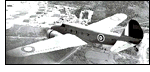 On
March 30, 1933, the Boeing 247 owned by United Air Lines became the first
accepted modern airliner, and by December 17, 1935, the first passenger
airliner, The DC-3, was in operation. It took off from Santa Monica,
California.
On
March 30, 1933, the Boeing 247 owned by United Air Lines became the first
accepted modern airliner, and by December 17, 1935, the first passenger
airliner, The DC-3, was in operation. It took off from Santa Monica,
California.
In November 1935, Pan American
Airways started the first pacific mail service route.
A new era had begun.
See our source online. Click here for the history of 1930s flight (provided by the American Institute of Aeronautics and Astronautics)
Atom, the:
In 1934, Enrico Fermi, then
professor of physics at the University of Rome, began experiments in which
a variety of elements were bombarded with neutrons. He found that
slow-moving neutrons were exceptionally effective in producing radioactive
atoms and became the first person to split the atom. He won the Nobel
Peace Prize for physics in 1938 for his contribution ("Enrico Fermi - Physicist").
Click here
to view the source for this information or here
to visit his biography courtesy of The
National Inventor's Hall of Fame.
 Two
german scientists, Lise Meitner and Otto Frisch split the uranium atom
in 1938, naming the process "nuclear fission." They are now considered
the people behind the creation of the atomic bomb, despite the fact that
Meitner refused to work on developing the bomb during World War II.
Two
german scientists, Lise Meitner and Otto Frisch split the uranium atom
in 1938, naming the process "nuclear fission." They are now considered
the people behind the creation of the atomic bomb, despite the fact that
Meitner refused to work on developing the bomb during World War II.
Click here to view the source of this information and image of Lise Meitner or here for more detailed information on Lise Meitner. Please click on the image to see it larger.
Albert
Einstein wrote a letter to FDR in August 1939 which outlined the possibility
of "producing a bomb of almost unimaginable power" (Boardman 131).
Two months later, he received another report on nuclear fission.
These reports led to the start of the Manhattan Project, which would result
in the dropping of the atom bomb less than six years later (Boardman 131).
Ernest O. Lawrence, of the
University of California, built the first practical cyclotron. He
received a Nobel Peace Prize for his work in 1939 (American Heritage...1215).
For more information about his work, please click here to
link to the Office
of Radiation, Chemical, and Biological Safety at Michigan State University.
Automobile Industry
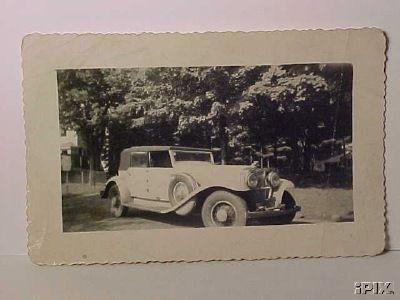 The 1930's
were not a time of luxury, and thus, many luxury car producers,
including Stuz Bearcat, Pierce-Arrow, and Marmon did not survive the era.
The companies did not fair well, as "the public was far more practical
and survival-conscious than the industry might have wished..
Some people were able to afford the 1932 Chevrolet sedan, but others settled
for a modest "tin lizzie" produced by Ford, and more often than not, those
who had purchased luxury cars in the 1920s settled for keeping them until
the economic situation improved. To appeal to the people, the Pierce Arrow,
which sold for $3650, bragged of its "survival value." Similarly,
the producers of the Packard advertised that it was the epitome of
"practical usefulness" (American Heritage of the 20s and 30s 204-5).
The 1930's
were not a time of luxury, and thus, many luxury car producers,
including Stuz Bearcat, Pierce-Arrow, and Marmon did not survive the era.
The companies did not fair well, as "the public was far more practical
and survival-conscious than the industry might have wished..
Some people were able to afford the 1932 Chevrolet sedan, but others settled
for a modest "tin lizzie" produced by Ford, and more often than not, those
who had purchased luxury cars in the 1920s settled for keeping them until
the economic situation improved. To appeal to the people, the Pierce Arrow,
which sold for $3650, bragged of its "survival value." Similarly,
the producers of the Packard advertised that it was the epitome of
"practical usefulness" (American Heritage of the 20s and 30s 204-5).
Bridges
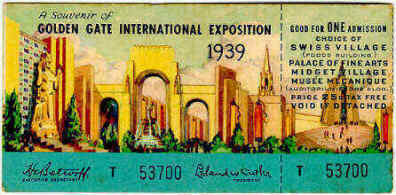 The
largest bride of the era, the George Washington Bridge, was opened in October
1931. Bridging the Hudson River between New York and New Jersey,the
main span was 3,500 feet long (Boardman 41).
The
largest bride of the era, the George Washington Bridge, was opened in October
1931. Bridging the Hudson River between New York and New Jersey,the
main span was 3,500 feet long (Boardman 41).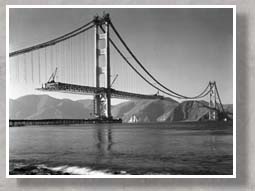
In California, the
construction of the Golden Gate Bridge began on January 5, 1933.
The bridge was officially opened to pedestrian traffic on May 27, 1937.
The next day, vehicles were allowed to pass over it Those who voted
in support of its construction felt that it "represented the economic relief
needed from the Great Depression" ("History,
Facts, and Figures")
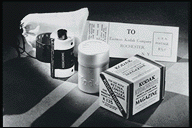 In
1933, Kodak and Western Electric commercialized a high speed camera for
industrial photography purposes. In 1935, KODACHROME film was introduced--
the first color film in 16 millimeters for movies. By 1936,
35 millimeter slides and 8 millimeter film for home videos had been developed.
The Cine-Kodak Camera became the first home movie camera to use magazines
instead of rolls. By 1937, Kodak had released the first sound-producing
home movie projector, the
In
1933, Kodak and Western Electric commercialized a high speed camera for
industrial photography purposes. In 1935, KODACHROME film was introduced--
the first color film in 16 millimeters for movies. By 1936,
35 millimeter slides and 8 millimeter film for home videos had been developed.
The Cine-Kodak Camera became the first home movie camera to use magazines
instead of rolls. By 1937, Kodak had released the first sound-producing
home movie projector, the
Note: This is
a brief explanation derived from a page on www.kodak.com:
Click HERE
for the official detailed outline of the History of Kodak.
Calculator, Binary
The first
binary calculator was invented in November 1937 by George R. Stibitz.
It could add two-digit numbers. Working with S.B. Williams, a scientist
for Bell Labs, he built a calculator capable of doing more complex mathematics.
The first complex computer was released one year later. Stibitz
is now known as the "father of the modern digital computer" (Tewari).
Click here to view the source for this information.
Cotton Picker
The automatic
cotton picker had been under construction since 1927 by the Rust brothers,
John Daniel and Mack Donald. During the summer of 1936, the cotton picker
was finished and tested on a large-scale. It would aid in increasing
production with its ability to pick as much cotton in an hour as could
be picked by 8-10 hand pickers in twelve hours (Boardman 118-19).
Carbon Dioxide, Solid
In 1930,
solid carbon dioxide, or "dry ice," as it came to be called, was adopted
commercially to make long shipments of fresh edibles. Because of
its ability to kill and check bacterial growth, it was used to preserve
foods and their nature flavors. By 1934, ten million bounds of frozen
foods were being sold. Refrigeration costs were reduced by over 3/4
over the course of the decade (Congdon 616).
Click here for a historical outline of DDT provided by the US Army Center for Health Promotion and Preventive Medicine.
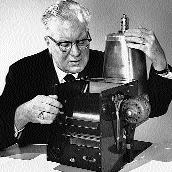 Chester
F. Carlson is considered the father of zerographic printing. Employed
by electronics firm P.R. Mallory Company in 1930, he was overcome with
the need to specifications and patent drawings. Thus, he began to
study ways of reproducing text and illustrations. Using electrostatics,
he developed the first 'dry-copy' in 1938. In 1944, after presentations
to more than 20 companies, Battelle Development Corporation took interest
in his invention.
Chester
F. Carlson is considered the father of zerographic printing. Employed
by electronics firm P.R. Mallory Company in 1930, he was overcome with
the need to specifications and patent drawings. Thus, he began to
study ways of reproducing text and illustrations. Using electrostatics,
he developed the first 'dry-copy' in 1938. In 1944, after presentations
to more than 20 companies, Battelle Development Corporation took interest
in his invention.
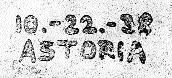 Pictured
at left, the first photocopy ever made-- complete with the location, Astoria,
NY, and the date: October 22, 1938.
Pictured
at left, the first photocopy ever made-- complete with the location, Astoria,
NY, and the date: October 22, 1938.
Click here to view the source of this information courtesy of The National Inventor's Hall of Fame or click here to view the source of the images.
Empire State Building,
the
By the
finances of Shreve, Lamb & Harmon Associates, the Empire State Building
was constructed at the site of the old Waldorf-Astoria Hotel between 1930-1931.
Starrett Brothers & Eken, Inc. began construction on the site on March
17, 1930, just a few months after the evacuation of the old hotel.
It was officially opened on May 1, 1931, when President Herbert Hoover
pressed a button in Washington DC to turn on the building's lights. Rising
1250 feet, or 102 stories, the Empire State Building was the tallest building
in the world for forty years (American Heritage; "Facts
about the Empire.."). The building came to symbolize the perseverance
of the United States, for though it was going through one of the most difficult
eras in history, the United States still managed to set an example for
the rest of the world.

Click here
to view the source for this information.
Note:
Image also from this source. Click on image to see it full-size. 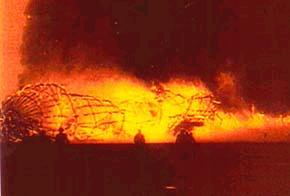
Hindenburg, the
On May
6, 1937, the hydrogen filled zeppelin, the Hindenberg, successfully completed
its crossing of the Atlantic Ocean. Unfortunately, as it dipped towards
its mooring mast in Lakehurst, New Jersey, it burst into flames.
Thirty six people were killed, and sixty one survived. The cause of the
explosion was never determined. (American Heritage History of the 20s
and 30s 336-7).
Hoover Dam

The Bureau of Reclamation
opened bids for the construction of the Hoover Dam and Power Plant on March
4, 1931. It awarded contracts to six companies who began construction
in 1932. By November, the Colorado River had been diverted around
the site of the dam, making way for the first concrete placement on June
6, 1933. The dam itself was completed in May 1935, and was dedicated
by Franklin D. Roosevelt on September 30, 1935. The dam and the power
plant were in official operation by 1938 ("The Chronology"). This
was one of the largest dams ever built, being 726 feet high and 1244 feet
long. It created Lake Mead, which is approximately 115 miles long
(Boardman 41).
Click here to see the complete history of the Hoover Dam.
Click here to view the source for this information.
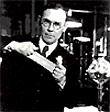 Following
the introduction of neoprene synthetic rubber in 1933, Dr. Wallace
H. Carothers (pictured at left) a scientist for the DuPont Corporation,
invented Nylon in 1938. DuPont decided to commercialize nylon with
the intention of competing with silk in the women's hosiery market.
Eventually, these "Nylons," as they came to be called, replaced silk stockings.
Held in place by a belt and garters, they covered from the feet to
mid-thigh and could be purchased in two varieties: either "full-fashioned"
or "seamless."
Following
the introduction of neoprene synthetic rubber in 1933, Dr. Wallace
H. Carothers (pictured at left) a scientist for the DuPont Corporation,
invented Nylon in 1938. DuPont decided to commercialize nylon with
the intention of competing with silk in the women's hosiery market.
Eventually, these "Nylons," as they came to be called, replaced silk stockings.
Held in place by a belt and garters, they covered from the feet to
mid-thigh and could be purchased in two varieties: either "full-fashioned"
or "seamless."
Click here
to see our source or here
to visit the official homepage of Nylon, provided by DuPont.
Image taken from the DuPont
website provided above.
Pluto :
In the late 1800's, it was
suspected that a small planet was disrupting the orbit of Neptune.
Although this turned out to be a conclusion based upon poor data, astronomer
Percil Lowell attempted to discover its location. In 1930, by coincidence,
Clyde Tombaugh actually discovered a faint planet near the originally
predicted area (Carkner)
Polio Research
Because its causes were unknown,
polio raged in the 1930's. Thousands of people suffered the headaches,
fever, and muscle pains that led to death or paralysis. Franklin
Delano Roosevelt, the president of the United States and a victim of the
polio virus, waged a campaign against the disease during his years in office.
Determined to change the situation, FDR called for the development of a
polio vaccine. Although a vaccine was developed successfully until
the 1960's, the 1930s' fight against polio was one of the most successful
medical fund-raising campaigns in history. In 1933, public dances
were held to raise money for polio research (Press 26). Four
years later, FDR got national radio programs to donate thirty second segments
asking the people to send dimes to the White House to support the battle
against polio. "Think what a thrill the people would get," he said.
"And we could call it the March of Dimes!" (qtd. in Press 26).
 The
existence of radar came about in the mid-1930s, but it was not until 1939
that efforts were made to increase accuracy. The U.S. Navy and Bell
Labs began tests in 1939. They tracked ship movements from the top
of a hill on the coast of New Jersey. In early 1941, as a result
of these tests, the first production high-frequency radar, the Mark I,
was installed on a U.S. Navy warship.
The
existence of radar came about in the mid-1930s, but it was not until 1939
that efforts were made to increase accuracy. The U.S. Navy and Bell
Labs began tests in 1939. They tracked ship movements from the top
of a hill on the coast of New Jersey. In early 1941, as a result
of these tests, the first production high-frequency radar, the Mark I,
was installed on a U.S. Navy warship.
Click here
to view the source of this information. Please note: the image displayed
here is provided by the source. Click on it to see it full-sized.
Radio Astronomy
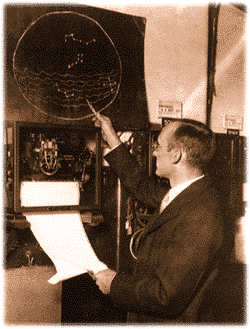 In
1933, Karl Jansky, a scientist for Bell Labs, was attempting to determine
that sources of static in overseas radio signals when he detected radio
waves radiated from the center of the Milky Way galaxy. This was
considered the beginning of radio astronomy.
In
1933, Karl Jansky, a scientist for Bell Labs, was attempting to determine
that sources of static in overseas radio signals when he detected radio
waves radiated from the center of the Milky Way galaxy. This was
considered the beginning of radio astronomy.
Click here
to visit the source for this information, providing by Lucent Technologies.
The above image is also from
this website. Click on the image to see it larger.
Radio, FM
Until 1933, when the fist
FM radio was invented by Edwin Howard Armstrong, only AM radio was available.
AM Radio, which had previously been the only kind of radio available, was
dependent on amplitude, and therefore often subject to interference by
lightening or other radio waves. But in the FM radio, the wave frequency
changed based on the speaker's voice. Thus, FM transmissions were remarkably
clear and static-free (Tewari).
Click here
to view the source for this information.
Click here to see this page's source, "The History of Teflon," provided by DuPont Laboratories or click here to visit the official Teflon home page.