

Entertainment
To escape from the sorrows of the depression, many Americans
turned toward entertainment. Many wonderful movies and books were
written/created in the 1930's, as well as some excellent songs. Family
life was very important in the '30's. Each family member had
responsibilities such as cooking, washing, ironing, cleaning, etc.
In free time, families listened to the radio, went on picnics and camping
trips, played board games, read, or went to the movies. Children
played with other kids in their neighborhood, while parents spent time
chatting and playing cards (Press 27).
Return to Top
Movies
To some extent, the thirties were thought of as the "Golden Age of
Hollywood" (McElvaine 149). Talkies (movies with sound) had
been introduced in 1928, and they became more popular during the thirties.
By the end of the thirties, there were even color movies (Becky Sharp
(1935) was the first full-length movie in color in (Nishi 76)) .
The movie industry primarily produced very lighthearted films aiming to
prompt viewers to forget the hardships of their lives. A person could
see a double feature for only 10 cents, and by the mid-thirties, sixty
percent of all Americans were going to the movies on a weekly basis.
"An average of some 80 million movie tickets were sold each week during
the last few years of the depression" (McElvaine 149). In 1934, religious
groups coerced the movie industry into creating a stringent production
code which enforced morality and did not permit unseemly or indecent subject
matter. (McElvaine 149). While most films were very light,
concentrating their efforts on "romanticized love, stylish glamour and
innocent sex appeal, uncomplicated comedy and adventure," there were some
exceptions (Leuchtenburg 58). In 1935, Warner Brothers produced a
movie called  G-Men.
It was the first F.B.I. movie created. Producers actually used real
F.B.I. photographs and buildings to enable the audience to glimpse what
it was like, crime labs, gun ranges, etc. Earlier films had primarily
portrayed police as inept, and many children fought to play the gangster
in make-believe games, but now everyone wanted to be an F.B.I. agent.
G-Men.
It was the first F.B.I. movie created. Producers actually used real
F.B.I. photographs and buildings to enable the audience to glimpse what
it was like, crime labs, gun ranges, etc. Earlier films had primarily
portrayed police as inept, and many children fought to play the gangster
in make-believe games, but now everyone wanted to be an F.B.I. agent. 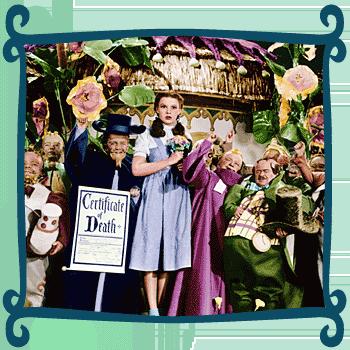 Hoover,
head of the F.B.I. at the time said, "'The value of this sort of thing
to the growing boy cannot be overestimated. He is taught that the
policeman can be and is his friend, and he learns to see crime in its true
light--as something far from glamorous, something sordid and evil that
must be stamped out"' (Nishi 70). Some very well known movies were
made during the 30's, among them: Gone With the Wind (1939), The
Wizard of Oz (1939), Frankenstein (1931) , Snow White and
the Seven Dwarfs (1937), The Little Princess (1939), Bride
of Frankenstein (1935) and Dracula (1931) (Leuchtenburg 58-61;
McElvaine 149-50; Smith 1; Press 90).
Hoover,
head of the F.B.I. at the time said, "'The value of this sort of thing
to the growing boy cannot be overestimated. He is taught that the
policeman can be and is his friend, and he learns to see crime in its true
light--as something far from glamorous, something sordid and evil that
must be stamped out"' (Nishi 70). Some very well known movies were
made during the 30's, among them: Gone With the Wind (1939), The
Wizard of Oz (1939), Frankenstein (1931) , Snow White and
the Seven Dwarfs (1937), The Little Princess (1939), Bride
of Frankenstein (1935) and Dracula (1931) (Leuchtenburg 58-61;
McElvaine 149-50; Smith 1; Press 90).
Return to Top
Radio
Radios began being used in the 1920's, and even after the crash in
1929, were still greatly sought after. The radio was the most popular
form of entertainment throughout the Depression. It had a major role
in the household- providing up to date news from around the world.
"Popular modes of thinking and living were created by radio" (Nishi 72). 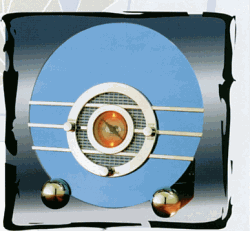 Airtime
was bought by astrologers, quack psychologists, soothsayers, people like
Father Charles Coughlin who preached political sermons about Jews, labor
unions, and big business over the air. President Roosevelt also used
the radio to broadcast what were termed his "fireside chats," beginning
after his first week in office on Sunday evening, March 12 (Stewart 65).
He was the first president to see the potential in using the radio as a
means of communicating to a large portion of the United States. His
voice was very charismatic and as one critic said, "when Roosevelt got
before a microphone...he appeared to be talking and toasting marshmallows
at the same time" (Leuchtenburg 51). The airwaves also brought hours
of "songs, jokes, comedy skits and commercials" to lighten the bleakness
of the Depression (Leuchtenburg 58; Nishi 72-3). Programs like "Amos
'n Andy" and "The Burns and Allen Show" sparked humor into the lives of
millions of Americans on a daily or weekly basis (Nishi 84). Singers
such as Bing Crosby and Kate Smith held audiences captive, while Soap operas
like "Ma Perkins" or "Just Plain Bill" kept housewives entertained during
the day (Leuchtenburg 62)
Airtime
was bought by astrologers, quack psychologists, soothsayers, people like
Father Charles Coughlin who preached political sermons about Jews, labor
unions, and big business over the air. President Roosevelt also used
the radio to broadcast what were termed his "fireside chats," beginning
after his first week in office on Sunday evening, March 12 (Stewart 65).
He was the first president to see the potential in using the radio as a
means of communicating to a large portion of the United States. His
voice was very charismatic and as one critic said, "when Roosevelt got
before a microphone...he appeared to be talking and toasting marshmallows
at the same time" (Leuchtenburg 51). The airwaves also brought hours
of "songs, jokes, comedy skits and commercials" to lighten the bleakness
of the Depression (Leuchtenburg 58; Nishi 72-3). Programs like "Amos
'n Andy" and "The Burns and Allen Show" sparked humor into the lives of
millions of Americans on a daily or weekly basis (Nishi 84). Singers
such as Bing Crosby and Kate Smith held audiences captive, while Soap operas
like "Ma Perkins" or "Just Plain Bill" kept housewives entertained during
the day (Leuchtenburg 62)
Return to Top
Music
Music during this time was very reflective of the times. In 1929,
the song "Happy Days Are Here Again" was released on Black Tuesday (the
day the stock market crashed). It became a reminder of how different
life in the twenties was from that of the 1930's. "We Sure Got Hard
Times Now" (1930) is very representative of the sharp change that had occurred
in just one year. The song "There's A New Day Comin' " was released only
6 days after Roosevelts inauguration on March 4, 1933, and portrays how
much hope people placed in his hands. Songs with titles such
as "Brother, Can You Spare a Dime?" (1932) relate how much the depression
was hurting people in America. World War I veterans were lobbying
in Washington for the "bonus" that Congress said it would get in 1945.
"National income had declined by 50 percent since 1929, and 14
million Americans were unemployed at the outset of 1932" (Humphrey
1).  The
song "NRA Blues" (1933) celebrated the most important part of the New Deal-
the National Recovery Act, with its three R's- Relief, Reform, and Recovery.
In 1936, the song "With Plenty Of Money And You" became the fantasy of
the youth of the depression. With many young men still high, they
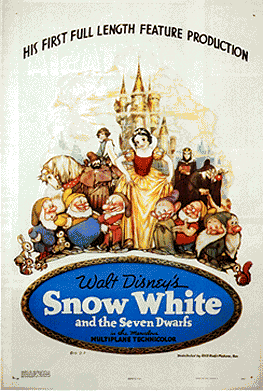
did not want to marry. Nine days after the release of Snow White
and the Seven Dwarfs, the song "Whistle While You Work" (1937) hit
the air waves. "Ironically, Americans were savoring the optimism
of "Whistle While You Work" as the recession of 1937-38 was hurling two
million of them back into unemployment. The whistling only became earnest
when America turned its energies to defeating the Axis. At a terrible price,
World War II ended the Great Depression" (Humphrey 1).
The
song "NRA Blues" (1933) celebrated the most important part of the New Deal-
the National Recovery Act, with its three R's- Relief, Reform, and Recovery.
In 1936, the song "With Plenty Of Money And You" became the fantasy of
the youth of the depression. With many young men still high, they
did not want to marry. Nine days after the release of Snow White
and the Seven Dwarfs, the song "Whistle While You Work" (1937) hit
the air waves. "Ironically, Americans were savoring the optimism
of "Whistle While You Work" as the recession of 1937-38 was hurling two
million of them back into unemployment. The whistling only became earnest
when America turned its energies to defeating the Axis. At a terrible price,
World War II ended the Great Depression" (Humphrey 1).
The 1930's are also widely known for swing music.
By 1936, swing music had a very large following of young people.
It perhaps hit its largest wave in 1938, when 20,000 young people crowded
into the "Carnival of Swing" at Randall's Island in New York. Twenty-five
bands alternated playing for five hours and forty-five minutes. The
term "destruction by admiration" was formed by the New York Times
to describe the pandemonium which had until then been unknown to most upholders
of law and order (Leuchtenburg 64).
Return to Top
Daring Feats: Truth or dare?
Some brave Americans put themselves to the
test by engaging in a number of dangerous endeavors. To attract attention,
some Americans swallowed up to a dozen goldfish, sat on flagpoles or in
trees for several weeks, or engaged in dance marathons. As more and
more people turned to these kinds of behaviors, more ideas came up and
existing "records" were challenged. In one case, someone rode a bicycle
for 13 days. In another case, someone played the piano for 240 hours
straight (Nishi 80).
Return to Top
Dance
Dance Marathons became very popular during
this era. Couples tried to dance as long as they could. Besides
short breaks, they often danced for 24 hours a day. The couple that
remained on their feet the longest one the prize (Boardman 82). Hundreds
of people looking for an easy way to make money entered the contest.
Most of them dropped out after a couple of weeks due to exhaustion, or
sometimes sabotaged by fellow dancers. They were often held in large
arenas or stadiums, where spectators paid a quarter to watch the events
(Nishi 80-81).
The schedule went as follows: they would dance for
an hour to a mix of slow and fast songs. Every hour, they were given
eleven minutes to rest backstage. At the end of the rest hour, loud
sirens called the dancers back, and every couple of hours, high-calorie
meals were wheeled in for the contestants to eat while dancing. The
cycle went on 24 hours a day for anywhere from a week to five months (Nishi
81).
Return to Top
Literature
Reading was another escapist past-time. Classics
such as Margaret Mitchell's Gone With the Wind and John Steinbeck's
The Grapes of Wrath, were written in the 1930's. Also very
popular were comic strips and 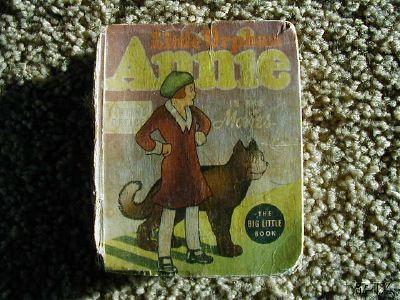 comic
books. Before church on Sunday, youth from all over the country would
flip through the newspaper until they got to the comic section, to see
the latest antics of Flash Gordon or Tarzan, or Little Orphan Annie.
These cartoons were also broadcast on the radio on weekends for four and
a half hours of cliffhanging series including Tarzan, Annie, and Flash
Gordon. For a dime, a child could get a 400 page Big Little Book
that had many of the back adventures of those characters.
comic
books. Before church on Sunday, youth from all over the country would
flip through the newspaper until they got to the comic section, to see
the latest antics of Flash Gordon or Tarzan, or Little Orphan Annie.
These cartoons were also broadcast on the radio on weekends for four and
a half hours of cliffhanging series including Tarzan, Annie, and Flash
Gordon. For a dime, a child could get a 400 page Big Little Book
that had many of the back adventures of those characters.
Superman became very popular after its public debut
in 1938. It was very close to the antithesis of philosopher Friedrich
Nietzsche's Übermensch, a concept translated to superman. While the
idea behind Nietzsche's superman described a
person with a will to power, the Superman comic conceived by Jerry
Siegel and Joe Shuster was of a "generous individual who is always willing
to 'do the right thing' for others" (McElvaine 140). The year after Superman
went on the market,
Batman debuted as another hero who fought for justice (he also resembled
Roosevelt in that he was a wealthy heir that took on different personas
to fight for justice). Children also played with pop-up and cut-out
books with characters such as Shirley
Temple, Buck Rogers, or Princesses Elizabeth and Margaret Rose (McElvaine
140; Terkel 66-82).
Return to Top
Games
The Depression caused people to resort to
inexpensive family entertainment such as cards, checkers, bingo, or chess.
The sale of playing cards did not go down at all during the Depression.
Contract Bridge was especially popular. The famous bridge player,
Ely Culbertson, estimated that Americans paid about ten million dollars
in 1931 for bridge lessons. In late 1931, the newspapers were filled
with coverage of the match between Culbertson and his wife and Oswald Jacoby
and Sidney Lenz (Boardman 45).
 Cards
weren't the only thing that was popular. Monopoly was invented by Charles
B. Darrow of Germantown, Pennsylvania. In 1934, he brought the game to
the Parker Brothers, but it was rejected. He went ahead and created
the games on his own, selling them at a department store. They were
in so much demand, he went back to Parker Brothers, and they began production.
"In its first year, 1935, the Monopoly game was the best-selling game in
America and was an overnight sensation" (The Monopoly®Companion! 1).
People loved trying to make as much money possible and buying up property
and houses by playing this fun game, as a break from their real lives where
they were struggling to make a
Cards
weren't the only thing that was popular. Monopoly was invented by Charles
B. Darrow of Germantown, Pennsylvania. In 1934, he brought the game to
the Parker Brothers, but it was rejected. He went ahead and created
the games on his own, selling them at a department store. They were
in so much demand, he went back to Parker Brothers, and they began production.
"In its first year, 1935, the Monopoly game was the best-selling game in
America and was an overnight sensation" (The Monopoly®Companion! 1).
People loved trying to make as much money possible and buying up property
and houses by playing this fun game, as a break from their real lives where
they were struggling to make a
living (McElvaine 143; Stein 28). Pinball was invented in 1931 and
became a very popular pastime as well. (Press 96).
Return to Top
Outdoor
Recreation:
 Many
adults escaped their difficulties by learning to rollerskate and bike riding.
Manufacturers competed to produce the most cost efficient models for consumer
purchases. But even people who couldn't afford to purchase their
own often found the money to rent them for a day of carefree living. Still
others made their own recreation vehicles-- like soap boxes--homemade cars
constructed out of old boxes, scraps of wood, and spare wheels (Press 95).
Many
adults escaped their difficulties by learning to rollerskate and bike riding.
Manufacturers competed to produce the most cost efficient models for consumer
purchases. But even people who couldn't afford to purchase their
own often found the money to rent them for a day of carefree living. Still
others made their own recreation vehicles-- like soap boxes--homemade cars
constructed out of old boxes, scraps of wood, and spare wheels (Press 95).
Return to Top
Soap Box Derbies
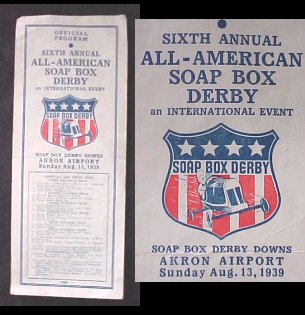 Soap Box Derbies
became very popular in the early thirties. Myron Scott, a photographer,
saw three boys sitting in crate-like frames with baby wheels and began
to photograph them. He invited the three children to come back and
bring their friends next week for a larger race. Nineteen children
came that time. By the end of the summer in 1933, these races drew
hundreds of cars and up to 40,000 spectators. The next year in Dayton,
the first All-American Soap Box Derby began. By the end of 1935,
the WPA had built a permanent track site for "Derby Downs." (Press 95).
For more specific information click here.
Soap Box Derbies
became very popular in the early thirties. Myron Scott, a photographer,
saw three boys sitting in crate-like frames with baby wheels and began
to photograph them. He invited the three children to come back and
bring their friends next week for a larger race. Nineteen children
came that time. By the end of the summer in 1933, these races drew
hundreds of cars and up to 40,000 spectators. The next year in Dayton,
the first All-American Soap Box Derby began. By the end of 1935,
the WPA had built a permanent track site for "Derby Downs." (Press 95).
For more specific information click here.
Return to Top
Broadway
While sales of plays and books dropped in the '30's, theaters still
produced dramas, musicals and comedies. 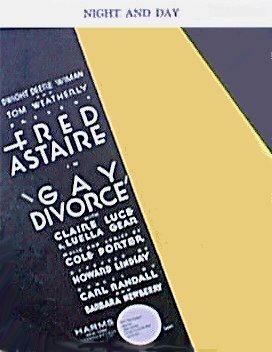 '"Life with Father", which ran for a record, 3,224 performances, was in
the mainstream of escape entertainment"' (Leuchtenburg 58). Busby
Berkeley created musicals with innovative dance patterns and extraordinary
sets including 42nd Street and Gold Diggers of 1933. Other musicals
included The Gay Divorce (1934) which starred Ginger Rogers and Fred Astaire,
Top Hat (1935), and Follow the Fleet (1936). The popular Mickey Rooney
was in sixteen musicians spanning 2 decades. In the fourth and most
popular musical of the Andy Hardy series (Love Finds Andy Hardy :1938),
Rooney stars with young teen costars Lana Turner and Judy Garland (Press
93-94). The Federal Theater project was also created, as a subdivision
of the Works Project
'"Life with Father", which ran for a record, 3,224 performances, was in
the mainstream of escape entertainment"' (Leuchtenburg 58). Busby
Berkeley created musicals with innovative dance patterns and extraordinary
sets including 42nd Street and Gold Diggers of 1933. Other musicals
included The Gay Divorce (1934) which starred Ginger Rogers and Fred Astaire,
Top Hat (1935), and Follow the Fleet (1936). The popular Mickey Rooney
was in sixteen musicians spanning 2 decades. In the fourth and most
popular musical of the Andy Hardy series (Love Finds Andy Hardy :1938),
Rooney stars with young teen costars Lana Turner and Judy Garland (Press
93-94). The Federal Theater project was also created, as a subdivision
of the Works Project
Administration. It emphasized entertainment as well as public
awareness of important issues. It provided jobs for thousands of
actors, playwrights, directors, and crew members who would otherwise have
been unemployed. During its four year life, over 30 million Americans
attended the free productions, for many, it was their first exposure to
live theater. Actors and actresses
employed by the FTP which later went on to earn more fame include Arthur
Miller, John Huston, E.G. Marshall, Joseph Cotten, Arlene Francis, Burt
Lancaster, Orson Welles, and John Houseman (Woog 66-67).
Return to Top
Jobs for Women
Getting married virtually eliminated most women's chances of finding
a job anywhere. This was because if she had a woman, she was assumed
also to have a source of income. Even school districts fired thousands
of newly married women. Hence, unable to support themselves, many
woman cut their hair and dressed as men before stowing away on freight
trains. Some traveled alone, but most went with partners. To
survive, they could trade sexual favors for money, food, or transportation
or contact charitable organizations or local merchants (Nishi 54-5).
Return to Top
Women and New Deal Employment
Women made several economic advancements under the New Deal programs.
In 1933, 500,000 women, mostly single women, widows, and women married
to unemployed men, worked for Works Progress Administration. While
minimum wages for women remained below those for men, the New Deal programs
bridged the salary gap (Katz 66-7).
Return to Top
Women's Fashions
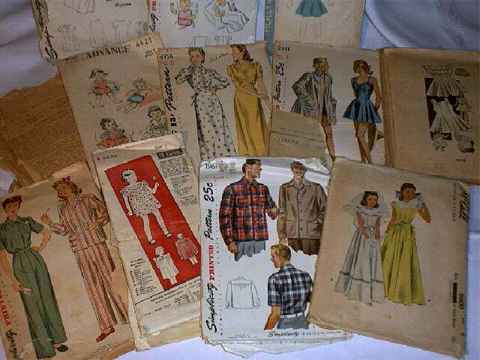 Most
men and women cut down on their clothing purchases during the Depression
era in order to save money and survive the hard times. But fashion still
remained. By 1933, most women wore skirts that went down to halfway
between the knee and the ground. Rather than sporting the shapeless
dresses of the 1920's, waistlines became part of the dress. Hair
was still very short, but most women grew out the "flapper" bob and wore
their hair-shoulder length. Fingernail painting, introduced by the
French in 1929, began to take root in the United States. Since many
women enjoyed bike riding as a form of recreation, slacks were introduced
(Boardman 79-80).
Most
men and women cut down on their clothing purchases during the Depression
era in order to save money and survive the hard times. But fashion still
remained. By 1933, most women wore skirts that went down to halfway
between the knee and the ground. Rather than sporting the shapeless
dresses of the 1920's, waistlines became part of the dress. Hair
was still very short, but most women grew out the "flapper" bob and wore
their hair-shoulder length. Fingernail painting, introduced by the
French in 1929, began to take root in the United States. Since many
women enjoyed bike riding as a form of recreation, slacks were introduced
(Boardman 79-80).
Return to Top
Minorities
"Members of minority groups who had long suffered from discrimination
faced a double burden in the depression. The other side of the coin,
however, was that the New Deal provided the 20th century's first positive,
though very limited, federal action that affected minorities" ---Robert
S. McElvaine (115)
They were often discriminated in the workplace--the
first ones to be fired when whites needed jobs and the first to be blamed
when someone needed a scapegoat (McElvaine 115). Still, the New Deal
Programs of the 1930s offered many opportunities for minorities to get
jobs to support their families. New Deal arts programs, like the
WPA for instance, produced an increased interest in Native American culture.
Murals were painted on walls of school houses and government building (McElvaine
120).
Return to Top
On October 1st, 1932, Babe Ruth, of the New York
Yankees hit a home run in the 3rd game of the World Series against the
Chicago Cubs at Wrigley Field! (Burg 77).
 In 1936, Joe
DiMaggio joined the New York Yankees and quickly became its star center
fielder. For four consecutive years, the Yankees won both the American
League pennant and the and the World Series (Boardman 117).
In 1936, Joe
DiMaggio joined the New York Yankees and quickly became its star center
fielder. For four consecutive years, the Yankees won both the American
League pennant and the and the World Series (Boardman 117).
Perhaps the saddest sports event of the decade was the retirement
of Lou Gehrig, the New York Yankees' first baseman. Once deemed "the
Iron Horse," he had set a record by playing in 2,130 consecutive games,
but was now struck down by a rare illness. At his farewell
ceremony, he told the world that he considered himself "the luckiest man
on the face of the earth" for having had his career (Boardman 130).
Return to Top
Football
While many sports lost attendance during the depression, football did
the exact opposite. College football became so popular by 1938 that
people began complaining about the amount of post-season games. From
1936, with only the Rose
Bowl, to 1938, with the Orange Bowl, Sun Bowl, Sugar Bowl, Cotton Bowl,
Eastern Bowl, and Coal Bowl, the amount of games had certainly increased.
Two of the most notable awards given out were the Knute Rockne Trophy (awarded
to the national champion at the end of the season) and the Heisman Trophy
(for outstanding player of the year). The first Heisman Trophy was
awarded to Jay Berwanger in 1935. He was considered a star player
for the University of Chicago. Also in 1935, the Rockne Trophy was
awarded to Southern Methodist University (Press 97). 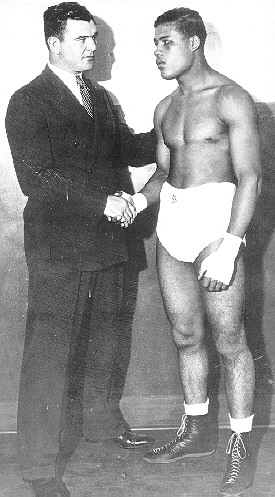
Return to Top
Wrestling
In 1937, Joe Louis, dubbed "the Brown Bomber," beat James J. Braddock
in the world's professional heavyweight boxing championship. He was
credited with making boxing a top attraction again when, in 1935, in his
match against Max Baer, he drew the first million dollar gate since 1927!
In 1936, this undefeated champion was defeated by German wrestler, Max
Schmeling, but in 1938, he reclaimed glory when he beat Schmeling in the
first round (Boardman 118).
Return to Top
Olympic Games
In 1932, both the winter and summer olympics were held in the United
States: the summer games were held in Los Angeles 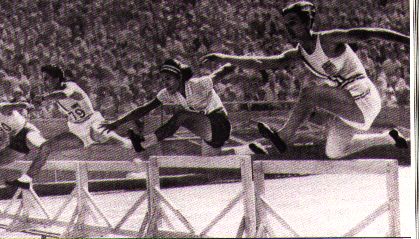 and
the winter games at Lake Placid, NY. The average crowd per day was
over 60,000, exceeding the attendance of all previous Olympics. The
1936 Olympics held in Berlin,
and
the winter games at Lake Placid, NY. The average crowd per day was
over 60,000, exceeding the attendance of all previous Olympics. The
1936 Olympics held in Berlin, 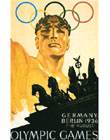 Germany
were also very important. African
Germany
were also very important. African
American Jesse Owens won numerous track events. He along with
a few other African Americans
won gold, as well as proved that Hitler's Aryan superiority was indeed
a myth (Press 97-98).
For more details, please visit
http://www.infoplease.com/ipsa/A0114502.html, courtesy of the Learning
Network.
Return to Top
 World's
Fair 1933
World's
Fair 1933
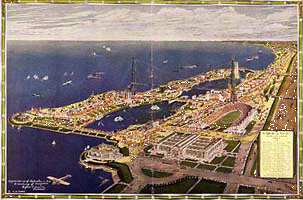
The World's Fair of 1933 was held in Chicago to
celebrate "The Century of Progress." While many people laughed at
the irony of making this the theme during a time when all of the country's
progress seemed to be standing still, the fair still drew ten million visitors.
The most popular exhibits included the "Hall of Science" and the performance
of Sally Rand, a fan dancer (Boardman 81).
Return to Top
World's Fair 1939 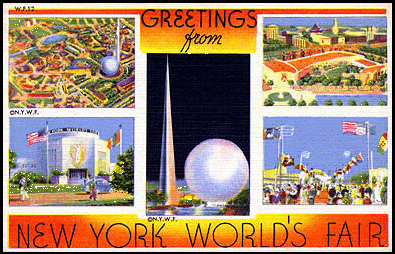
The World's Fair of 1939 was held in New York,
New York. This time, its theme was "The World of Tomorrow."
Most of the foreign nations (except Germany) had exhibitions set up, including
the food stands, the French Pavilion and the Belgian Brussels. The first
TV studio was exhibited by General Electric, Dr. Albert Einstein
suffused the fairground with multicolored light and pulsing sounds. Rides
for thrill-seekers included the parachute jump. (American Heritage
History of the 20s and 30s 364-5).
Return to Top
Prohibition
On the night of December 5, 1935, thousands
sat in their favorite speakeasies awaiting for the 19th amendment to take
effect, ending the reign of Prohibition. Since the president had
requested that Americans not abuse their freedom, many Americans celebrated
calmly. Unfortunately, since alcohol needs time to ferment and age
properly, there was not enough alcohol to satisfy the demands of every
establishment. The immature liquors that were served were not very
good, and thus they were flavored to disguise their low quality.
Bootleggers' services were still demanded for the smuggling of alcohol
from Canada and other foreign sources. Many speakeasies were legalized
and local bars, cocktail lounges, and liquor stores sprung up.
New nightclubs also appeared in addition to the newly legalized ones (Nishi
67-8).
According to one source: "If Prohibition accomplished
anything, it seemed to drop the barriers that divided the social lives
of men and women" (Nishi 67-8). Before Prohibition, "respectable"
woman did not drink in public, and most certainly not without their husbands!
But during this time, women began to visit speakeasies in large numbers.
Some also attended large, illegal nightclubs that were made legal after
the repeal (Nishi 66).
Return to Top
The Itinerant Classes
It is important to recognize that there was a significant
difference between the members of the poor class, despite the fact that
the differences were more often than not left unrecognized by the higher
classes of society.
Here is a general breakdown.
Tramp: a migratory non worker who wanders and dreams. They abhorred
any kind of work and preferred to steal or beg to get what they needed
to live. They often shared living arrangements with hoboes, but the
two groups abhorred one another's lifestyles (Nishi 56).
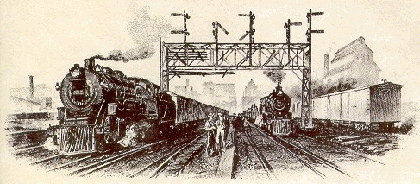 Hobo:
a migratory worker who was hardworking and honorable. They traveled
around the country often by railroad, seeking work. During warm weather,
they usually lived in open communities called "jungles" which were set
up near sources of running whether or near railroad stations or towns.
Life at the jungles was governed by a code of rules. Here,
race barriers were broken down. Everyone was poor-- whether they
were white, black, Indian, or Latino. Many hoboes rose up and became famous
and reputable. Clark Gable, the star of Gone with the Wind, was
originally a hobo, as was the Jack London, a novelist, and a poet named
Carl Sandburg (Nishi 56-8).
Hobo:
a migratory worker who was hardworking and honorable. They traveled
around the country often by railroad, seeking work. During warm weather,
they usually lived in open communities called "jungles" which were set
up near sources of running whether or near railroad stations or towns.
Life at the jungles was governed by a code of rules. Here,
race barriers were broken down. Everyone was poor-- whether they
were white, black, Indian, or Latino. Many hoboes rose up and became famous
and reputable. Clark Gable, the star of Gone with the Wind, was
originally a hobo, as was the Jack London, a novelist, and a poet named
Carl Sandburg (Nishi 56-8).
Bum: non migratory non worker who cares only about drinking
and wants comfort without working for it. They were often seen sleeping
off their drunkenness (Nishi 56-7).
Yeag or Johnson: an itinerant criminal also known as
a grifter (con artist), dip (pick pocket), jackroller
(mugger/thief), depending on their specialty. They victimized
fellow travelers and were recognized later as the ones who gave all members
of the itinerant classes a bad reputation (Nishi 56-7).
Return to Top