Great
Depression Politics
Return
to Home

Election
Basics
Election of 1928 Election
of 1932 Election of 1936
Presidents
Herbert
Hoover Franklin Delano
Roosevelt
Roosevelt's Relief
Programs
Political
Opponents/Challengers
Charles Coughlin Huey
Long Francis Townsend
Presidential
Candidates
Alfred Smith Alfred
Mossman Landon
Elections
Election of 1928:
Herbert Hoover (Republican) vs. Alfred
Smith (Democrat)
Election of 1932:
Herbert Hoover (Republican) vs. Franklin
Delano Roosevelt (Democrat)
Election of 1936:
Alfred Mossman Landon (Republican) vs.
Franklin Delano Roosevelt (Republican)
Return
to top
Presidents:
Herbert Hoover
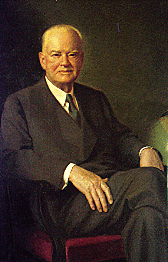
Herbert Clark Hoover was the president
of the United States when the stock market crashed on October 29, 1929.
Originally from Iowa, Hoover was a Standford graduate and had been internationally
recognized for his relief efforts in Europe after World War I and for his
work as secretary of commerce under the Harding administration. Although
extremely popular when elected in 1928, Hoover soon lost face when "the
bottom fell out of the market and the unemployed figures towered" (Nishi
12).
A strict Republican, Hoover held to his
beliefs that the government should remain out of the affairs of its people.
In one of his campaign speeches, he explained that "the power of and duty
of the general government ought to be extended to the relief of individual
suffering" (qtd. in Nishi 12). "If you let the federal government help
the individual, soon the federal government will control that individual,"
Hoover proclaimed, worried that government intervention would lead to socialism.
(qtd. in Stewart 45). Instead, he encouraged private institutions and charities
to help the misfortunate, and launched a campaign to promote volunteering.
(Nishi 12). But because times were tight, no one wanted to contribute to
charities, and local governments were often too weak to help local citizens.
(Stewart 45). Clearly, Hoover underestimated the extremity of the depression
that hung over the land.
Because he was so wealthy and could not
relate to the struggles of Americans, the gap between he and the American
people stretched further and further. Over time, people began to blame
him for the fact that the Depression was not ending and that their lives
were only getting worse. They named their "tar paper communities" Hoovervilles
and dubbed the newspapers they used to keep warm "Hoover blankets" (Stewart
43).
After being harshly accused of doing nothing
about the crisis, Hoover established the Reconstruction Finance Corporation,
whose function was to loan two billions dollars to banks, insurance companies,
and railroads to keep them in business. Hoover had hoped that helping businesses
would increase employment opportunities in the long run, but as the poor
stayed poor and little changed, people grew more and more frustrated (Stewart
45-6).
By 1932, Americans were weary and desperate
to elect a president that would provide them with some promise of an improved
situation.
Return to
top
Franklin Delano Roosevelt
(FDR)
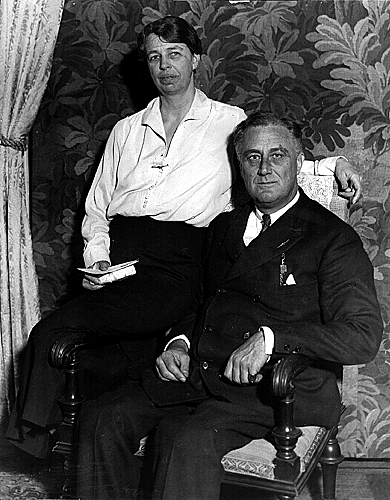
When Franklin Delano Roosevelt was elected
to the presidency in 1932, many people sighed with relief as he proclaimed
that "the only thing to we have to fear is fear itself." Unlike Hoover,
he promised to take an active role in salvaging the economy and providing
relief to every American.
He had already had a reputation for being
brave. At 39 years old, Roosevelt was stricken with polio, and was faced
with the fact that he would never walk again. Still, he refused to give
up politics, despite warnings that people would never elect a disabled
politician. With the help of crutches, he made his way to the Democratic
National Convention to nominate his friend, Alfred E. Smith, then governor
of New York, for the presidency. In 1928, Roosevelt was persuaded by Smith
to campaign for governor.
When elected, Roosevelt became "the best-traveled
governor in the history of his state" for he was "incapable of understanding
a problem unless he saw it with his own eyes" (Smith 89). He was a very
active governor, and was reelected in 1930 with over a million votes. As
governor, he created the first comprehensive unemployment relief system
in the nation and sponsored a broad social welfare program (Leuchtenburg
9).
As a presidential candidate of 1932, he
criticized Hoover of spending prodigally without providing much relief
to the American people and vowed to use the power of the government to
restore the quality of life that had been left in ruins by the stock market
crash of 1929. "The country needs and, unless I mistake its temper, the
country demands bold, persistent, experimentation," he asserted (qtd. in
Leuchtenburg 9). Although his promises were considered by some to be ridiculously
vague, the country quickly voted for him on his promise of active participation.
After his inauguration speech, people all
over the country wrote to the new president, sensing immediately that they
had a leader who would act in the best interests of the people (Leuchtenburg
10). With his cabinet, affectionately known as the "brain trust," Roosevelt's
first task was to rehabilitate the banks, declaring a national bank holiday.
He continuously spoke to the people over the radio in a series of "fireside
chats." Here, he updated the people on the actions of the government and
promised to restore their faith in the country.
Living up to his campaign promise to provide
"a new deal" for all Americans, Roosevelt worked to pass a series of bills
establishing a number of government sponsored relief programs from 1933-1938
(Leuchtenburg 10).
Return to
top
Roosevelt's
Relief Programs:
"The Alphabet Agencies"
Agricultural Adjustment Act (AAA)-
This act was an attempt to bring aid to failing farmers. The government
paid farmers to cut down on production so that demand would increase and
prices would rise. It also gave the president the ability to sell
surplus farm products on the world market for any available price (Glassman
44).
Civilian Conservation Corps(CCC)- This
organization combined the need to conserve natural resources and the need
to improve the quality of life for many American of men. Across the nation,
hundreds of thousands of men were employed by the CCC to clear land, construct
dams, and improve national parks. By the end of the Depression, over
two million men had worked for the CCC (Glassman 46).
Farm Credit Administration(FCA)- The
establishment of the FCA was an expansion of the goals established in the
AAA. It established a bank for American farmers and helped to refinance
farm mortgages, buy old mortgages from banks and insurance companies, and
lowering interest payments on mortgages to prevent foreclosures (Glassman
44).
Farm Security Administration(FSA)-
This
organization replaced the New Deal's Resettlement Administration in 1937.
Its workers were paid to photographically document the land and people
of the United States during the time. It was hoped that these photographs
would be preserved and the ups and downs of the generation would be remembered.
Photographers included Dorothea Lange, Arthuer Rothstein, Russell Lee,
Marian Post Wolcott, Walker Evans, and Carl Mydans. Today, about
270,000 photographs have been documented (McElvaine 30).
Federal Emergency Relief Administration(FERA)-
This organization, established in 1933, granted $3 billion to states to
fund work projects relief for unemployed adults. This was the beginning
of the movement to provide jobs as a means of both monetary and emotional
support instead of doling out relief checks (Nishi 23).
Federal Housing Administration(FHA)-
This organization helped middle-income families to build new homes or modernize/renovate
existing ones by insuring the loans made by private lending institutions
(Leuchtenburg 36).
Homeowners Loan Corporation(HOLC)-
The HOLC was an institution whose purpose was to refinance home mortgages
for people who had lost their homes as far back as 1930. Because
the HOLC helped so many Americans to mortgage their homes (one in ten had
mortgaged their homes within months of its establishment!), American real-estate
and construction industries significantly improved (Glassman 48).
National Industrial Recovery Act(NIRA)-
This act established the National Recovery Administration (NRA) It was
declared unconstitutional on May 27, 1935 by the US Supreme Court
(Nishi 21). See National Recovery Administration.
National Labor Relations Act(NLRA)-
This act declared the National Labor Relations Board a permanent independent
agency whose job was to protect members of labor unions from "unfair labor
practices" such as discrimination due to membership (Leuchtenburg 36).
National Recovery Administration (NRA)-
This was a program that aimed to provide long term solutions to the industrial
difficulties of the New Deal era. It created 550 voluntary codes
and standards that lowered working hours, set minimum wages, and banned
child labor and price fixing. Posters advocating the NRA presented
a big blue eagle and the motto "We do our part." Unfortunately, under
the NRA, the cost of living and the cost of production rose, and many small
businesses suffered. In a unanimous session on May 27, 1935, The
United States Supreme Court declared the NIRA unconstitutional, thus ending
the existence of the NRA (Nishi 21).
Public Works Administration(PWA)-This
administration's duty was to create adequate and affordable housing for
low-income families. The PWA razed slums that existed in the poorer
areas of cities and built apartment buildings featuring private bathrooms
and hot and cold running water. The rents averaged about $26 a month,
and families whose income eventually exceeded requirements of the program
were asked to surrender their appartments.
Social Security Act- In response
to the requests of political challengers Huey Long and Francis Townsend,
granted unemployment insurance, aid, and pensions to disabled Americans
and dependent children (Feldmeth).
Tennessee Valley Authority(TVA)-
The
goals of this organization were to provide cheap electrical power to local
farmers, to manufacture cheap fertilizer, and to work on preventing erosion
and flooding in the Tennessee Valley. The government seized control of
the Muscle Shoals electric and nitrogen power plant on May 18, 1938.
Works Progress Administration(WPA)-
This administration, founded in 1935, was established for the purpose of
giving jobs instead of handouts. One of the most diverse programs
of the era, the WPA employed 8.5 million people alone for the building
of parks, roads, and bridges, but had four other constituents-- the Federal
Theater Project, the Federal Music Project, the Federal Art Project, and
the Federal Writers' Project. The Federal Theater Project
sponsored
many theatrical productions. (In four years, 3 million people had
attended their performances.) The Federal Music Project
conducted
music courses for adults and children and sponsored orchestras and choir
programs. The Federal Art Project provided painters with the
chance to advertise FTP productions, announce FMP concerts, advocate good
safety and health practices, bring forth government messages, and so on.
The Federal Writers' Project produced state, territorial,
and city guides (Leuchtenburg 32-33). The organization was popular
because it gave people a chance to make money doing what they loved, thus
boosting the morale of an otherwise bleak time in history.
Return to
top
Political Opponents/Challengers:
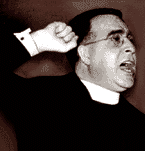 Charles
E. Coughlin: was a Catholic
priest from Detroit Michigan. Known by millions as "the Radio Priest" he
made weekly radio broadcasts in which he explained his plans to salvage
the US economy and blamed international bankers for the crisis (Stein 27).
Because of his affiliation with Catholicism, he appealed highly to members
of the Catholic faith in the urban areas of the Northeast and Midwest (McElvaine
91). In attacking the fundamentals of both capitalism and communism, he
appealed to people by giving them someone to blame for their troubles.
Like Hitler, he slowly weaved anti-Semitism and fascism into his speeches,
and for this reason, he was eventually silenced by the Roman Catholic hierarchy.
(McElvaine 93).
Charles
E. Coughlin: was a Catholic
priest from Detroit Michigan. Known by millions as "the Radio Priest" he
made weekly radio broadcasts in which he explained his plans to salvage
the US economy and blamed international bankers for the crisis (Stein 27).
Because of his affiliation with Catholicism, he appealed highly to members
of the Catholic faith in the urban areas of the Northeast and Midwest (McElvaine
91). In attacking the fundamentals of both capitalism and communism, he
appealed to people by giving them someone to blame for their troubles.
Like Hitler, he slowly weaved anti-Semitism and fascism into his speeches,
and for this reason, he was eventually silenced by the Roman Catholic hierarchy.
(McElvaine 93).
Return to
top
Huey P. Long:
was
the governor of Louisiana from 1928-1932 and was elected to the United
States 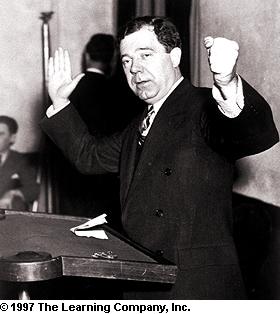 Senate
in 1930. While in office, he sponsored many reform programs that made him
popular with the lower classes and spoke out for the protection of individual
rights. He quickly became a hero of the poor people when he promised to
put "a chicken in every pot" under his proposed "Share the Wealth Program."
The plan would attempt to bridge the gap between the rich and poor by taxing
rich people and limiting private fortunes to $50 million while providing
a $5000 house and $2000 per year income for all Americans so that they
might "have the necessities of life, including a home, a job, a radio and
an automobile" ("Huey Long":..). In January 1935, he told the US Senate
that there was one way to save America: to "pull down wealth from the top
and spread wealth at the bottom" (qtd. "Huey Long Senate…") Long would
have posed a serious threat to the campaign for FDR's election in 1936,
because, as a third party candidate, he could "siphon off enough votes
to throw the election to the Republicans" (McElvaine 97), but instead,
he was shot to death in the State Capitol building in Baton Rouge in September
of 1935. (McElvaine 97).
Senate
in 1930. While in office, he sponsored many reform programs that made him
popular with the lower classes and spoke out for the protection of individual
rights. He quickly became a hero of the poor people when he promised to
put "a chicken in every pot" under his proposed "Share the Wealth Program."
The plan would attempt to bridge the gap between the rich and poor by taxing
rich people and limiting private fortunes to $50 million while providing
a $5000 house and $2000 per year income for all Americans so that they
might "have the necessities of life, including a home, a job, a radio and
an automobile" ("Huey Long":..). In January 1935, he told the US Senate
that there was one way to save America: to "pull down wealth from the top
and spread wealth at the bottom" (qtd. "Huey Long Senate…") Long would
have posed a serious threat to the campaign for FDR's election in 1936,
because, as a third party candidate, he could "siphon off enough votes
to throw the election to the Republicans" (McElvaine 97), but instead,
he was shot to death in the State Capitol building in Baton Rouge in September
of 1935. (McElvaine 97).
Return to
top
Dr . Francis Townsend:
was a retired physician and resident of California. He wrote a letter to
the Long 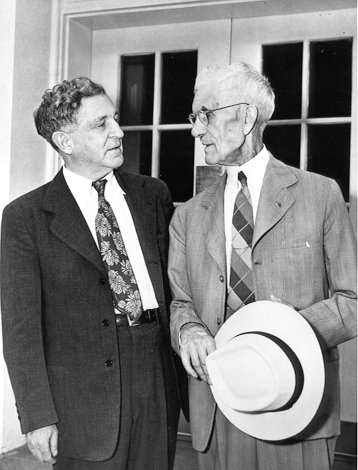 Beach
Press-Telegram entitled "Cure for Depressions," which was published
on September 30, 1933 (McElvaine 91). He proposed that the National Government
should elect legislation so that every United States citizen over the age
of sixty would retire on a pension of $200 per month. By the beginning
of 1934, he had established a national organization called the Old Age
Revolving Pensions, Ltd (OARP), whose sole purpose was to promote his plan.
His followers were able to obtain more than twenty million signatures endorsing
the plan. (McElvaine 96-7). The problem with the plan was that it would
cost the country more than half of the money it collected annually by taxes
and would eventually lead to national bankruptcy (Stein 28-9).
Beach
Press-Telegram entitled "Cure for Depressions," which was published
on September 30, 1933 (McElvaine 91). He proposed that the National Government
should elect legislation so that every United States citizen over the age
of sixty would retire on a pension of $200 per month. By the beginning
of 1934, he had established a national organization called the Old Age
Revolving Pensions, Ltd (OARP), whose sole purpose was to promote his plan.
His followers were able to obtain more than twenty million signatures endorsing
the plan. (McElvaine 96-7). The problem with the plan was that it would
cost the country more than half of the money it collected annually by taxes
and would eventually lead to national bankruptcy (Stein 28-9).
Return to
top
Presidential
Candidates:
Alfred Smith: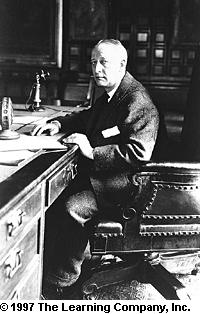
Affiliation: Democratic Candidate
Political History: Smith was the
governor of New York when he ran for president in 1928.
Other Relevant Information:
Religion: Roman Catholic
Temperance: Against Prohibition
The Election Itself:
-
He had little opposition for the Democratic
presidential nomination.
-
He won only the electoral votes of only 8
states. (He did not win New York, his home state.)
-
Many political observers felt he lost because
of his religious beliefs.
(Jenkins 82; "Alfred Smith")
Return to
top
Alfred Mossman
Landon:
Affiliation: Republican Candidate
Political History: Landon was the
governor of Kansas when he ran for president in 1936.
Other Relevant Information:
Communism: He refused to sanction a proposed
investigation of Communist activities at the state university of Kansas.
Race Battles: He campaigned with William
Allen White against the Klu Klux Klan during the 1920's.
The Election Itself:
-He proclaimed himself to be a progressive
politician
-Next to Roosevelt's eloquent manner, he
was considered by H.L. Mencken "to be one of the worst public speakers
recorded in the archives of fuanal zoology"
-Because he was from a "prairie state",
many people felt him unprepared to deal with the financial challenges of
the Great Depression.
Source: (Leuchtenburg 53-4).
Return to
top
Return to Home


