Economy
Causes of the Great Depression
The Business Cycle
Annual Earnings from 1932-1934
Classical vs Keynesian Economics
The Bank Holiday and Emergency
Banking Act of 1933
Economic Differences
The Labor Force, 1929-1941
Welfare
The Bonus Army
Causes of the Great Depression
No one knows for sure what it was that caused the Great Depression,
although there are a variety of theories and events that may have played
a part. There are really two parts to the problem, those being (1)
why economic activity turned down, and (2) why having begun to go down
it continued to go down, and remain low for a decade.
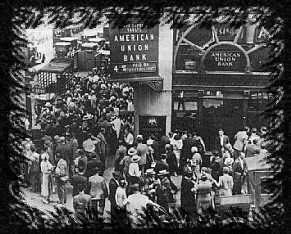 The Federal Reserve indexes of industrial activity and factory production
reached a peak in June, 1929. It wasn't until October that other
indicators such as factory payroll, freight-car loadings, and department
store sales, were reported as being down. The economy then, had weakened
in the early summer (well before the crash). There are a variety
of explanations for this weakening. (1) More products were being
produced than were being consumed (supply outweighted demand). (2)
businesses misjudged the increase in demand, and acquired more inventories
than they needed. This resulted in less buying and a cutback in production
(an inventory recession) (3) more deap-seated factors: production
and productivity rose steadily per worker between 1919 and 1929 (output/worker
in manufacturing rising by about 43%). Wages, salaries, and prices
however all remained comparably stable (no comparable increase).
Since the cost of production fell, with prices staying the same, profits
increased. The profits kept the well-to-do spending, investing
in the stock market (encouraging boom), and encouraged a high level of
capital investment. The increasing investment in capital goods was
a principal device by which profits were spent. Anything that would
keep the investments from showing the necessary rate of increase could
cause trouble by decreasing consumer spending. So if investment failed
to keep up with the steady increase in profits, it would result in a
decrease in total demand (by falling orders and output) (4) It could have
had to do with the high interest rates, which finally caused people to
stop buying (5) Or trouble was transmitted to the economy because of a
weak sector such as agriculture (Galbraith 174-176).
The Federal Reserve indexes of industrial activity and factory production
reached a peak in June, 1929. It wasn't until October that other
indicators such as factory payroll, freight-car loadings, and department
store sales, were reported as being down. The economy then, had weakened
in the early summer (well before the crash). There are a variety
of explanations for this weakening. (1) More products were being
produced than were being consumed (supply outweighted demand). (2)
businesses misjudged the increase in demand, and acquired more inventories
than they needed. This resulted in less buying and a cutback in production
(an inventory recession) (3) more deap-seated factors: production
and productivity rose steadily per worker between 1919 and 1929 (output/worker
in manufacturing rising by about 43%). Wages, salaries, and prices
however all remained comparably stable (no comparable increase).
Since the cost of production fell, with prices staying the same, profits
increased. The profits kept the well-to-do spending, investing
in the stock market (encouraging boom), and encouraged a high level of
capital investment. The increasing investment in capital goods was
a principal device by which profits were spent. Anything that would
keep the investments from showing the necessary rate of increase could
cause trouble by decreasing consumer spending. So if investment failed
to keep up with the steady increase in profits, it would result in a
decrease in total demand (by falling orders and output) (4) It could have
had to do with the high interest rates, which finally caused people to
stop buying (5) Or trouble was transmitted to the economy because of a
weak sector such as agriculture (Galbraith 174-176).
There were a lot of things wrong, but here are some
primary weaknesses had a major effect on the ensuing disaster:
(1) Bad distribution of income. The rich were rich, and although
they only composed 5 % of the population, they had 1/3 of all personal
income. The proportion of personal income in the form of interest,
dividends, and rent of the well-to-do was twice as great as the years following
WWII. This meant that the economy was dependent on those with the
money to invest or spend a lot on luxury items, both of which are open
to fluctuations (much more so than the bread and rent outlays a workman
who makes $25 a week would have) (2) a severely depressed farm
economy (3) barriers to international trade in the form of high tariffs
(4) over production of consumer goods (5) The insufficient purchasing power
of working men and women (5) the slipshod practices of banks and credit
institutions (Twentieth Century... 21). There were a large
number of independent banks, so when a bank failed, it led to another bank
failure- the domino effect. (6) Bad corporate structure. Enterprise
in the twenties had not been conservative; it had an exceptional number
of grafters, promoters, swindlers, impostors, and frauds (Galbraith 177-183).
For More information see The
Crash and the Great Depression
Back to Top
The Business Cycle:
As any economist can tell you, looking at the market as a whole, there
is a business cycle involved. There are four phases to this cycle.
There is the peak, which is the top, then the downturn, then the trough
(the bottom), and the upturn, when total output begins to expand.
The nineteen twenties were in the upturn portion of the cycle due to a
boom in stock market prices, because of general optimism. Economists
and businessmen alike believed the fledgling Federal Reserve would stabilize
the economy, and that rapid technological advances would lead way to a
better quality of life and expanding markets. The business cycle
then hit its peak. The Federal Reserve had raised the interest rates
two times, once in 1928, and then again in 1929 to try to slow down the
economy, bringing on the initial recession (DeLong 1). The only place
to go was down, and the economy stayed down for more than 2 consecutive
quarters (called a recession). It continued to stay down and became
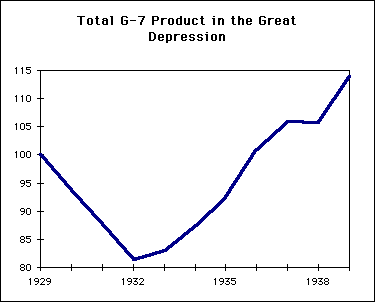
known as a depression. Looking at the graph below, 1932 was the worst
year of the depression, and could be considered the trough, the bottom
of the depression. Production and expansion then began to rise, in
part because of New Deal programs (Colander 489). By 1934,
conditions had improved to the point where, although 11,000,000 people
were still out of work, unemployment had decreased by about 1,700,000,
while the number of men and woman with jobs rose by close to 2,300,000.
The index of industrial production rose about six points, commodity prices
were up, as were stock market prices (Boardman 83).
Back to Top
Annual Earnings from 1932-1934
(Hard Times 26).
Airline pilot: $8,000.00
Airline stewardess: $1,500.00
Apartment house superintendent: $1,500.00
Bituminous coal miner: $723.00
Bus driver: $1,373.00
Chauffeur: $624.00
Civil service employee: $1,284.00
College teacher: $3,111.00
Construction worker: $907.00
Dentist: $2,391.00
Department-store model: $936.00
Doctor: $3,382.00
Dressmaker: $780.00
Electrical worker: $1,559.00
Engineer: $2,520.00
Fire chief (city of 30,000-50,000): $2,075.00
Hired farm hand: $216.00
Housemother--boys school: $780.00
Lawyer: $4,218.00
Live-in maid: $260.00
Mayor (city of 30,000-50,000): $2,317.00
Pharmaceutical salesman: $1,500.00
Police chief (city of 30,000-50,000): $2,636.00
Priest: $831.00
Public-school teacher: $1,227.00
Publicity agent: $1,800.00
Railroad conductor: $2,729.00
Railroad executive: $5,064.00
Registered nurse: $936.00
Secretary: $1,040.00
Statistician: $1,820.00
Steelworker: $422.87
Stenographer-bookkeeper: $936.00
Textile worker: $435.00
Typist: $624.00
United States Congressman: $8,663.00
Waitress: $520.00
Back to Top
Classical vs. Keynesian Economics:
Before the 1930s, economists had seen the market from a classical viewpoint
and only microeconomics were in existence. This began to change in
the thirties, with the help of John Maynard Keynes. When the US economy
fell into the Great Depression, businesses collapsed and unemployment rose
to the point where twenty-five percent of the workforce was out of work.
Previously, economics had concentrated on microeconomics (the study of
partial-equilibrium supply and demand). This did not take into account
the aggregate however, and so macroeconomics emerged (Macroeconomics is
the study of the aggregate moods in the economy, concentrating on problems
of growth, business cycles, unemployment, and inflation). There were
two groups of macroeconomists: Classicals and Keynesians (pronounced
KAIN-sian) both of which still exist today, although their differences
have become less distinct. Classicals were "macroeconomists who generally
favored laissez-faire or non activist policies" (Colander G-2). Keynesians
believed that the government should play an active role in the market (Colander
483-559).
Classicals argued that fluctuations in the market
were to be expected, that it would be strange if there were not fluctuations
when the market allowed individuals the freedom to do what they wanted
to do. Therefore, they should be accepted, just as people accept
the changes in seasons. If the government stepped in to take control
of the situation, people would anticipate the government's reaction, and
thereby undermine its attempt to control cycles. In reference to
unemployment, classicals believed that anyone who wanted to find work could
find work, at some wage, even if it was lower than a previous wage. If
a person was not working, it was his choice (making all unemployment frictional
- "unemployment caused by new entrants intoo the job market and people quitting
a job just long enough to look for and find another one" (Colander 493).
Economic growth was based on saving. If the economy wanted to grow,
people should save more, the more saving the better. Therefore, classicals
objected to government deficits (when gov't spends more than gets through
taxes). Classicals focused on the long run. While there might
have been problems in the short-run, in the long run the economy would
return to its potential output and natural rate of unemployment.
When the Depression hit, most Classical economists ignored the issue of
unemployment. When they were asked how the invisible hand could have
allowed the depression. They replied that the government policies
and labor unions kept prices and wages from falling, not allowing the invisible
hand to coordinate economic activity (Colander 483- 559).
Keynesians on the other hand, felt that fluctuations
were symptoms of underlying problems in the economy, and that the government
should step in and deal with them. They felt the same way about unemployment-
Society owes people jobs that equal their training or job experience.
Furthermore, jobs should be close enough to home that people don't have
to move. This would mean most employment was structural "unemployment
caused by economic restructuring making some skills obsolete" and cyclical
"unemployment resulting from fluctuations in economic activity" (Colander
492). If people weren't working and they wanted to, Keynesians wanted
a short run policy to address this. During the depression, people
became dissatisfied with Classical economists "have faith" solution and
wanted help at that moment. As Keynes said, '"In the long run, we're
all dead"' (Colander 558). Keynes concentrated on the the causes
of the Depression, and on solutions to it. He believed that wages
and the price level adjusted to changes in expenditures, and it could get
stuck in a rut. If people stopped buying, then production would decrease,
causing people to lose their jobs. Those people would then have less
money and would save more and buy less, going around in a circle, until
the economy was stuck at a low level of income. Through this thought
process, Keynes created the theoretical foundation that unemployment was
caused by too little spending (Colander 483-559).
Back to Top
The Bank Holiday and Emergency
Banking Act of 1933
On Monday, March 6, 1933 the president along with his economic advisors
decided to close every bank in the country. By the third month of
1933, over 4,000 banks had gone under. Governors from 47 states had
already declared bank holidays in order to stop the frantic withdrawals.
Roosevelt's announcement however, put a halt to all banking transactions
anywhere not specifically authorized by the secretary of the treasury and
the president. It also outlawed the export of gold, in an effort
to keep reserves from being further depleted. The bank holiday was
a short term solution which could remain effective only until Congress
acted. Both houses approved Roosevelt's administration-drafted Emergency
Bank Act on Thursday, March 9 (Watkins 150-151). The Emergency Bank
Act
not only authorized the president to do what he
already had done--close the banks and embargo gold--but stipulated that
no bank could be reopened until approved by the
secretary of the treasury, permitted the comptroller of the currency to
install conservators over insolvent banks and gave
such conservators the power to reorganize them, authorized the purchase
of bank stocks and notes by the Reconstruction Finance
Corporation to provide qualified banks with long-term investment
funds, gave the president greater control over credit,
currency, foreign exchange, and the setting of the price for gold and
silver, and allowed the Department of the Treasury
to call in all privately held gold and gold certificates to be exchanged
for
paper currency (Watkins 151).
Back to Top
Economic Differences:
In 1933, at the London Economic Conference in June, the United States
announced that it would be coming off the international gold standard as
a way to measure the worth of American currency. The Gold standard
meant that currency would be measured in terms of a fixed amount of gold.
Instead, the American dollar would measure its worth in relation to other
countries currencies depending on the demand for it in world markets, as
Great Britain had been doing since 1931. By announcing this decision,
Roosevelt was actually encouraging a currency war. Though Roosevelt
continued to support the purpose of the economics conferences, his administration
was divided. Cordell Hull, the secretary of state, was a stout internationalist.
He believed that by lowering trade barriers in the form of protective tariffs,
the world's economy problems would be saved. One of Roosevelts closest
friends however, assistant secretary of state Raymond Moley, was less convinced
with the international approach. He believed that national solutions
should solve national problems. On July 3rd, Roosevelt gave the "Indianapolis
Statement", which sunk the ideas of Hull and the conference. "From
the deck of the cruiser Indianapolis the president announced his
own opposition to the very idea of stabilized currencies and pressing upon
Europeans that need for balanced budgets and domestic financial reforms"
(Depression America 48). By taking itself out of the international
gold standard, Roosevelt felt that America's exports would be given a boost.
The lowered value of the dollar would lower the cost of exports to foreign
buyers. Roosevelt also felt that that a currency-stabilization scheme
might ruin his New Deal efforts to raise prices, particularly farm prices.
Therefore, Roosevelt and Moley went with the nationalist approach, forming
the Johnson Act of 1934 (chief creator Senator Hiram Johnson of CA).
This act barred foreign governments who had not paid back war debts from
floating loans on the American financial markets (Depression America 47-48).
Back to Top
The Labor Force, 1929-1941
(Gregory 84)
|
Year
|
Total Labor Force #
|
Total Labor Force Noninstitutional Population *
|
Armed Forces
|
Civilian Labor Force
|
Employed
Total
|
Employed Farm
|
Employed Nonfarm
|
| 1929 |
48,017 |
55.1 |
260 |
47.757 |
46,207 |
10,541 |
35,666 |
| 1930 |
48,783 |
55.0 |
260 |
48,523 |
44,183 |
10,340 |
33,843 |
| 1931 |
49,585 |
55.2 |
260 |
49,325 |
41,305 |
10,240 |
31,065 |
| 1932 |
50,348 |
55.4 |
250 |
50,098 |
38,038 |
10,120 |
27,918 |
| 1933 |
51,132 |
55.6 |
250 |
50,882 |
38,052 |
10,090 |
27,962 |
| 1934 |
51,910 |
55.7 |
260 |
51,650 |
40,310 |
9,990 |
30,320 |
| 1935 |
52,553 |
55.6 |
270 |
52,283 |
41,673 |
10,110 |
31,563 |
| 1936 |
53,319 |
55.7 |
300 |
53,019 |
43,989 |
10,090 |
33,899 |
| 1937 |
54,088 |
55.9 |
320 |
53,768 |
46,068 |
10,000 |
36,068 |
| 1938 |
54,872 |
56.0 |
340 |
54,532 |
44,142 |
9,840 |
34,302 |
| 1939 |
55,588 |
56.0 |
370 |
55,218 |
45,728 |
9,710 |
36,028 |
| 1940 |
56,180 |
56.0 |
540 |
55,640 |
47,520 |
9,540 |
37,980 |
| 1941 |
57,530 |
56.7 |
1,620 |
55,910 |
50,350 |
9,100 |
41,250 |
* means entire population excluding people under 14, students, wives
and mothers at home--who were not counted as part of the work force, and
those who were institutionalized.
(Source: Wattenberg, Statistical History, 126)
Back to Top
Welfare
Before the Roosevelt administration, most relief
services were provided by voluntary charities. The Hoover administration
especially had declared that it was not the place of the government to
provide such services to its people. To combat unemployment, President
Herbert Hoover established the President's Emergency Committee on Employment
(PECE) in 1930. It was later renamed the President's Organization
on Unemployment Relief (POUR). Its sole purpose was to urge business
to rehire workers and to create a sense of moral support and direction
world-wide. But by 1931, voluntary agencies across the nation "tottered
under the weight of rising case loads" (Gerdes 127).
Thus, in 1933, when the Roosevelt administration
established the Federal Emergency Relief Administration (FERA), people
were shocked. It was considered "a landmark in American social welfare
history" (Gerdes 125-6). It was the belief of Roosevelt and his advisors
that the economic crisis had created such high levels of joblessness and
poverty that it had become impossible for the government to ignore.
These crises, it was believed, could undermine the fabric of American culture.
Federal action, therefore, was needed to preserve the "American way of
life" (Gerdes 126). Furthermore, the administration believed,
it was necessary to establish a series of work relief programs would need
to be enacted. This assertion led to the establishment of the New Deal
works projects.
Additionally, in 1933, Americans were able to insure
themselves against hospital care cost for the first time through a nonprofit
system called the Blue Cross. Before long, millions of people were
covered by this insurance (Boardman 82).
Back to Top
The Bonus Army
At the peak of the depression, 1932, thousands of WWI veterans
paid a call to Washington, ordering Congress to pay them a wartime “bonus”
which was scheduled to be paid in 1945 immediately. This movement
was led by Walter Waters, a former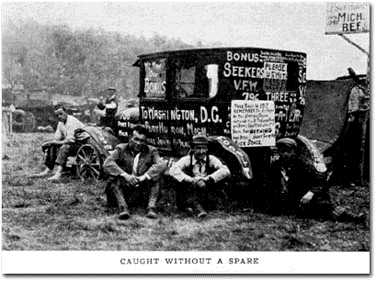 medic for the 146th Field Artillery. The group rose to over twenty-five
thousand within two months, and Hoovervilles began to spring up all around
Washington and in abandoned buildings. Representative Edward Eslick
spoke before colleagues to support the veterans. During a debate
over a bill which would allot some of the bonus money to the veterans,
Eslick died of a heart attack. The next day, the bill was passed
by the House, 21 to 176 with 40 abstaining. It then went on to the
Senate, where it was defeated 62 to 18, with the help of Hoover.
(Hoover was against increasing the national debt and a heard protester
of the bill.) Crushed, many families left for home. Hoover
even encouraged a 100,000 dollar transportation loan bill which would help
marchers to return to their homes. Some families decided to stay
however, hoping the situation would improve. Fearing health problems,
Hoover ordered U.S. troops to “escort” anyone who remained out of the city.
Army chief of staff Douglas MacArthur went a little further, by burning
the shantytowns and routing any remaining campers with water hoses, bayonets,
and tear gas (Nishi 14-17).
medic for the 146th Field Artillery. The group rose to over twenty-five
thousand within two months, and Hoovervilles began to spring up all around
Washington and in abandoned buildings. Representative Edward Eslick
spoke before colleagues to support the veterans. During a debate
over a bill which would allot some of the bonus money to the veterans,
Eslick died of a heart attack. The next day, the bill was passed
by the House, 21 to 176 with 40 abstaining. It then went on to the
Senate, where it was defeated 62 to 18, with the help of Hoover.
(Hoover was against increasing the national debt and a heard protester
of the bill.) Crushed, many families left for home. Hoover
even encouraged a 100,000 dollar transportation loan bill which would help
marchers to return to their homes. Some families decided to stay
however, hoping the situation would improve. Fearing health problems,
Hoover ordered U.S. troops to “escort” anyone who remained out of the city.
Army chief of staff Douglas MacArthur went a little further, by burning
the shantytowns and routing any remaining campers with water hoses, bayonets,
and tear gas (Nishi 14-17).
Back to Top
Return
To Home