take a look at this C major scale (fig.1)
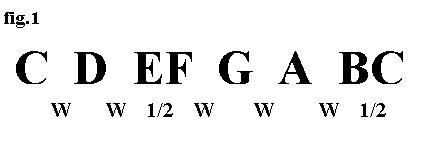
The spaces between the notes represent the tones(whole steps). No spaces between the notes represent the semi-tones(1/2-steps).
Now, its time to explain sharps(#), and flats(b).
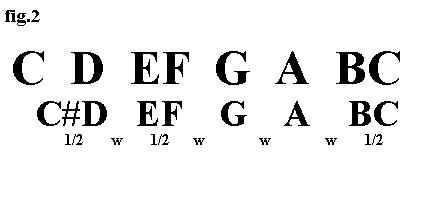
A sharp makes a note to sound a pitch 1/2 HIGHER than normal like in fig.2, the note C is combines with a # sign making it now the note of C#. Also notice that there's no space between the C# and the D notes, meaning there no longer is a tone but a semitone.
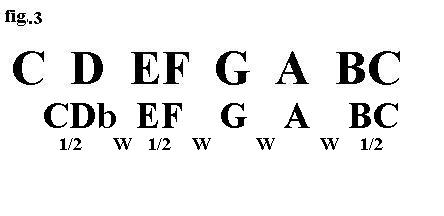
A flat is the opposite of a sharp, it makes a note sound a pitch 1/2 LOWER than normal. Look at fig.3, the D combines with a b sign, making it now the note of Db. Like in fig.2 there's no space between the first two notes, therefore making the interval between them a semitone.
Now that you know the pattern of intervals for every major scale, and the tools to shift tones from high to low and vice versa, its time to teach you how to form other scales using all the tools given.
Let's say you want to form the D major scale, start by writing down all notes naturally(without sharps or flats) starting with D, as shown in fig.4.
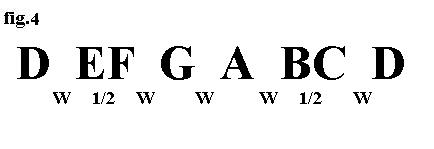
notice how that series of notes don't follow the pattern w w 1/2 w w w 1/2. From D to E there's a tone, so we're ok there. From E to F is a semitone but we cant have that. So we take a sharp and combine it with the F note to bring it 1/2 step higher and making the interval from E to F# a tone. Look at fig.5.
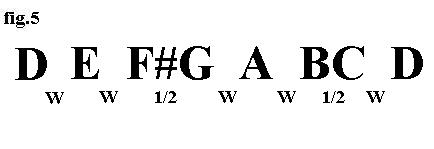
Now we see that from F# to G is a semitone. From G to A is a tone. From A to B is another tone. So good so far. But from B to C is a semitone when we need a tone. So again we take a sharp and attach it to the C, making it C#, and makind the interval from B to C# a tone and from C# to D a semitone, just like in the pattern. So there you go the major scale of D.(fig.6)
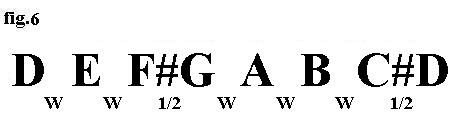
It follows the pattern like it's supposed to. To get the other scales just follow the same steps as above, combining sharps and flats where appropriate to make them follow The pattern.