|
-
Introduction -
Birds
have been known to inspire man since time
immemorial. They
occupy a powerful place in the
cultures
of many nations as reflected in their
arts,
mythologies and beliefs. In addition, birds
too become
popular symbols of freedom, trans-
cendence,
wisdom and hope. Birds enchant man
with
their beauty, their songs and their flights.
They
provide nuances to our music, aphorisms to
our speech,
cadences to our poetry and wings to
our
aspirations. Each bird has its own allure.
Hence
wisdom is ascribed to the Hoopoe, vanity
to the
Peacock, intimacy to the owl.
In
the Malay world, birds feature prominently
in the
myths of its people. The Hikayat Merong
Mahawangsa
or
The Kedah Annals, for example,
traces
the origins of the state of Kedah in West
Malaysia,
to an incident involving a Garuda, a
Hindu
demi-god, part man and part bird.
The Malay
language is replete with perumpamaan
(similes)
that use the bird anology.
Bagai
itik pulang petang
(Like
the duck that homes in the afternoon)
Bagai
murai tercabut ekor
(Like
the Magpie that lost it's tail)
In
poetry, there is the famous 16th century
poem
called Syair Burung Pungguk (Poem of the
Owl)
by the Sufi, Hamzah Fansuri.
Of all
the birds in the world, none come close
to the
Hud Hud to represent the Malay's quest
for
a deeper purpose to life.
If the Owl
symbolizes
spiritual yearning as in "the owl that
yearns
for the moon", the Hud Hud symbolizes
the "perfected
man" and the Guide.
-The
Hud-Hud-
The Hud
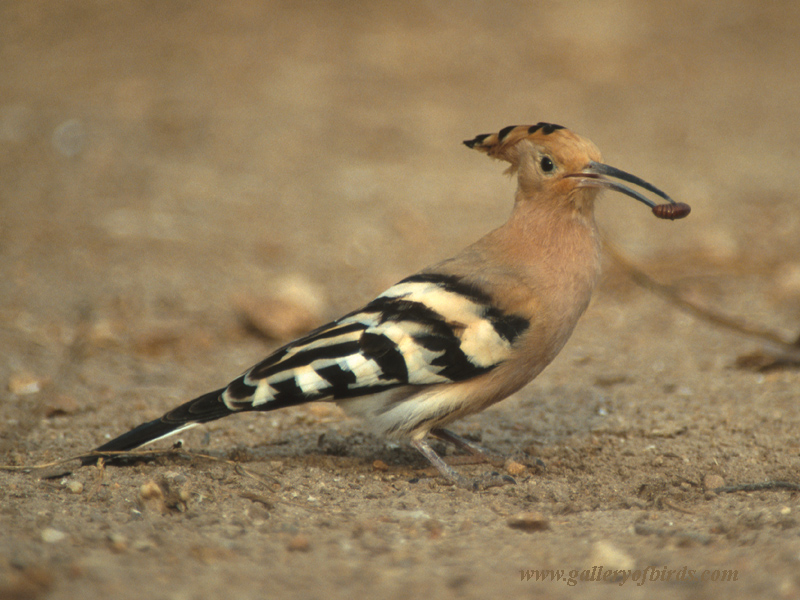
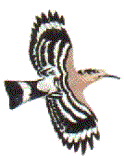
Hud is an unusual looking bird with a
long
thin curved beak, colourful feathers and a
long
erectile crest. The body is of a beautiful
pinkish
brown, and the wings and tail are
of
black
and white feathers.
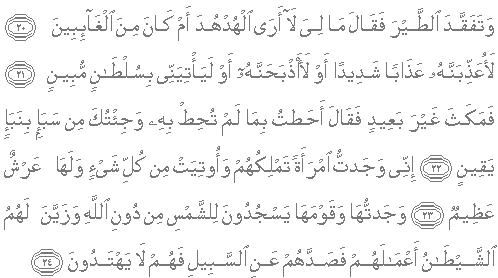
The
Hoopoe (Arabic Hud-Hud)
Al
Quran Sura 27 Al Naml verses 20-26
wherein
the name Hud-Hud is mentioned
-Solomon's
Emissary-
The Hud Hud
is probably the only bird that is in
the unique
position of having been mentioned by
name in the
Quran, Muslim's holy scripture.
In it we are
told of the Emissary role played by
the bird in
the communications between Solomon
and the Queen
of Sheba that finally resulted in
her submission
to the path :
And
he took a muster of the Birds; and he said:
"Why is it I see not the Hoopoe? Or
is he among
the absentees? I will certainly punish
him with a
severe penalty, or execute him,
unless he bring
me a clear reason (for absence)."
But the Hoopoe tarried
not far : he (came up
and) said: "I have compassed
(territory) which
thou hast not compassed,
and I have come to
thee from Saba
with tidings true. I found
(there) a woman ruling over them
and provided
with every requisite; and she has
a magnificent
throne. I found her and her
people prostrating
(worshipping) the sun besides
God: Satan has
made their deeds seem
pleasing in their eyes,
and has kept them away from the Path,-
so they
receive no guidance, (Kept them away
from the
Path), that they should
not prostrate (worship)
God, Who brings to light what
is hidden in the
heavens and the earth, and knows what
ye hide
and what ye reveal. God!-
there is no god but
He!- Lord of the Throne Supreme!"
(Solomon) said : "Soon shall
we see whether
Thou has told the truth or lied
! Go Thou with
this letter of mine, and deliver it
to them ; then
draw back from them,
and (wait to) see what
answer they return......."
27 verses 20-28
-Tanya
Sama Itu Hud Hud-
(Ask the Hoopoe)
A Bird Song of sorts !

M Nasir,
a popular contemporary Malay singer and composer,
popularises
the
13th
century Persian Sufi tale of the pilgrimage of Birds led by the Hud Hud
to meet
their
legendary
King,
Simurgh....
through
a song
entitled
"Ask
the Hoopoe"

" Music has to have its soul and
its own original form. The soul must be strong and the form must be clear.
The form must be able to be heard and able to highlight its true, original
self..The form must be expressed as required by the soul or spirit..." |
73
pintu
73
jalan
Yang
sampai
Hanya
satu jalan
Beribu
margasatwa
Mencari
raja Si Murag
Yang
sampai hanya 30
Ooh
Sang Algojo
Ooh
(Hei) nanti dulu
Lihat
dunia dari mata burung
Atau
dari dalam tempurung
Yang
mana satu engkau pilih
Dalam
kalut ada peraturan
Peraturan
mencipta kekalutan
Dimana
pula kamu berdiri
Disini
Ooh
Sang Algojo
Ooh
nanti dulu
Berikan
Aku kesempatan akhir ini
Untuk
menyatakan kalimah sebenarnya
Berikan
Aku kesempatan akhir ini
Ini
semua konspirasi (Lai)
Tanya
sama itu HudHud
Lang
mengsilang
Kui
mengsikui
Kerna
dia yang terbangkan
Ku
kemari
|

Mantiq
Ut Tair (Conference of the Birds)
13th
century Sufi Tale by Fariduddin Attar
In this
tale, the birds who succesfully completed the
journey
numbered thirty. At the end of their
journey,
they discovered that, that which
they
seeked, Simurgh, has been with
them
all along, from the very
beginning
of the journey,
guiding
them cross
the
valleys of
self
disco
-very
.
Simurgh,
in the
Persian
language,
the language in
which
the tale was written, means
THIRTY
BIRDS
-Other
Bird-o Facts-
.
In Pharoanic Egypt, the Hud Hud is depicted
in hieroglyphs as a symbol of gratitute. The
Egyptians believed that the Hud Hud plucked
the old plumage of their aged parents and
cleansed their eyes by licking
. To later North Africans, the Hud Hud was
known as "the doctor" by virtue of curative
properties of the bird's heart and head
. The Bible lists the Hud Hud flesh as unpalat-
able, and in the same category as the crow
and vulture
. In the Malay world, the Hud Hud flesh is
believed to be good for persons suffering
from Asthma
. Hoopoe breeds in northern Eurasian
continent and winters at southern parts of
the continent. However, it does not come
down further to Malaysia. It is recorded as
a rare/irregular visitor in northern parts of
the Peninsular. Also, it used to be resident
in Perlis. |
The Story
Of
Merong Mahawangsa
.
One
day an eagle arrived and told the Garuda that the Prince of Rum will be
married to a daughter of the Emperor of China. He had received this news
from a Cuckatoo, who also mentioned about a big fleet that will accompany
the Prince.
Determined
to prevent this marriage from happening, the Garuda sought an audience
with Prophet Solomon. He protested againts the marriage on the pretext
that the Prince and Princess were from countries far apart. Having failed
to convince the Prophet, the Garuda decided to use force.
Immediately
he flew to China, grabbed the Princess and her maid in his talons and proceeded
to hide them temporarily on an island. He then attacked the fleet from
Rum which was captained by one Merong Mahawangsa, a son of an Indera
(a
descendant of a minor deity) and a Gergasi (daughter of an ogre).
The attacks were vigorously repulsed by Merong Mahawangsa, who used
magic
to change his bow and arrow into a Jentayu, a powerful mystical
bird. However, after much attempts, the Garuda managed to sink the fleets.
The jubilant
Garuda returned to the presence of Prophet Solomon with the intention of
boasting his exploits, only to be told that the Prince was safe. Greatly
ashamed of his failure, the Garuda left the Earth in self banishment.
Merong Mahawangsa, who was spared the fate of many of his men, on
his part decided not to return to Rum for he too thought that the
Prince was dead. He sailed on, keeping to the coastline till he found a
place to settle. That settlement, he named Langkasuka.- the ancient
name of Kedah Darul Aman.
|
Bird authorities
differ in opinion with
regards to
the number of species that
this bird has.
There is but one genus
(Upupa). One
opinion put the species
to three -
that of Eurasia (U.epops),
Africa (U.africana)
and Madagascar
(U.marginata)
- the latter distinction
being due to
a distinct difference in
voice. Here's
what a bird expert has
to say about
the behaviour of the Hud
Hud :
"Feeds mainly
on the ground, walking
with ease and
even running with
accompanying movement
of head.
Fond of feeding on lawns
and paths
or, alternatively, on manure or refuse
heaps, probing
for larvae. Crest
depressed when at rest,
but erected
when excited or alarmed
and for a
moment on settling. Flight is not weak
and uncertain as
it appears, for it
will readily elude
trained falcons,
mounting easily into
the air away
from them. Perches in trees,
as well
as on buildings,
walls, etc., and
according to Lilford will occasionally
climb up a tree like
a woodpecker,
but this is not usual.
Fond of dust
and sand-baths"
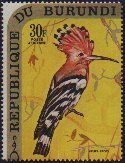 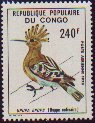
Hoopoe
stamps
-The
Crest-
One day
Prophet Solomon was riding
upon his white
eagle when the sun beat
became too
unbearable that he thought
he would die.
Suddenly a flock of Hud
Hud flew by
and formed a canopy over
Solomon's head
by joining their wings
together -
wingtip to wingtip.
In gratitute
for their kind deed, the
Prophet summoned
the King of the Hud
Huds to his
presence and granted him
a wish.
After much consultation
with his flock,
the King
asked that Solomon grant
them
golden crowns to wear. True to
his word,
Solomon granted their wish
but also warned
them of the potential
danger that
could befell them due to
spell that
the gold's glitter has on the
Hunters.
It was
not long before news spread
about Solomon's
gift to the Hud Hud.
Hunters, keen
to wrest the crowns set
traps
with mirrors for bait. Many a
Hud Hud, now
vain by their elevated
status
were caught and killed when
they tried
to admire themselves in the
mirrors.
Soon their
numbers became depleted
to the
point that the King of the Hud
Huds
had to swallow his pride and
approached
Solomon for help.
The kind
Prophet decided that hence-
forth
no birds will wear a crown and
to the
Hud Huds crests were given
instead. In
this way, their beauty will
no longer entrap
them.

-The
Hud Hud as Sufi-
The Birds, who
represent humanity
are invited
by the Hud Hud, the Sufi,
to take
on a journey to seek their
legendary King,
Simurgh, who lives in
the mountains
of Kaf. The birds,
after the
initial excitement begin to
give
excuses not to partake on the
journey. To
each of their complaints,
the Hud Hud
would reply with a story
to emphasize
the uselessness of being
satisfied with
what they have versus
what
they should have. Finally the
Hud Hud mentions
that their journey
would entail
travessing seven valleys.
These are the
-
Valley of Quest,
where the pilgrim
must renounce
desires;
Valley of Love,
where the Seeker is
completely
consumed by a thirst
for the beloved;
Valley of Intuitive
Knowledge, where
the heart receives
directly the
illumination
of Truth;
Valley of Detachment,
where the
Traveller becomes
completely
detached from
desires and
dependence;
Valley of Unification,
where the
Seeker understands
that what seemed
to him to be
different things and
ideas are in
fact, only one;
Valley of Astonishment,
where the
Traveller experiences
both
astonishment
and love;
Valley of Death,
where the Seeker
understands
the mystery, the
paradox, of
how an individual "drop
can be merged
with the ocean, and
yet remain
meaningful".
Valley
description after Idries Shah.
HOME
>>NEXT
 27/3/2002
This page is dedicated to brother
Harun bin Ahmad
Antal Hadi Antal Haq !
Laisal Hadi illa Hu !
|