
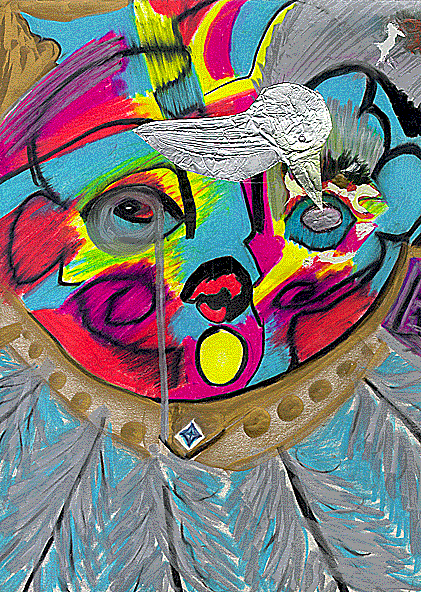
 SUN ON A BLADE OF GRASS
Morning adorns the sky with a limpid light blue color and the sun of the east. All manner of life stir in the warmth of it's hiding in the night, to welcome yet another glorious day. The stumbling soldier ants report to duty to do the Queens' bidding; the mother bird charts the sky for some grub for the loaded nest; and in the farmer's house, the kitchen is already lit and the voices of children mingle with the clanking of plates, cups and saucers.
The meandering river makes no notice of the morning sun. It's labor continues silently like in the night when the only witnesses must be the solitary moon and the night owl that cries "Hoo". The only difference is the wavelike golden reflection of the morning's ray that it now puts on as a mantle or garment replacing the silver cloak of the night.
The farmer, picking up a changkul makes his way to the fields. He stops at a Keriang tree, breaks a small twig which he places delicately in the ledge of his right ear, much like one puts on the spectacles and plucks some ripe dark purple berries and put them in his mouth. The twig replaces the skull cap and it is a sign of humility. And as for the berries, they are....well, berries.
As he focuses on the distant plot, he makes sure that his feet do not slip from the uneven narrow path that divides the padi field into small lots of fifteen by fifteen or so feet. With the Changkul on his shoulder and the need to be nifty with his feet, the farmer soon gets into a rhythm, as natural as the swaying of the padi plant in the wind. This is the rhythm of my land, the heart beat of my soul.
And in a sonorous voice, the farmer breaks into a song....
Hasbi Rabbi Jalallah !
Ma fi Qalbi Ghairullah !
Nur Muhammad Salallah !
Nur Muhammad Salallah !Adam Safiullah
Nuh Najihullah
Ibrahim Khalilullah
Ismail Dhabihullah
Daud Khalifatullah
Musa Kalimullah
Isa Ruhullah
Muhammad Rasulullah !Frequently, he stops to look at the fish traps that he had placed the day before - the Bubu, the Tuak, and the Pelompat and the fish line, the Taut. The fishes caught - Haruan, Keli, Sepat and Puyu would complement other dishes for the night or next few days.
They say the Farmer, the tiller of the land, has the king of professions for it is through him that people are fed. The truth of the matter is, he works like a slave. The stinging noon sun in a flat plain like Kedah can do wonders to you when you muster every muscle to loosen the earth. Many a young man turned adults before their time. Such was the case with my friend, Sobri. When we were teenagers, we went separate ways - me to school and he to the fields. By the time I completed my secondary school, he was already a man with broad shoulders and heavy biceps. Two years later, I could hardly recognize the pale shadow of what he used to be.
The Farmer breaks from his work and rests himself in a Dangai. A Dangai is a small hut made of bamboo poles and the leaves of the Rumbia plant. It is here that he eats his lunch - rice, fish and vegetables, brought over by a member of his household. The Farmer, like others of his kind, has a humble look. One that is moulded by the dictates of the circumstances - the hard life, the slow pace, and the ever awareness of bigger forces that impinge on his life. He finds meaning in the small things that modern man, like us, overlooks, like the following lines from a Keronchong song :
Angin menderu,
Dahan jatuh menimpa batuThe Wind passes by in a breeze
The bough breaks and fell on a stone !Late in the afternoon, our Farmer traces his steps back to the dotting village, ending a day of subservience - a prayer of body and soul.
-ABA