Waxleaf Ligustrum:
Ligustrum japonicum
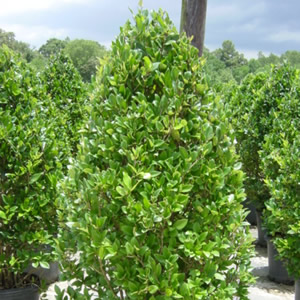
Waxleaf Ligustrum is an evergreen shrub with an upright, dense, and vigorous growth habit. This shrub makes a nice sheared hedge but can also be used as a small tree if trimmed up. The leaves are dark green, leathery and oblong. From spring to early summer it produces panicles of fragrant white flowers which are followed by round black fruit in the fall. Ligustrum is heat, drought, salt and pollution tolerant, making it an excellent choice for a variety of different landscape situations.
Exposure: Full to Part Sun
Water Requirements: Medium to Low
A very adaptable shrub with large, glossy, dark-green leaves, it will grow in sun or shade. Used as foundation plants, hedges, screens, and topiaries, it tolerates heavy pruning well. (6’ to 18’ height; 6’ to 8’ spread).
Allee Chinese Elm:
Ulmus parvifolia
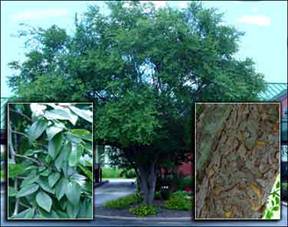
The Lacebark Elm is a fast growing deciduous tree that can get 40-60’ in height at maturity with a 25-40’ spread. Ulmus parvifolia gets its name because it bark sheds and reveals orange-brown patches, giving the trunk a lacey appearance. Lacebark Elm has good resistance to Dutch Elm disease and is also heat and drought tolerant. The foliage is fine-textured, toothed, and glossy green. This tree has an almost weeping appearance at maturity. Ulmus parvifolia is also known as Chinese Elm but should not be confused with another Elm species which is inferior to this species.
Exposure: Full Sun
Water Requirements: Medium
Natchez Crepe Myrtle:
Lagerstroemia indica x fauriei
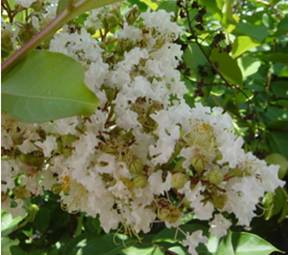
A National Arboretum introduction, Natchez Crepe myrtle is a cross between Lagerstroemia indica 'Pink Lace' and the first L. fauriei brought from Japan. This vigorous cultivar blooms from June through September for roughly 110 days revealing beautiful tiny white flowers; it can have up to 100-800 flowers per inflorecence, that are offset by stunning cinnamon colored bark. The Natchez Crepe myrtle has dark green oblong leaves that turn orange and red in the fall. This towering Crepe myrtle grows to a height of 20 to 30’ with a crown spread of 35’ at maturity. It is tolerant to heat, humidity, and powdery mildew.
Exposure: Full Sun
Edward Goucher Abelia:
Abelia cross
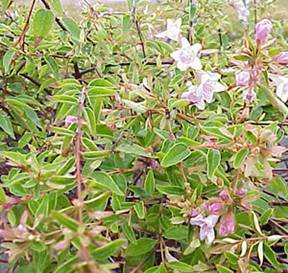
Pink Abelia can be an evergreen or semi-evergreen shrub depending on the zone. The cultivar grows 3-5’ tall and 5’ wide. Edward Goucher has a lacier foliage than A. grandiflora and can be somewhat less hardy. Edward Goucher is a result of a cross between A. grandiflora and A. schumannii. Pink Abelia produces lilac-pink flowers in the spring and a bronzy foliage in the fall. In winter, the foliage turns purple. In severe winters, some of the foliage may drop and tops may be killed back, but new shoots develop rapidly from the base in spring. Prune the dead twigs in late spring after growth starts.
Exposure: Full Sun to Partial Sun
Water Requirements: Medium
Blue Pacific Juniper:
Juniperus conferta
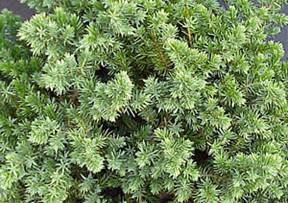
Juniperus conferta Blue Pacific is a trailing prostrate Juniper that only gets 12" tall but can get up to 6-8' wide, making a nice groundcover. Blue Pacific Juniper has dense blue-green evergreen foliage, a fast growth habit and good heat tolerance.
Exposure: Full Sun to Partial Sun
Water Requirements: Medium
Sargent Juniper:
Juniperus chinensis sargentii
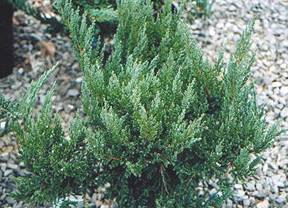
1' high by 3-5' wide. A dense, low spreader with rich blue-grey foliage in all seasons. Makes a tough ground cover in sunny areas.
The whiplike, broad-spreading branches have light green foliage that retains its color all year. Reaches 18 to 24” tall and 6 to 8’ wide.
Dwarf Yaupon Holly:
Ilex vomitoria nana
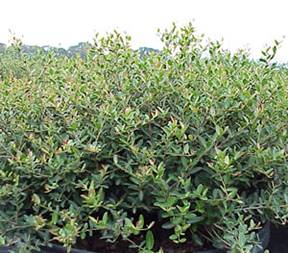
The Dwarf Yaupon Holly is a small evergreen shrub that has a refine and attractive look, it can get 5’ in height and 8-10’ in width. Dwarf Yaupon can be very formal when sheared, or a small mound if not. Often this shrub is seen as little “meatballs” in the landscape. Produces inconspicuous scarlet-red berries.
Exposure: Full Sun-Part Sun
Water Requirements: Medium
An extremely versatile plant, yaupon holly can be used as a foundation plant, hedge, screen, and even as an espalier and small tree. Similar to Japanese holly in leaf shape, a purplish tinge to the new leaves and white to gray bark help to distinguish it. In addition, the fruit of the yaupon is red and often borne in very showy clusters. Very tolerant of moist areas. (5’ height; 5 to 10’ spread).
Red Knockout Rose:
Rosa x 'Radrazz'
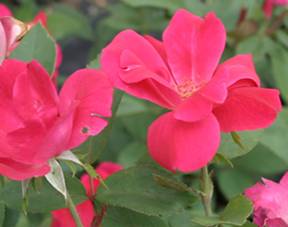
Rosa x ‘Radrazz’ is a floribunda type rose that was introduced in 2000 and is known for its compact size and resistance to disease, particularly black spot. This rose stays compact at 4' tall with a 3' spread, and has 3-4" diameter single blooms. These open apple red but will deepen with age. This rose will put on a show almost all year with continuous bloom from Spring until Frost. Does best in a moist well-drained soil.
Exposure: Full Sun
Water Requirements: Medium
Eleanor Tabor Indian Hawthorne:
Rhaphiolepis indica
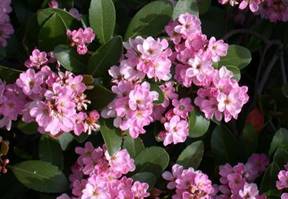
It is a tough, evergreen shrub that can be used in a hedge. It doesn’t wilt in the summer; its glossy leaves always seem fresh and cool. In late spring, it is covered with small, pale pink flowers. After a frost, some leaves turn a bright orange or red, but like live oaks, the old leaves remain until the new leaves push them out.
Indian hawthorns should be cut only in the spring, after flowering, because next year's flowers form on this year’s new growth. But you don't have to cut them back. You should only do so if want to keep them compact or to a certain height.
Deer love to browse Indian hawthorn.
Endless Summer Hydrangea:
Hydrangea macrophylla
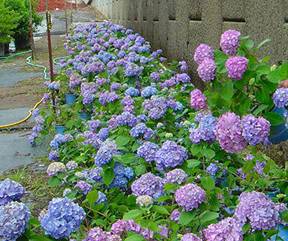
Blooms on both old and new wood for repeat-blooming color all summer long. In addition to repeat blooms, ‘Endless Summer’ Hydrangea is unusually hardy. It produces big, showy flower mops – clear pink blooms in alkaline soils and blue blooms in acid soils. Makes an excellent choice for foundation, specimen and shrub or perennial borders. 'Endless Summer' Hydrangea prefers a moist soil (not wet) in a place with afternoon shade and morning sun. Spring is the best time to prune.
Gold Mound Spiraea:
Spiraea japonica
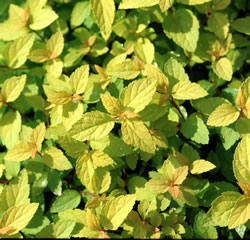
A hybrid of Goldflame, Goldmound Spirea also begins the growing season with foliage that has a reddish hue, but it’s a far more muted red. Foliage quickly fades to yellow, and later in the season may even turn a very light green. Flower blooms take the form of large clusters of very small, light pink flowers. Dead-heading may result in additional blooms later in the season. With this shrub’s tolerance of most soils, moisture and sun, it’s a popular choice among homeowners looking to add some brightness to their landscape.
Height: 2'
Spread: 2-4'
Growth Rate: Fast
Rose of Sharon:
Hibiscus syriacus
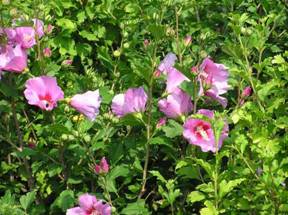
Rose of Sharon bushes can get 8'-10' tall and have a spread of 4'-6'. Blooms on Rose of Sharon can be white, red, lavender or light blue; some have double blooms. Most Rose of Sharon bushes bear small, deeply-lobed, light-green leaves. Rose of Sharon prefers full sun and well-drained soil.
Cast Iron Plant:
Aspidistra elatior
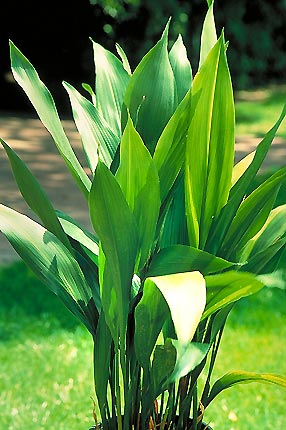
This perennial is as tough as its name! It will practically grow in the dark. Excellent for those difficult to fill areas in deep shade. Spreads by underground stems. Evergreen. Shade. Slow-growing bold blades to 2’ tall, forms clumps 2 to 3’ wide.
The leaves measure about 4 inches wide and 24 to 30 inches tall. It has inconspicuous purple-brown flowers that bloom close to the ground in the spring. Although it will grow in poor soil, Aspidistra performs best in porous soil enriched with organic matter. It also responds to feeding annually with an all-purpose fertilizer. To keep the plant looking its best, water it deeply during dry spells and cut unsightly leaves back to the ground.
