Introduction to the Internet and How it Works
What is the Internet?
When most people say the word "Internet" they are referring to a small part
of the internet known colloquially as the World Wide Web (WWW). The internet is
of course much bigger than just the "The Web". The word Internet defines itself,
it is a network which is "between networks", i.e. it is a network of networks.
So the internet is a huge collection of individual computers and computer
networks which all communicate with each other to share information. These
computers and networks are incredibly diverse in structure and location, yet
they all communicate, in what appears to the user to be, a seamless fashion.
The real structure of the internet, it turns out, is not actually the
collection of hardware that talks to each other but it is the ways and methods
that allow such a diverse collection of systems to communicate. Obviously in
order for all these systems to communicate they must follow some agreed upon
standards. These standards are called protocols and the first part of this
lesson really focuses on these protocols: What are they?, How do they make the
internet work?, How are they made?, etc. Following lessons will deal with those
specific protocols and standards that make the web work.
The Structure of the Internet
The system of protocols that make up the internet are based upon the OSI model or "Open
Systems Interconnect" framework for layered network architecture. The full
OSI specification describes a seven layer
network model but the internet is based upon a simpler 5-layer network:
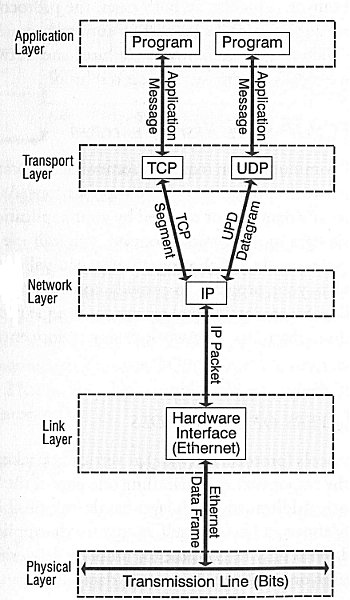 an application layer:
- Contains all server applications, such as web and FTP servers
- Contains all client applications, such as Web Browers
- Layer through which all protocols used between clients and servers act,
e.g.:
- HTTP
- FTP
- Telnet
- Gopher
- NNTP
- Ping
- Finger
- Pop, SMTP and other email protocols
- Layer in which peer to peer internet applications would function
- a transport layer
- Within the hosting computer
- Identifies and delivers network data to the correct application in the
application layer, i.e. makes sure you FTP data goes to your FTP client and
your HTTP data goes to your Web client, etc.
- a network layer
- The entire networks primary delivery system. It routes data
between host systems.
- manages network traffic-congestion problems related to routing and
delivery.
- a link layer
- In a PC this is your network interface card.
- primary layer responsible for checking that data is error free
- Transforms data the binary data required for transmission across the
physical layer
- and the physical layer
- The underlying hardware that makes up the network.
(This model exclude the presentation and session layers of the standard 7
layer model.)
This whole system then functions simply a stack of protocols. As each
protocol finishes with your data it passes on to the next protocol in the chain,
until it finally gets transmitted as bits down the physical network and then the
process starts over again in reverse at the destination host. Data is
handed between protocols via a process called " encapsulation".
In practical terms, when looking at data flow between layers, encapsulation is
the process of storing your data in the format needed by the next protocol in
the chain. All of this encapsulation is cumulative and the end result is a
complex packet of information to which each layer has added its own bit of
information. The diagram below shows this process and what the resulting
final parcel of data looks like.
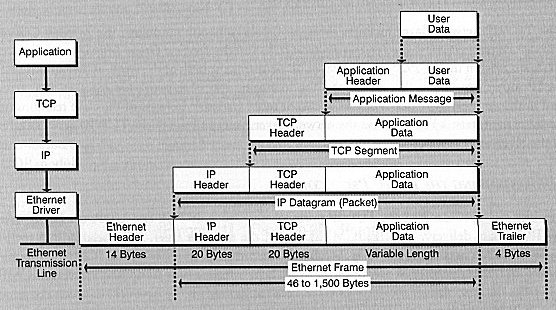
(Both of the images above are from: Web Programming,
Jamsa, Kris, Jamsa Press, 1996.)
Protocols, RFCs and Standardization
(At this point you should be asking: "So if the entire operation runs
on these protocol thingies, who the heck writes all of them?" and the next
question would then obviously be "And how do you get the whole world using and
running the internet to agree on a protocol once its written?". This section and
the linked readings attempt to answer these nagging questions.)
The bottom line is that there a number of agencies (some official, some
government agencies, some international agencies, and some just evolved from the
cooperative anarchy that is culture of "the net") which control very aspects of
what makes everything on the net run. As far as the networking protocols
we have discussed here, a majority of these are generated by various working
groups under the IETF or "Internet
Engineering Task Force" (be sure to read at the very least the overview on the site and also
the section 1 of " The Tao of
IETF" to understand what IETF is and does). Some of the other agencies
that contribute to these protocols are:
- ANSI - American National Standards
Institute.
- ARPA - Defense Advanced Research
Projects Agency
- ISO - Intenational Standards
Organization. (They have a discussion of how their
standards are set.)(You might be familiar for instance with the ISO
character sets.)
- ISOC - Internet Society. This is the
parent organization of the IETF and other standard setting groups.
Most standards are set via a process using RFC's (Request For
Proposals). These are documents describing proposed standards which are
sent out publicly to allow all interested parties to give feedback on the
proposed standards. The process of using RFC's was started in 1969 by ARPA (now called DARPA) to set networking
standards for military network systems. (If you are not aware of the
history of the internet from its roots out of military research see this site.) For
RFC's there are 2 Tracks:
- Standards Track:
- Proposed Standard – Stable but "deploying … of such standards into a
disruption-sensitive environment is not recommended"
- Draft Standard – A final specification with changes only like to address
very specific problems. "it is reasonable … to deploy … into a
disruption-sensitive environment."
- Internet Standard – A draft standard that has had "significant
implementation and successful operational experience"
- Non – Standard Track - these RFCs generally dont make protocols directly
but deal with topics that are:
- Informational,
- Experimenal, or
- Historic.
You might think that the internet is then run using protocols that have
reached the RFC "Internet Standard" but not many RFC's have made to the finished
"Internet Standard" level, only 61 of the 3042 submitted since 1969. Thus
actually much of what the internet runs on is RFCs at "Draft Standard".
(The best description of how these RFC's are used and how standards are set
are given in 2 RFCs (I guess you could call them Meta-RFCs): RFC number
1920. (At a minimum you need to read sections 1, 2 and 5 (n.b.
section 5 has a nice map of the standards track) of this document.) and RFC 2026 (At a
minimum you need to read sections 1.2, 4 and 6 of this document.) Reading
these is a good introduction to what an RFC is and how one is written. You
might also want to check out a technical, standards RFC, I might recommend RFC 2616 the HTTP
protocol since we will be looking at that in more detail in our next lesson.)
Meta-Sources, i.e. sources that list or describe other sources: