
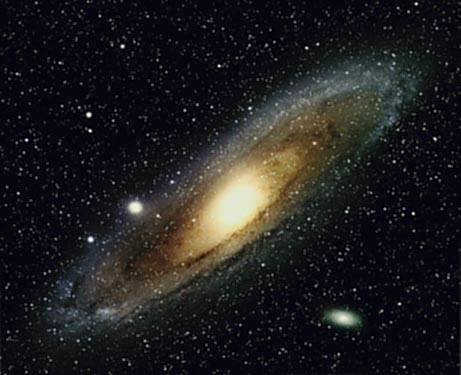
The galaxy contains about 100 billions of stars and has an estimated diameter of 120,000 light years. The apparent size of the galaxy is 4 degree, 8 times bigger than the full moon.
Due to its apparent size the view through a telescope is someway disappointing, only the core is visible and shows like a bright but unresolved patch of light.
With widefield telescope it is possible to appreciate the size of M31 and it also possible to image it as a whole.
Close to M31 two more small galaxies are visible, M32 and M110. Both of them are satellites of M31.
This picture was done during a very bad night from luck point of view. I tried 18 shots before realizing my new autoguider had a wrong cable and could not properly work. Eventually i lost M20 behind some trees and i was calling it a night when i realized (at 1:00 am) that M31 was clearing the trees on the northern sky. I decided to give it a shot and it was worth it.
Date: 7-24-2000
Location: Fremont Peak
Telescope: 80mm refractor f/5 piggybacked on Celestar Drive
Exposure: Composite of one 30 minute and one 45 minute exposures. First attempt in my life i tried this technique.
Film: Fuji Super G 800
Drive: Manually
Note: The night was perfect. A thick layer of fog was covering the Monterey bay and all the lights below. It could not be better than that.