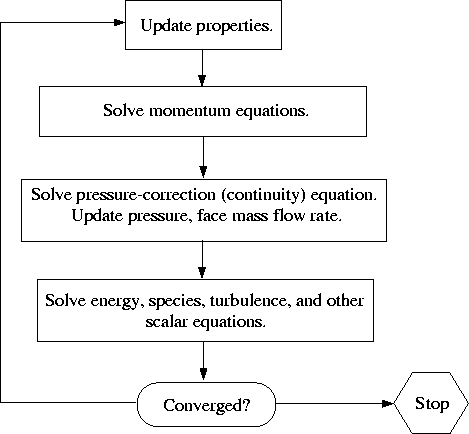
When the result is converged to a solution, data is exported to a post processor. The post processor is used to display the geometry and the grid with the solution of the flow behavior, most of the post processors have outstanding graphic capabilities with great visualization tools. The post processor can show animations of particle tracking, contour plots, vector plots.
This visualization of the numerical solution is very important for the interpretation of the results, given that the CFD code will solve the problem with the assumptions and the input values that the user set the results must be examined very deeply before they are believed. The result of the CFD analysis are believed based on the experience of the user, the flux balances reported in Fluent and a comparison with similar simulations and wind tunnel data.
Wind tunnel and raod test are traditional predictive tools used in the indusrty to evaluate aerodynamic performance of vehicles. Wind tunnel testing in the automotive industry does not produce totally reliable results, there are several sources of error. The reynolds number effect and the errors due to the fact that the road moves relative to the car, whilst the floor of the tunnel is normally stationary are the most representaive errors in my personal point of view.
The Reynolds number effect is due to scale model testing. It is common to test scale models instead of full scale models in wind tunnel test, the reason is that it is expensive to build a full scale wind tunnel. As seen in figure 5, the scaled model will have a greater portion of laminar boundary layer, and consequently a lower drag per unit of area than the full scale model. To correct this effect, the model could be put in a faster stram of air, this will increase the Reynolds number (?Vl / ?) and move the transition point forward, but unfortunately a 1/10 scaled model would need 10 times the speed of the full scaled model, we are talking of very high speeds that are very expensive to construct and to run. Another way to tackle the Reynolds number problem is to pressurize the tunnel to increase the air density. This solution is extremely expensive given the dimensions of the tunnel. For automotive applications the only solution is to build an wind tunnel large enough to accommodate a full size car.
The other issue in wind tunnel testing is the moving road problem, in real conditions the air is still and do not present relative motion with the road, so a boundary layer is not developed on the road. In wind tunnel testing a boundary layer is created on the floor affecting the results. One way to deal with this problem is the moving belt method that consists in a belt that runs below the tyres of the car, The belt is normally acompained with suction holes that must be adjusted (see Figure 6).
CFD simulations have the advantage that can easily deal with these wind tunnel problems. As in any test, the results must be under study to ensure that they are reliable. It has been found that CFD analysis cannot be used as the main tool to predict flow behavior. The CFD solutions are cheap to achieve in comparison of the large cost of a well equipped wind tunnel, but mixture of both must be used to have reliable data in flow analyses.
As a conclusion, the accuracy of numerical solutions is dependant on the quality of the discretization used, the grid generation and the turbulence model chosen. The numerical solution must be under study and must be compared with wind tunnel data (or similar analyses) in order to deliver a credible result.

MSE Automotive Engineering