 |
| Shirley Reiff Howarth |
| Interview with Shirley Reiff Howarth, art historian and expert on corporate art collections.
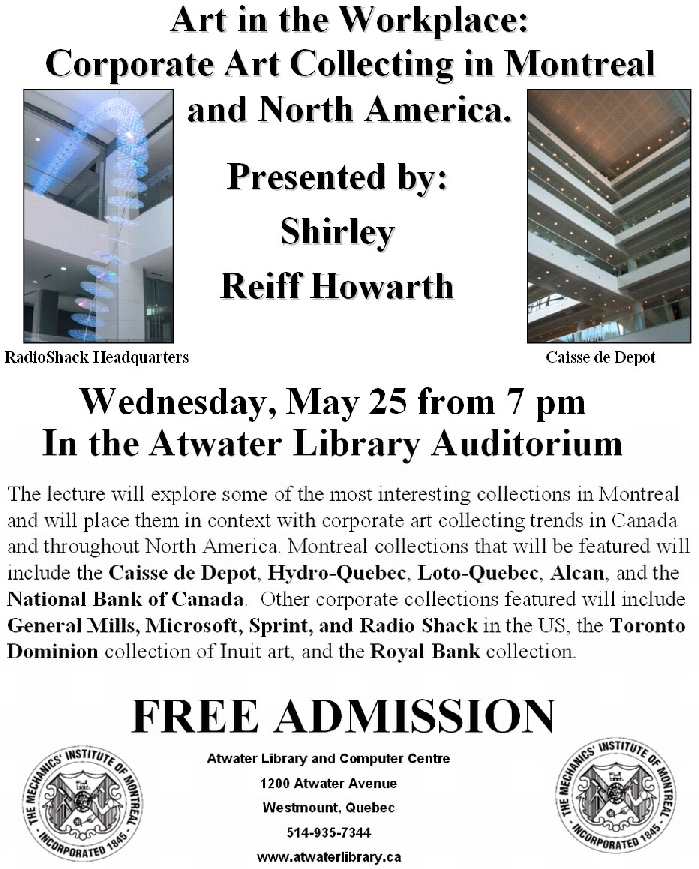
The interviewer was Bruce Peterson, the coordinator of the Atwater Library and Computer Centre Speaker Series, 2005. Shirley Reiff Howarth�s lecture was scheduled for Wednesday, May 25, 2005. The subject of her lecture was Corporate Art Collections. The interview the transcription of which is presented below took place in the Atwater Library and Computer Centre in Montreal on May 22, 2005. |
 |
| Interview follows this announcement.... |
| Interview with Shirley Reiff Howarth, art historian and expert on corporate art collections.
The interviewer was Bruce Peterson, the coordinator of the Atwater Library and Computer Centre Speaker Series, 2005. Shirley Reiff Howarth�s lecture was scheduled for Wednesday, May 25, 2005. The subject of her lecture was Corporate Art Collections. This interview took place in the Atwater Library and Computer Centre in Montr�al on May 22, 2005. Personal Background Peterson: Shirley Reiff Howarth, tell us a bit about your background. Howarth: My education was as an art historian. And my professional experience has been both in the museum, publishing, and teaching world. After receiving my Master�s degree in art history, I worked in the museum world for fifteen years as a curator, then a museum director. I was the founding director of the Tampa Museum in Florida, which gave me a view of the administrative side of the museum world. I then taught art history, photography, and arts management for seven years at a small liberal arts college which helped me explore the theoretical side of the art world. But after many years of working on the administrative side, I was getting farther and farther away from the art which I loved. So I decided to leave the museum world as an in-house person, as a curator-director. At that time there was no information on corporate art collecting, so I began to publish a Directory of corporate art collections. Nobody seemed to know much about this field at the time � about art in a work environment. I was asked to curate an exhibition that was sponsored by General Mills Corporation, and I met the company curator and learned that they also had an extraordinary art collection -- that was the first time that I was aware that there were many fine art collections owned by corporations Possible course Peterson: Wouldn�t you like to present your experience and this information as a course somewhere? Howarth: It seems like it would be a useful study. There�s a similar course being taught at New York University called the Business of Art. It is in the adult education program and the class meets weekly at art galleries in New York City, where they interview people working in the art world and discuss the problems and challenges of commercial galleries. The corporate art environment is an interesting segment of the art world and few people know very much about it. It is very different world � it is nothing like the auction world, the gallery world, the artist�s world, or even the museum context. And yet it has grown into becoming quite an important force in the arts. Peterson: And it�s not described enough in the newspapers or magazines? Howarth: No, the public really doesn�t understand why companies are collecting art and why they would even do this as a business activity. Peterson: It�s seems contradictory with what people think of as a corporation�s prime goals. Howarth: Yes. Peterson: Do you think you could give a course here in Montr�al, at Concordia maybe? What department would that be put in? Howarth: Well that is the question. What category does it fall under? Are we talking business administration or are we talking about art history? We�re not talking just about companies� buying art work, because it would include business sponsorship of the arts. We�re talking about the whole idea of the business world and the art world working together and collaborating to help support and promote the arts � using art in a more active fashion. I think such an approach would be of interest to people in the art world -- gallery people, artists, development people -- to know how this world functions, to know how to approach corporations. There have been some MA and PhD dissertations written on corporate art collecting. They have come primarily from the art history departments For example, the curator at the Alcan collection, Jo Ann Meade, has been the curator of that collection for many years and was responsible for selecting the works of art at the beginning. I will be talking about that collection in the lecture here at the Atwater Library and Computer Centre on Wednesday. She did her doctoral dissertation for McGill University in 2000. At the beginning, she had a difficult time getting her topic approved.. It was a topic that was considered inappropriate for an art historical study. But her advisor fought to have the topic accepted and the project was finally approved. And several theses have been written by Concordia students, as well. JoAnn Kane, the Curator of the Banque Nationale collection wrote a thesis about Quebec corporate collections for UQAM. So there is interest from the university environment to studying corporation art collections because it is a trend, it is a phenomenon�.. It is a phenomenon that is just beginning to be understood, acknowledged and accepted. Peterson: Maybe such a course would go into the adult education department? Howarth: Yes, the one at New York University is in adult education. They offer another one through their arts management program. I taught for seven years at a small liberal arts college fifteen years ago. I put together an arts management program for them. We covered issues such as copyrights, censorship, grant writing, sponsorship, public art, art tourism,. It cut across many disciplines and departments. Corporate art curatorship is also a new field for potential employment. For students who are majoring in art or art history, they need to know all of the possibilities for finding employment, and many of them would never think of that as a possibility. When I came out of college with a major in art history, there were few choices. There was university teaching, in which a PhD was considered essential, and an MA the minimum�. Or there was museum work. Even working for a gallery was not obvious since that was considered to be part of the business world. You might work for someone in a gallery, but again, since it�s a business most arts graduates didn�t know much about that. The education in art history doesn�t give you any experience to understand the business side. The Directory Peterson: Tell us a bit about your Directory. Howarth: It started in 1983 as a result of the realization of the growing importance of corporate art collecting. Coming from the cloistered museum world, this came as a revelation to me. I began to realize that there were hundreds of corporations with art collections and there was absolutely no reference to this world at all. So in documentary fashion, I started the directory with 300 collections that I had been aware of around North America. The directory has now grown to include over 1300 around the world. I describe the basics: � the contact people for more information � what the company collects � the approximate size � when they started it � what the business entity is � whether it is a corporation, partnership or a foundation � its legal structure � what has been written about the collection � a bibliography � past exhibitions � catalogues So the Directory has continued for over twenty years now. Every other year I update it. The Meaning of �Collection� Peterson: What problems have you encountered in the point of view of people when you were researching your directory? Howarth: One of the problems is that people consider a �collection� to be a group of art works in the same room in a gallery. So when I would telephone a corporation and ask about their art collection, I would sometimes get the answer, �We don�t have an art collection� because they were thinking of a single room, a gallery. They would say that they had a few things hanging on the wall, but it�s not a �collection�. So that word �collection� is a misnomer. Unfortunately, there isn�t a better term to use. The company�s �collection� might not only be displayed throughout a single building; it might be displayed across the country. For example, JP Morgan Chase, which has offices and branches around the world, has works of art in all of these locations. They are managed by the curator in New York. The term corporate art really means art in a business environment. Peterson: Does your Directory deal with art in smaller businesses as well as the art of �corporations� in the narrower sense? Howarth: Yes, it really deals with art in a business environment -- in an unexpected environment. For instance, there are hotels and restaurants and foundations that have art collections. The term �corporate art� is much broader than just �corporation�. For instance, some law firms have art collections. They�re not corporations of course; they are partnerships. The term �corporate art� has become a generic term. The Cartier foundation is included in the Directory, as is the New York-New Jersey Port Authority because they have a very active program of commissioning art for their facilities. And let�s face it, art is not one of the responsibilities of the Port Authority. The M�tro transit system here in Montr�al has commissioned art. When a new station is built, they will commission an artist to create a work of art. This is not perhaps a collection in the usual sense, but it is art in public spaces�. It�s art in the environment�. It�s installation art�. It�s art commissioned for specific sites. The Directory describes theses programs also. Not public art of a general nature, because all cities have public art. But if they are governed by an entity like a port authority, then yes, they are included. Convention centres have collections of art�.airports, too, have art collections. Airports are usually quasi-government institutions. The definitions of course vary from country to country. That�s the real problem I ran into. There are wonderful collections in Asia. Are they private companies? Are they government companies? Are they private, personal collections? Here for instance Loto-Qu�bec has a wonderful collection. It�s in the Directory because it is a business, but it is also quasi-governmental body. That�s why for each company in the directory, there is a category for the �Governing Authority�. Peterson: In Canada there�s the expression �Crown Corporations�? Would they be in your Directory? For example, Air Canada. Howarth: Yes, they would be and are. Also the City of London is a corporation. So that is included. It�s not a museum, but it has its own collection. The City of Toronto has an art collection. Loto-Qu�bec has a gallery of art in the lobby area as you go in the building on Sherbrooke Street and it also places art in the work place for employees. This is a challenge each company has to deal with individually. Some companies have exhibition spaces. The Banque Nationale Tower, near Victoria Square, has moveable partitions in the lobby for exhibition purposes. It is always difficult to make a collection available for viewing by a wider public. It can be disruptive and a security problem if the public is allowed to wander through the work space looking at art works. It can be very distracting for the employees. It becomes an issue of accessibility that has to be solved with each company. Peterson: Does your Directory come out in paper form? Howarth: Originally it did. Up until the mid 1990s it was a bound book. But the latest edition, with a total of 1300 collections, is on CD, so you can see that it has grown considerably. Not only has the trend grown, but the Directory has grown, and on a CD you can take advantage of flexible searches, and you can locate information by artist, by country, by any word you wish to use. Peterson: How does one purchase it? Howarth: It�s sold on the Internet. You can just search for �corporate directory� using any of the popular search engines, or go to our web site at: http://corpart.cjb.net. Peterson: Do you have any competition? Howarth: Surprisingly, no. In the first few years, I was worried that some of the large art magazines would copy the idea and begin to produce a directory, but that proved to be an unnecessary concern. This type of publication does not appeal to large publishers because it has a small niche market. The big publishers need to sell hundreds of thousands of copies of a publication to survive. I sell a few thousand, primarily to artists, galleries, museums, libraries. Peterson: It might be an important part of that course at a university? Howarth: It�s another source of information for people looking for information. If artists wish to go beyond the creation of the work, to then sell their work, they need another source of information like the Directory. Museums have a limited usefulness because museums are generally interested in acquiring works of art from established and well-known artists. Even a contemporary art museum has a limited budget that it can use for acquiring art. So it leaves the artist constantly searching for buyers and money in order to survive. Peterson: Are all artists really poor? Haven�t some of them shown real skill at making money? I mean was Picasso sitting in a little garret in poverty? Howarth: No, certainly not. Some of the successful living artists like Lichtenstein, Oldenberg, Rauschenberg, -- these are practically corporations in themselves. Their works sell for thousands and hundreds of thousands of dollars. I may not agree with this mixture of commerce and art, and the fact that most artists must not only create the work of art, but also try to sell it -- but it is there. It is part of our society. Peterson: Do the corporations themselves produce catalogs of what art works they have already collected? Howarth: Occasionally. Of course they make an inventory for insurance purposes. But that�s not generally public information. There aren�t many catalogs of corporate collections. There are some exceptions. Toronto Dominion Bank, for example, has a superb collection of Inuit art. It began early as an attempt to acquire the best, and to preserve the tradition. Power Corporation has also published a book about their collection. One of my frustrations is that many people want to use the Directory just to do mass mailings, or to send out a promotion. As a resource, the Directory is more than that. In the first place, no company is going to purchase art from somebody who just walks in off the street without doing his research. It�s like applying for a grant. You don�t just apply for a grant without knowing what the guidelines are. The Directory attempts to show what the company is interested in, to give a picture of the company so that you can focus on which ones would be the most likely to be interested in what you are producing. Peterson: Could you estimate how many new corporations go into the Directory with each edition? Howarth: Probably about a hundred new ones. It�s a nightmare to keep updated because of the mergers and because of companies going out of business. Like the JP Morgan � Chase merger, they both had impressive and large collections that had to be combined. Some collections disappear completely like Seagrams. This was a superb, well thought-out collection assembled by people who understood and knew art. It had been assembled over many years, so that the sum total was larger than the individual parts. The collection was dispersed when it was sold at auction last year. Every corporate collection is very different. A lot of them are not collections in a true sense. They are simply assemblages of art purchased to decorate the walls, to make a pleasant environment for the employees. The true collections that have an integrity and coherence tend to have been of long standing. For example, Fleming�s Bank in Scotland has a collection of Scottish art. It is probably the finest single collection of Scottish art. When that bank was sold and merged with an American bank, they protected the collection and created a foundation separately, so that the collection is still intact. Examples of Corporation Art Collections Peterson: So that�s what you would probably advise a corporation to do long before the spectre of a merger begins? Howarth: Yes. To plan ahead to assure that the collection stays intact�. by creating a trust or foundation entity that will live beyond the life of the company. Every corporate collection is very different. That�s what one must remember. Here are some examples of the wide-ranging differences in the orientations of corporations. The Progressive Corporation � high risk insurance There is one corporation, the Progressive Corporation, that specializes in high-risk insurance, automobile insurance. Their art collection is purposely meant to astonish. Progressive Corporation Statement: �The collection is designed to surprise, to please and even provoke employeees. The curator of the collection, Toby Lewis said, �What I don't want is the art that has the wall paper effect. This is a challenging collection.� While encouraging originality the art collection shows respect for all people. The art in the collectio is often provocative, has forstered discussions and, sometimes, passionate controversy through the years.� The UBS Collection (Swiss bank): Here�s another orientation: UBS Statement: �Art reflects who we are as a society, as an individual, and as an institution. It can remind us of our collective heritage, or hint at our future. The same goes for us. The UBS Art Collection reflects the many paths our business has taken as we have grown to become one of the world�s largest financial institutions. It incorporates the major works from our former collections in both the US and Europe, mirroring the businesses that have become a part of us in that time. We actively want to reach out and share our passion with our clients and the public.� UBS is a Swiss bank. They have an extraordinary art program. They merged with several other banks. They also purchased Paine-Webber in New York City, which had a very important art collection. The RadioShack Approach RadioShack has just completed construction for their new corporate headquaters. It opened just a month ago in downtown Fort Worth. I shall read you their mission statement. This is a branding collection. From the beginning, they wanted to consider including art in their new headquarters. RadioShack: �When we first dreamed about creating a new home for RadioShack, we were adamant about its transcending mere bricks and mortar. Our Riverfront Campus is designed from the ground up to be an active driver of our business strategy.� They are exploiting art, using it as a part of their business strategy. RadioShack says about itself, �It�s all about creating a culture at Radio Shack that is open to new ideas, driven to better serve our customers, and forever learning and growing.� They commissioned works of art that either used Radio Shack components or reflect Radio Shack business in some way. Some people would be offended by that, saying that companies are forcing the artist into being a publicist for the company. But the challenge for RadioShack was to find artists who would be willing to work within those parameters. They had a very positive response from the artistic community. The artists enjoyed it thoroughly because they had an opportunity to think in totally different ways. They were given access to RadioShack products, technology, which is cutting edge, and they created works of art that reflected RadioShack in some way. These were simply art commissions and they were hired to work within certain parameters. RadioShack did this as an exercise because they wanted to promote out-of-the-box thinking. They wanted to reflect the idea that RadioShack does things in unusual ways. Their mission statement, �The art at the Riverside Front Campus is intended to encourage people to use both sides of their brains.� It�s incredible for a company to put that in a mission statement. They are openly encouraging creative and original thinking. The Microsoft Corporation Corporate art collections can reveal a great deal about a company and its approach to business. For example, Microsoft feels that their main software users are young, in their twenties and thirties, and well educated and somewhat liberal. That is the picture of their audience. So they tend to purchase artworks from emerging artists in their twenties and thirties. This helps to build customer and community relations. Microsoft Mission Statement: The Collection�s mission is to help create a positive work environment and appealing business setting at Microsoft. Presenting original art in the workplace offers an important respite, inspiration, and challenge for the thousands of people who interact with the Collection every day. Art inspires creative thinking and offers people a chance to see life from a different perspective, which can in turn foster elements essential to a company�s success. Microsoft sees its customers as young and and educated. In one of their statements they point out that they are interested in art by artists in that group: Microsoft Statement: The Collection fosters creative excellence of significant reigonal and national scope by presenting and interpreting international contemporary art of the highest quality by emerging and mid-career artists. That�s using art in a way that most people would not expect. We�re not talking about investment here. We�re talking about reflecting the company�s values. For example, look at some of the conservative English banks. The art works they have on their walls are portraits of their former CEOs. Some of them of course go back to Gainsborough, and the company�s are very conservative. It�s not exploiting the art the way earlier collections might have done. Instead, the art expresses the company�s values in a much more subtle manner. History of Art in the Work Environment Peterson: Would you sketch for us, please, the history of art in the work environment? Howarth: The history of art in the work environment has undergone a very interesting progression. In the earliest companies, art was used to decorate the board rooms of the largest and most conservative companies. In the early part of the century, art was used for blatantly self-serving reasons. For example, the railroads would use art to publicize themselves. They would commission artists to go out with free rail tickets and hotel accommodations and spread the word: show the American West, the Canadian West. I think Benedictine Brandy for a while had competitions and the artists would paint bottles of Benedictine Brandy or include them in paintings. They were using art very much as part of a marketing plan. It was commercial art. That was the beginning. Then it became image building. IBM and other companies used art to reflect the fact that they were reputable businesses, the supporters of the arts. Then, in the late 1980s, it became such a popular phenomenon that every company had to have a corporate art collection. If you were in the Fortune 500 category, then you had to have an art collection. A lot of misguided purchases by the CEO took place at the time. But there were a lot of wonderful things happening, also. For example, John D. Rockefeller assembled a world-class collection of folk art for Chase Manhattan Bank. During the 1980s and early 1990s there was an incredible boom in corporate art buying. That�s when corporate collections began to dominate and influence the art market because they had the money and were buying large quantities of art. There was a general economic boom at the time. A lot of companies began collections that almost bankrupted some companies because the individual CEO would become so enamoured of certain works that he would buy everything in sight. After the collapse in the early 90s and the mid-90s, everybody began saying that corporate art was dead. That of course was nonsense, because it had always had a stronger foundation than was apparent on the surface. There were a lot of companies that were doing the right thing. They were buying art for the right reasons. They were doing it to inspire and to create enjoyable and comfortable work environments. I think today that corporate art buyers are a lot wiser. In fact, more and more museum people have defected to the corporation art world. For example, the former Director of the Contemporary Art Museum in Chicago, a man who wrote his PhD dissertation on Matisse, became the curator of First National Bank art collection several years ago. The Importance of Patronage Peterson: You have used the expression that the corporations are the �new Medicis�. That�s a wonderful expression. Take the Medici family. They may have promoted and sponsored art for self-glorification. But aren�t we thankful to them despite their wrong motivation? Howarth: I�m a great promoter of art patronage. I think the world we live in, and the history we have as human beings has not been kind to artists. If it hadn�t been for the various patrons, like the church, the popes, the Medicis, the world would be a much poorer place to live in artistically. Peterson: The churches are a good a example. Much of the art that they commissioned serves up the message of the church. Isn�t it PR? Howarth: Yes, exactly. I do get a little bit irritated and frustrated because many artists still view creating art for corporations as a kind of prostitution -- that the artist has prostituted himself by creating this work of art and selling it to a corporation. There are some artists who won�t even sell their art to a corporation. Also, I think that a lot of people in the art world discredit corporate art collections � saying that there�s nothing important being done there. That�s false. The corporations are a force in the art world. It has had a great impact on the art world. It is up to the artist to decide for himself. I don�t view it that way, as some sort of selling out. It is indeed a creative experience no matter what the motivation. The creation of a work of art is the important point � not who chooses to buy or exhibit it! Peterson: The Sistine Chapel is a PR work. Howarth: Yes, poor Michelangelo had to go to extraordinary lengths to please the Pope, but he created an extraordinary work of art. He knew he was dealing with a patron who had a particular message. The Role of Foundations Peterson: You said, �they buy the artists�. Do corporations have programs that foster artists by taking them under their wings? Howarth: That�s probably not so typical. I can�t think of any company that has done it that directly. They support artists on individual commissions. If a corporation is building a glorious new building, they want artists to create wonderful new works of art for it. The guidelines, by the way, are usually rather flexible. So the artist comes back to the corporation with various proposals that are then selected. Some of the types of support you mention -- direct support of artists through providing studio space -- are more the interest of foundations. The Cartier Foundation is a separate division of the Cartier Company in France, not only supports the arts, but they have a tradition of supporting actual art creation, providing stimulation and support for artists. They created sculpture grounds with studios for the artists. In Europe there are a couple of arrangements like that, but I don�t think I�ve ever seen anything in North America along the same lines. Governments and corporations Peterson: Governments have museums and collections of art. Some governments have been criticized for their purchases of art. After all, opposition parties can have a field day criticizing the expenditure of public funds on �questionable art�. One thinks of �The Voice of Fire� that was much talked about in the newspapers a few years ago. Do corporations sometimes make mistakes and admit doing so? Howarth: Yes, they do. When a new CEO comes in, he will sometimes sell purchases by an earlier CEO or may even eliminate an entire art program. The new CEO�s announce that they have to tighten belts, cut back, eliminate frivolity, and sell the art collection. This can happen when the company�s profits are down. Unfortunately, often the first thing to go is the art collection.. That�s the one of the drawbacks in the world of corporate art collecting. It is subject to the vagaries of business cycles. Corporations and Museums In a museum, the work of art is protected � it will probably not be sold. It�s in the museum for posterity, whereas, the corporate environment is much more speculative. It is subject to the business the company is in. If the business goes through an economic downturn, then the collection is in danger. There are many examples, one of the most interesting is the Drambuie Collection. Drambuie Collection This is a collection of the finest material from the time of Bonnie Prince Charles � glassware, memorabilia, and paintings. It�s a superb collection -- a family collection. Drambuie was the favourite drink of Bonnie Prince Charles, and as supporters of his cause he gave the family exclusive rights to produce it. The company and the production of Drambuie has continued down into the present time. However, recently, the family sold the company � even though they still continue to be involved in the operation of the company, there is a possibility now that this collection will be sold and dispersed. It has already be announced that the collection of Scottish paintings will be sold at auction later this year or early next year. There is an attempt underway to protect the Bonnie Prince Charles portion of the collection, to put it into some sort of a foundation. But that�s the problem. When a collection is assembled under one management, it can be sold when the company merges or is sold. So there�s no security or continuity. Speaking to architects in Paris Peterson: You�ve just come back from Paris. I hope you enjoyed the food over there. You were there for a conference. What kind of a conference was it? Howarth: I was invited to give a speech to the British Council for Offices, which is a professional association of architects and real estate development people. This was their annual meeting. One of the sessions was on the benefits of art in the work place. It was an attempt to persuade and help architects and developers see the benefit of considering art as an essential part of the buildings they�re building -- Art is not an add-on. Peterson: Why do they have to think about this ahead of time? Howarth: In the case of many office buildings, the art is purchased later and is just hung on the walls. But it makes for better buildings if the art is considered an integral part of the building from the beginning. Architects who build office buildings usually think in terms of functionality. They want of course to create aesthetic buildings, but that doesn�t necessarily mean that the buildings are ready to accommodate art works. A work of art does not always enter their consciousness. I find that frustrating because an art work always adds to a building�s environment. Many architects view art as an intrusion onto their design. I think it is helpful if they think instead, of art as a benefit. It makes their building more desirable. So I�m not saying that an architect should build in a gallery space with each new corporate building he designs. What I�m saying, is that he should take into account the very real possibility that art will be displayed in this building, in the offices, in the board rooms, and in the cafeteria. These public places are good locations for special commissions of art. They might want to consider commissioning a special mural in the cafeteria, or in the board room or in the atrium you might want to display a beautiful tapestry. Peterson: What does the architect need to think about ahead of time? Howarth: Art in the workplace has certain challenges. For example, you can�t have works of art with lots of projecting points. You can�t have things that are hazardous. If works are subject to light damage, anything on paper like photographs or prints on paper - soon enough the works will be completely faded out because often you can�t control the amount of light in an office environment. Although that is not as much of an issue today as before, cigarette smoke damages works of art, so you have to take into consideration that some locations may not be suitable for artworks. After all, an office environment is not meant to be a museum, so in placing art, you have to think about how it can be integrated into the workplace � not take it over! Art in the Work Place � and the Workers Peterson: CEOs make decisions about the art. Do the workers themselves have any input into the choice of the art? Howarth: Ah, yes. That�s an important aspect. Thank you for bringing that up. In the early days, no. It was the CEO. What he said was law. It has become much more democratic now. Just because the CEO is the head of the company, it doesn�t necessarily mean that he or she is knowledgeable in art selection or has art expertise. The trend now is to have art selection committees made up of interested employees, as well as art people, administrative people. I think that that�s a good idea. In many companies, like General Mills, that have extensive art programs, the employees select their art in their own offices. That�s pretty much the trend here in Montr�al, too. In the public spaces, the curator is in charge. But within the office environment employees can select something they would like over their desk. It is only common sense -- if a work of art irritates you all day long, it�s counter productive. In fact, in some companies the art work becomes a very important aspect of the life of the employees in that company. They begin to love the art environment. Some administrators have suggested eliminating all the art from the company, and the employees become outraged. I�ve heard of one case where a company removed a work of art from an office, and the employee was so outraged that he protested vehemently. It escalated to the point that the employee actually resigned because he felt that the company was insensitive and that he did not wish to work for a company that cared so little about the well-being of its employees. A company does that sort of thing at its own peril. Every business is different. That�s what is fascinating about corporate art: every corporation is different -- like individuals. Some corporations think more locally; some have large numbers of branches around the world so they think more globally. For example, in the case of Sprint, most of the art was purchased from Kansas City artists. Even though Microsoft has a global reach, they tend to buy much of their art from regional artists. Other companies like Alcan acquired art from all of the countries where they have business interests. Humanity is creative. No matter what society evolves into, there will be individuals who are creative � who will reflect what the society is. You wouldn�t expect a progressive mission statement from more conservative institutions like banks. They will think more in terms of the value of the work of art. Misconceptions about Corporate Art Collecting Peterson: What are some of the misconceptions or myths that you would like to see addressed in the area of corporate art collections? Frivolousness of Art Howarth: One attitude towards art in the corporate environment, and it�s more a problem in North America, is that art is viewed as a frivolous pursuit, an �add-on�. By contrast, it is a part of life in Europe. It IS life. The government supports museums. There are subsidies for artists. Even in Canada there are subsidies for artists. In the States it is viewed as an unnecessary expense, an add-on. My sister, for example, is a classic example. She feels that museum people are a bit weird. The fact that such people spend their lives caring for beautiful and irreplaceable works of art is irrelevant to such people. In this way corporate art is a beneficial trend because it is taking art and putting it in the work environment. People spend forty hours a week in this otherwise stressful and often uninspiring environment. If you can look up and see a beautiful work of art, it can help change your focus. I think it can be a very strong force in bringing society to the realization that quality of life is important. Art is only an investment Another myth is that the art is bought for the investment value. Stockholders might complain that the company should be spending money to make more money for the stockholders instead of on art. But studies show corporate efficiency, productivity, and creativity increase when art is put in the work place. Corporate Interest in Art is Dead Another myth is that corporate art is dead in the sense that corporations have stopped collecting. That myth is fostered by the media who always report that collections are being sold or dispersed. A few years ago Readers Digest sold the most important paintings � the stars �of their collection because the works were becoming too valuable to leave hanging in corporate offices. They became an insurance and security risk. All the media said �Ah, they�ve sold off their collection.� That was just absurd! They still had most of the collection. They still had hundreds of works hanging throughout the corporate facilities! Art is Wall Paper Another huge myth is that corporate art collections are all visual musak, art as wall paper. That�s nonsense! There IS a lot of terrible art hanging on office walls, but there is also a lot of art in offices that is very good Corporations don�t have to cover their walls with reproductions and �paintings on velvet�. Good design doesn�t cost any more than bad design! You can purchase good original works of art for the same cost as reproductions if you do it right. So many businesses try to cut corners by putting up reproductions, whereas in the long run, they are wasting money, because at least original artworks will continue to hold their value. Future Book I am presently involved in book project. I�ve teamed up with the principal of a firm that works with companies around the world to acquire and commission art for their offices. For the past 20 years, he has worked with some of the most important companies around the world such as Pfizer and Glaxo/Smithkline. We have decided to co-author a book about art in the working environment. It will be from a different point of view � not a history of corporate art, or a book filled with statistics, but a visual study of the many different ways that art has been used in the workplace. And I use the word �use� with reservation. That implies that it is being exploited, but that is certainly not our intent. I think the nature of art is so important, so earth shaking, that it creates an experience. To bring art directly into the corporate environment, there is no doubt that it will have an impact, whether it�s the intended impact, or not. It can even be somewhat disruptive. A few years ago, one of the banks in the Midwest purposely bought art that was controversial. They had a curator who was very familiar with the educational uses of art. They had a �controversy corridor�. If there were works of art that irritated people, they would relegate it to �the controversy corridor�. And people would discuss it. The company�s view was that art has a way of affecting people in many ways � it can challenge, it can stimulate creativity, it can encourage problem solving. This was their method of moving people out of their ruts. You see a museum can�t do that. If people don�t like an artist�s work, they just don�t go into the museum. But if it�s hanging over your desk, or if you have to pass it when you go to the cafeteria, it�s going to move you. It�s going to open your eyes. You may hate it. You may love it, but it�s going to affect you. From the view point of commercial art, a company has to be careful about what it is saying. But in the corporate environment you have much more leeway. Many corporations today actively understand that art moves you, opens you up, gives you different ways of viewing the world. The Importance of Original Works Peterson: Some corporations or offices hang up reproductions, perhaps cheap reproductions. What do you think of that? Howarth: I do not include reproductions in the Directory. I only include companies that select original art. And I don�t eliminate companies because their collection may be too �small.� For example Pepsico has a wonderful sculpture garden. They may only have a few sculptures, but each sculpture is an important work of art. Some corporations may pay more for framing and hanging reproductions than they would pay if they bought originals from local artists. And an important thing to realize is that reproductions don�t have the same effect or impact as an original work of art. An original work of art can change people. It generates an emotion that isn�t possible from a reproduction. This is one of the tragedies in our educational system. When I was teaching art history and when I was studying, we used slides � we were not viewing the original work of art but a pale reproduction. Students and even art historians are looking at slides. I�ve heard people lecture who have never seen the original work. They�ve learned about it from books or slides. It�s important to go into the museums and see the real work. That�s why books don�t have the same spirit. They don�t speak the same way. They don�t have the same soul. Having art in the work place is a wonderful experience. Conclusion Art in the workplace is really a part of a larger trend. It is a part of the trend towards humanizing the work place. Every year there are surveys about the best places to work. The companies that are high up on the list always have art collections. It�s symptomatic of the environment of the company and how they view the importance of their employees. Of course they also have athletic clubs and day care and good compensation packages. It�s all part of the environment and its part of the trend towards making the office a better place to work. �. and improving the quality of life for everyone. |
 |
| Interview |