PRIMATE RESEARCH
An undercover investigation by the BUAV at
The catalogue of atrocities revealed in the investigation makes for
heartbreaking reading.
The following details reveal exactly what we could expect should the plans
for the Girton primate lab get the green light. It is
also worth noting that these atrocities would be partially funded by our taxes.
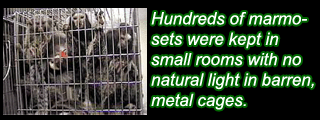
The University houses a breeding colony of some 400-500 marmosets in tiny,
barren metal cages; the animals are used in neurological experiments and endure
horrific suffering at the hands of the researchers.
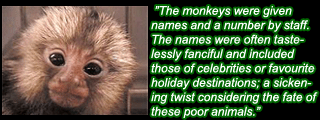
Experiments include using marmosets as models for human strokes and
Parkinson’s disease, testing new drugs, comparing experimental treatments and
looking at the role of specific areas in the brain in cognition and emotion.
Records obtained showed that some of the experiments lasted two years and
included brain damaging the marmosets by either cutting or sucking out areas of
their brains or injecting toxins which involved either sawing open the skull or
drilling it.
Food and water deprivation before and after these procedures took place
ensured the animals carried out various tests and tasks.
The same monkeys were used in drug trials, brain grafts and gene therapy.
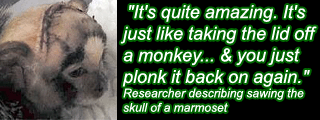
Some of the surgery involved clamping the marmoset’s head in a frame,
cutting open the skull and scraping away the muscles attached to it. An
electric saw was then used to remove the skull so that a major brain artery
could be blocked, the skull replaced, the muscles glued back and skin stitched
back.
These procedures did not always go smoothly as records revealed:
“…lost a lot of blood from muscle which I cut in the old
fashioned way by mistake”.
“Difficult to find fornix (a
region of the brain). I think I was… too far forward. Am fairly
confident I got it but probably did a bit extra damage”.
Records also revealed that surgery had to be abandoned when animals were
found to be insufficiently anaesthetised.
The code of practice for vivisectors
states: “Animals which are undergoing scientific procedures must be inspected
at a frequency commensurate with the severity of the procedure”.
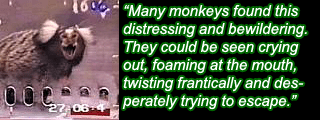
The investigation revealed complete disregard of that code. Post operative
care was grossly negligent, and animals suffering serious effects of brain
damage were left completely unmonitored for up to 16 hours. One monkey was left
despite the fact that staff were aware there was a
problem and she was found dead the morning after surgery.
The immediate post operative effects experienced by the marmosets included
pain, distress, bleeding from head wounds, fits, vomiting, tremors, swelling,
bruising, loss of body temperature, failure to eat and drink, abnormal body
movements, loss of use of parts of the body, visual disturbances and loss of
balance.
Even the vivisectors’ records attested to the
distress experienced by the animals. Many monkeys died, others had to be killed
because they were suffering so much.
The long term effects - as one would expect in brain damage experiments -
included physical disabilities, learning and memory impairment, weight loss and
lack of self care.
Those animals the investigator had got to know prior to surgery were like
different animals post operatively. Many seemed confused, and uncoordinated,
and the pitiful state of one animal in particular was described by a researcher
as “watch the birdies”.
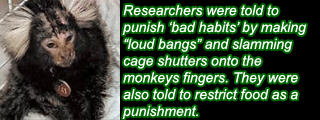
Do we really want more animals to suffer and die like this at Girton?
That these scenes are repeated in laboratories around the country and
throughout the world there is no doubt.
That they would be duplicated ad infinitum at the proposed laboratory in Girton there is also no doubt. Animals in laboratories are
convenient bits of living flesh to the researchers and their pain is irrelevant
in the pursuit of science.
The Government advisory committee has said that primate experiments should
be stopped. This campaign is about ensuring that the first step towards
achieving that is the immediate cessation of plans for the facility at Girton.