
by Libby 11th Grade Honor Physics

Force=mass x acceleration
(F=ma)
Example: If an objects mass is 20 Kg and its acceleration is 10 m/s then what is the object's force?
F=ma
F=20 x 10
F= 200 N*
* Force is measured in Newtons
|
|
|
|
|
|
|
|
|
|
|
|
|
|
| Newton's Laws of Motion by Libby 11th Grade Honor Physics |
|||||||||||||
| links page | |||||||||||||
| Newton's First Law of Motion states that any object that is moving in uniform motion or in a state of rest will remain in the same state unless acted upon by a non-zero net force. The picture below shows the instructor tapping the bowling ball ,which was at a state of rest, with a mallet, the non-zero force, causing the ball to move. | |||||||||||||
|
|||||||||||||
| Newton's Second Law of Motion says that the force of an object is directly proportional to the mass multiplied by a the acceleration of the object. Force=mass x acceleration (F=ma) Example: If an objects mass is 20 Kg and its acceleration is 10 m/s then what is the object's force? F=ma F=20 x 10 F= 200 N* * Force is measured in Newtons |
|||||||||||||
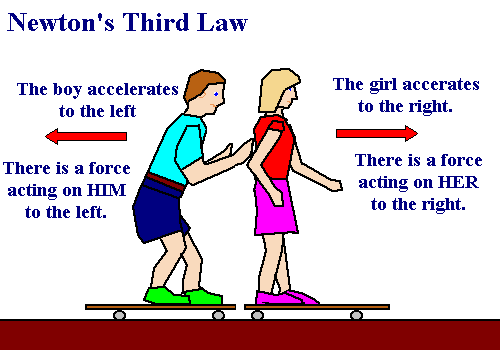
| Newton's Third Law of Motion states that for every action there is an equal and opposite reaction. | |||||||||||||
|
|||||||||||||