Once a topic is selected, the student must decide what information will be presented. Analyzing and organizing data must be completed in order for the student to move on the next step of outlining. There are several ways to organize and analyze data. The next section will examine different techniques that can be employed to create a high-quality, organized compilation of information that will aid in the speech-making process.
Mind Mapping
One way to obtain a clearly defined main theme or "big idea" is to use mind mapping. There are several advantages to this technique.
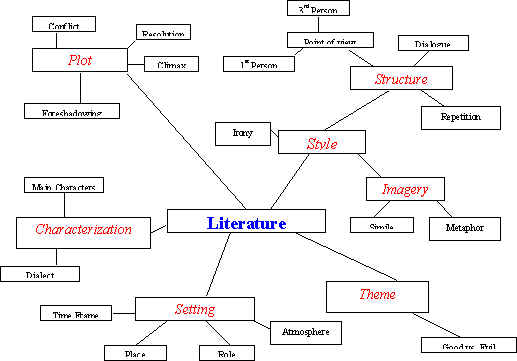
The following is an example of a mind map. Using literature as the topic, the map expands out to the major themes to be considered. Then the less important ideas are rooted off of these themes.
The technique, also known as clustering, places the general subject in the middle of a blank sheet of paper. Then other lines and rectangles are drawn to radiate form the original subject. The ideas that fall together will be clustered jointly.
Listing
Another technique is to jot down all the ideas that pop into one’s head. Try to brainstorm for at least ten minutes and don’t hold anything back. A quick list on running might look like this:
Fun Training for races Healthy Both sexes Relieves tension Any age group
No expensive equipment Running with a friend or spouse Shoes
Too much competition Poor shoes won’t last Great expectations Shin splints
Good for lungs Fresh air Improves circulation Good for heart Firming
Jogging paths vs. streets Weight loss Hard surfaces Warm-ups before run
Muscle cramps Cool-downs after Going too far Getting discouraged Going too fast
Hitting the wall Sense of accomplishment Marathons
Look for connections between ideas or one large idea that encompasses several small one. The list starts out by ideas, which focus on health, but then turns to other less obvious ideas for a speech.
Free writing
In order to find a focus, some people just need to start writing. Take out a sheet of paper and write for ten to fifteen minutes about whatever comes to mind about a particular subject. Do not worry about grammar or punctuation at this point. Here are examples of free writing from students who were given ten minutes to write on the general topic of "nature."
Student 1:
I’m really not the outdoorsy type. I’d rather be inside somewhere than out in Nature tromping through the bushes. I don’t like bugs and snakes and stuff like that. Lots of my friends like to go hiking around or camping but I don’t. Secretly, I think maybe one of the big reasons I really don’t like being out in Nature is because I’m deathly afraid of bee. When I was a kid I was out in the woods and ran into a swarm of bees and got stung about a million times, well, it felt like a million times. I had to go to the hospital for a few days. Now every time I’m outside somewhere and something, anything flies by me I’m terrified. Totally paranoid. Everyone kids me because I immediately cover my head. I keep hearing about killer bees heading this way, my worst nightmare come true…
Student 2:
We’re not going to have any Nature left if people don’t do something about the environment. Despite all the media attention to recycling, we’re still trashing the planet left and right. People talk big about "saving the environment" but then do such stupid things all the time. Like smokers who flip their cigarette butts out their car windows. Do they think those filters are just going to disappear overnight? The parking lot by this building is full of butts this morning where someone dumped their car ashtray. This campus is full of soda cans, I can see at least three empties under desks in this classroom right now…
These two students reacted quite differently to the same general subject. More writing on either of these might have lead to a humorous speech on bee phobia or a call to action on a college recycling program.
Often free writing will not be as coherent has these two samples, but by allowing one’s mind to roam freely over a subject with no restrictions, one may remember or discover topics they feel strongly about and wish to introduce it to others.
Did You Get Some Ideas?
These are just a few methods one can use to start generating ideas and narrow the focus of one’s speech. There are many more techniques that one can read about in any writing textbook (which can be found in Willis Library). There is a writing lab on campus in the Auditorium building that will be able to help not only in brainstorming techniques, but also in outlining and proofreading. The following is a list of websites that also will help in this process of your speech assignment:
Overcoming Writer’s Block – http://leo.stcloudstate.edu/acadwrite/block.html
Using Specific Concrete Details – http://leo.stcloudstate.edu/acadwrite/sonsorydetails.html
The Writer’s Block – http://www.sff.net/people/lisarc/into2.htm
** The techniques presented above were taken from:
Wyrick, Jean. Steps to Writing Well. 5th ed. New York: Harcourt, 2002.
