The First Attempt
 This particular embroidery was of the Drachenwald Broiderer's Guild. I thought it was kind of appropriate a patch to start with. I considered filling in the fingers, but couldn't decide on the colour, so that's it for now. If I even have this patch left, I doubt it will be made up into anything useful. I used a cotton brocade to work on in left over cotton embroidery floss. I believe I threw this piece out at some point.
Blackwork
One of the most important things for me when I start a new project is that it has some practical purpose. Doing embroidery for the sake of embroidery will likely result in projects that are never finished (see the guild patch above). However, when there is a clearly defined goal and purpose to embroidery, I can get very caught up in it. This realization made me search for techniques I could incorporate in my garb. I settled upon blackwork.
Blackwork is a debated topic which can be defined in any number of ways, but I am working from the definition presented at the Historical Needlework Resources site, a most excellent site for such information. So far, I have only done blackwork in the linear school, which, being counted, helps me keep my work neat. It also means I do not have to trace the pattern onto my fabric, and if I can just make sure I start in the centre I will end up with a perfectly symmetrical piece of embroidery which appeals to my scientific mind.
Further links for blackwork
- Yahoo! Groups: Blackwork. A discussion group for blackwork fans, historical and modern.
- A Blackwork Embroidery Primer. A very good article about the history. Including tips for execution and lots of links.
- The Cunnan Wiki: Blackwork.
- Linn Skinner's article on blackwork
- How to do the double-running stitch. Tutorial from the Elizabethan Costuming Page.
- Goggle search results. Go wild finding sites on the net dealing with blackwork. There are plenty of them out there.
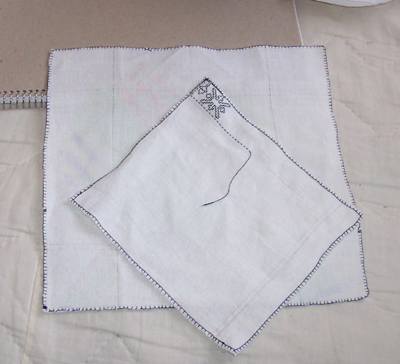 The first piece of blackwork embroidery I did was take some left over piece of linen from sewing a smock to try out some patterns and practice. I did a small hanky and you can see that the front and back of the repetition look essentially the same.
Tudor Court Gown Embroidery - After that, it was time to apply blackwork to a project I was working on; namely my Tudor court gown. For that project I wanted blackwork on the cuffs of the chemise sleeves that are seen, so I looked for patterns in "German Renaissance patterns for embroidery: A facsimile copy of Nicolas Bassée's New Modelbuch of 1568" where I found many nice things.
 The cuffs were started and I discovered that I really liked this kind of counted work. I had already made up the sleeves, so what I did to get the embroidery even was start at the centre and work my way out to the edges. I ended up only a little off, but it can't be seen in the end. Here is a mock-up of the finished sleeve showing the embroidery finished.
 For the same project I also embroidered the neckline of my smock, to be shown above the edge of the dress itself. I chose a very narrow band of blackwork from the Nicolas Bassée book, which was quick to do, and produced a very pretty border. All in all, the embroidery on this outfit worked out gorgeously, as can be seen in this photo of me wearing it at an event, and inspired me to start on another, larger blackwork project.
 The Blackworked Sture Shirt - For this project I took my love of planning to the nth degree. I charted the entire pattern for my collar on the computer, marking out top, bottom, middle, centreline and each stitch from one end of the collar to the other, starting by counting the threads I had in my fabric. The patterns were taken from Queen Elizabeth's Wardrobe Unlock'd, by Janet Arnold. And then I got down to work.


 It took me quite a while to finish all the embroidery on this collar, but I didn't get bored with it, despite the repetition. It is, as I said, a type of meditation. Once the embroidery was finished, I made it up and the finished collar became quite spiffy, if I may say so myself.


 July 2007: A suite of blackworked collar and cuffs - As an encouragement and for some goal to work towards I offered to blackwork a set of collar and cuffs for a Lady whom I thought would look fantastic in 16th Century clothes. Said and done, I decided on a pattern and set to work.
The pattern was taken from the teaching material given out by Viscountess Helwig Ulfsdotter at one of her blackwork courses. She has cleaned up several blackwork designs from pictures in Queen Elizabeth's Wardrobe Unlock'd by Janet Arnold and provided them for use through her classes. I chose a simple but pretty design and got to work.
The collar took most time, being twice as long as the cuffs, and worked in two rows. The cuffs are worked with the same design, but only one row. Using an even weave linen ground I worked up the pattern using Güterman's black sewing silk thread, making each stitch over two threads of the ground fabric. Since I was sending this work through the mail I decided to leave the linen un-cut, the recipient can then cut the pieces out for attachment to a shirt when appropriate.
Nordmark Needlebooks
In the spring of 2006 (AS XL) Nordmark went through a bit of a crisis, so my local shire decided to arrange a day of crafts to benefit the Principality. We got together a bunch of materials and got to work being crafty. For myself, I had the idea of making needlecases using left over wool cloth.


 There is an excellent article on the West Kingdom Needleworkers Guild webpage about needlecases. But the basic design is really quite simple. Cut two strips of wool one to two inches wide and up to 6 inches long. Put them on top of each other and stitch in the middle to make a "book" of four wool "pages" - voila your basic needlebook is finished.
I went with this rather simple method of making my needlebooks. But in addition to just cutting the strips I also did blanketstitch in a contrasting colour all around the pages using DMC embroidery floss. With that done, I was still not entirely happy with my needlebooks, so I went ahead and started embroidering the front of one with Nordmark's arms (Per pale sable and azure, a chevron argent and overall a laurel wreath Or). This was lovely - but since they are supposed to be given out to the populace of Nordmark I changed the embroidery to the populace badge (Per pale sable and azure, a chevron argent and a bordure Or) for the rest of my needlebooks.
Talking technically, on the first one, with the Nordmark Arms, I used all DMC embroidery floss for the design. The shield shape was outlined in black stem stitches, the white chevron was done with laid and couched stitches, and the black half of the shield was then loosely filled in with laid and couched threads. The laurel wreath was then done using stem stitch for the stem and chain stitches for the leaves over the rest of the design. The first two needlebooks with the populace badge I did the border in DMC floss, using two rows of chain stitches, before switching to wool yarn. Couching the black half of the shield first I then added the white chevron ontop similarly. The remaining four of my blue needlebooks are all outlined in yellow wool yarn using split stitch, with the black laid and couched and the white chevron laid and couched last.
Whiteworked Partlet
 Another embroidery project - I decided to make an embroidered partlet. I did not, however, want to do blackwork again, rather I wanted something a bit more understated - whitework. Generally, whitework is defined as working a pattern on white linen using white embroidery floss. Simple enough definition, but how to find patterns? Well, I did some searches for period samplers, looked through files saved on my computer and then I winged it. I sketched out a pattern on paper which I transferred to linen (see left). The red running stitch all around is there to keep the two layers together - I embroidered through both layers for stability.
 I decided that I wanted to keep it simple, filling in the pattern with DMC cotton embroidery floss using satin stitch.
The outlining of my pattern using stem stitch took me no more than one average length movie, or about two hours. To finally prepare it for mounting on my partlet I blocked the embroidery by folding in the edges and topstitching all around using linen thread. The protect the back of the embroidery a linen lining was applied to the inside. For images of the finished partlet, refer to the dress diary section.
Assisi-work
October 2007 - With a spare bit of linen and some gorgeous red DMC floss I decided to finally learn how to do embroidery in the Assisi style. Broadly, Assisi style embroidery was a voided technique. You fill in the background, leaving the motif itself as a void. Some patterns has outlines done in black inside the voided areas, other just outlines the pattern itself and lets the human mind fill in the blank. It is often referred to as Assisi work because the town of Assisi in Italy was known for producing these kinds of embroideries. The ones that remain today remain as table clohs often, and this seemed like the perfect size on which to practice.
Stitches and Materials
To work this kind of pattern the outlines would first be done in black using either backstitch or Holbein stitch (also known as double running stitch). Then the background would be filled in with an overall covering technique. Often simple cross stitch was used, but equally long-armed cross stitch was a favourite depending on how much coverage was desired.
The materials used for this style of embroidery is linen ground cloth, and silk embroidery floss; black for outlines, and the fill pattern very often done in red. Blue was also used, but slightly less often.
Assisi-work table setting
 For the table setting I went, as so often before, to the On-Line Digital Archive of Documents on Weaving and Related Topics hosted by the University of Arizona. The source this time was the facsimile of Paganini's book "Il Burato" with patterns for Burato lace. Many of the patterns used at this time were used in different forms. From wood-carvings, to painted borders, to embroideries, to lace - the popular patterns were used and re-used in many forms. For my inspiration I used one pattern from page 64 and one from page 65 of the pdf document (plate vii verso and plate viii).

 To begin with I took the hearts pattern and interpreted the black in the design as void, and the white squares as background and proceeded to fill this with long-armed cross stitch. The question was, should I always go from left to right, or right to left, or should I alternate? I chose to alternate rows so as to save some thread, and aso because that enabled me to go up and down in between the voided hearts in a very efficient manner. The back is, as you can see in the photo, nearly as neat as the front and the hearts stand out there as well.
For the other end of the cloth I decided to try something a little more close to the originals I found at the V&A among other places. That is to say, outline first in black, and then fill in with the slightly less ground covering cross stitches.
Embroidered apron
 January 2008 - The table cloth was the first bit of assisi-work I finished, true, but it was not the first I started. Having been given a hank of gorgeous quality hand dyed silk floss in an orange/red tone I wanted to put it to use in a setting worthy of the gift. In the renaissance, if you owned more than one apron you had one that was crisply white and freshly starched with crease-marks still in it from the pressing to wear on dressed up occasions. This type of apron could be additionally adorned with embroidery, and in the inventories of Eleonora of Toledo and of Queen Elizabeth I are listed white linen aprons decorated with silk embroideries. Typically in-graine red (kermes bugs that produce a red dye) and a true black were most favoured for the embroidery thread for two reasons. One being that red and black contrasts very well with white. The second reason being that both these colours were difficult and expensive to achieve.
Though the colour of my floss was not quite the red desired, coming from madder, it wants to be properly red, and it is not inconcievable that a less well-to-do lady had to settle for a cheaper silk for her apron embroidery. So, I looked for inpiration. Again looking to the Universty of Arizona weaving site I found "La Vera Perfezione del disegno di Giovanni Ostavus", published in 1561, and the pattern for a three-row high border on plate LXXXI (page 91 of the pdf document) that would be gorgeous, I thought.
The first line was no trouble at all, although I created problems for myself later on by unthinkingly choosing to always embroider from left to right. Working with the silk floss on linen was such a lovely experience though, and the silk positively sparkles once it is done.
The second line of embroidery is three times the height of the first and third, and is a much more involved pattern. Finding the best path to take from left to right to avoid jumping too many threads took quite a lot of thought effort, and the first few repeats have threads that carry unnessecarily far on the back. The third and final row took practically no time at all in comparison. If I had this to do over again I would do all vertical rows in long-armed cross stitch as well as the horizontals. The singlet stitches and the diagonals you have no choice about, but it was not until well into the second row that I figured out that the verticals could, and probably should, also be done using the long-armed cross stitch technique. However, as the apron is worn and with all the whitespace in the pattern, the fact that the verticals cover the ground cloth a little less fully is completely disguised.
I thought I should also report on a success I had at Double Wars XXI, in 2008.
Meisterinne Katheryn Hebenstreiz asked me in the middle of the week to enter the A&S competition with my apron, which I had out at the time to show off, and I agreed. My documentation was not exhaustive or very long, so I quote it here:

ITEM: Embroidery, 16th Century on an apron. PLACE: Italy.I had no expectations, so when they called my name in court as the winner of the competition it was a complete surprise. But there you go, embroidery can be a winning concept.
Documentation:
The embroidey on this apron is done in madder dyed silk thread on linen. The pattern is taken from the facsimile of a 1561 pattern book by Giovanni Ostavus(*) and the stitch is long-armed cross stitch(**) which was commonly used in the period(#).
This kind of counted embroidery was commonly applied to aprons, shift, smocks and shirts. Black and red were the most common colours, being very effectful against white linen. Queen Elizabeth's Wardrobe Unlockd lists an apron with "carnacion in graine silke"(##) - being a red colour. In Moda a Firenze a photo fo a detail of a painting by Alessandro Allori shows an apron with embroidery done in black(¤).
* La vera perfezione del disegno di Giovanni Ostavus, 1561. Available on-line at the University of Arizona.
**, # Embroideries at Hardwick Hall, a catalogue. Levey, Santina M. (Stitch diagram drawing here).
## Queen Elizabeth's Wardrobe Unlockd. Arnold, Janed. Page 225.
¤ Moda a Firenze. Orsina Landini, Roberta & Niccoli, Bruna. Page 130.