I feel this an Honorable Venture to Pay Tribute to my
Ancestors as well as
other indigenous people's.
Mitakuye Oyasin...We are all related!
Connie

The Cherokees called themselves the Ani-Yun' wiya meaning leading or
principal people. The original Cherokees lived early times in Georgia, Alabama,
North and South Carolina, Tennessee, Kentucky and West Virginia.
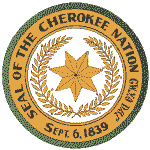
The Cherokee seal (above) was designed to embrace the early government
structure, and the eternal endurance of the Cherokee Indians. It was adopted by
Act of the Cherokee National Council, and approved in 1871. The seven-pointed
star symbolizes: (1). the seven age old clans of the Cherokee: (2). the seven
characters of Sequoyah’s syllabary, meaning "Cherokee Nation." (The
Cherokee characters are phonetically pronounced "Tsa-la-gi-hi
A-yi-li") .. The wreath of oak leaves symbolizes the sacred fire which,
from time immemorial, the Cherokees kept burning in their land. Oak was the wood
traditionally burned, different species of oak having ever been indigenous to
Cherokee country, both in North Carolina and Georgia as well as in the Indian
Territory to which the Cherokees removed in the early 1800's...The margin
wording proclaims the authority of the seal in both the English and the Cherokee
languages, and records the date (1839) of the adoption of the Constitution of
the Cherokee Nation West...This seal was imprinted on all documents until the
dissolution of the Cherokee Nation at Oklahoma Statehood.

A few links I hope you find of interest.
Hot Links for American
Indian Tribal Libraries
http://members.aol.com/sue3hawk/index.htm
http://www.samsilverhawk.com
Important Dates in Cherokee History
 1540 -
The Spanish explorer, Hernando De Soto and his party are the first whites seen
by the Cherokees.
1540 -
The Spanish explorer, Hernando De Soto and his party are the first whites seen
by the Cherokees.
1629
- The first traders from the English settlements began trading among the
Cherokees.
1721
- The Cherokee Treaty with the Governor of the Carolinas is thought to be the
first consession of land.
1785
- Treaty of Hopewell is the first treaty between the U.S. and the Cherokees.
1791
- Treaty of Holston signed. Includes a call for the U.S. to advance civilization
of the Cherokees by giving them farm tools and technical advice.
1802
- Jefferson signs Goergia Compact.
1817
- Treaty makes exchange for land in Arkansas. Old settlers begin voluntary
migration and establish a government there. In 1828, they are forced to move
into Indian territory.
1821
- Sequoyah's Cherokee Syllabary completed, quickly leads to almost total
literacy among the Cherokees.
1822
- Cherokee's Supreme Court established.
1824
- First written law of Western Cherokees.
1825
- New Echota, GA authorized as Cherokee capital.
1827
- Modern Cherokee Nation begins with Cherokee Constitution established by a
convention; John Ross elected chief.
1828
- Cherokee Phoenix published in English and Cherokee; Andrew Jackson elected
President. Gold discovered in Georgia.
1828-1830
- Georgia Legislature abolishes tribal government and expands authority over
Cherokee country.
1832
- US Supreme Court decision Worcester vs Georgia establishes tribal sovereignty,
protects Cherokees from Georgia laws. Jackson won't enforce decision and Georgia
holds lottery for Cherokee lands.
1835
- Treaty Party signs Treaty of New Echota, giving up title to all Cherokee lands
in southeast in exchange for land in Indian Territory (now Oklahoma.).
1838-1839
- Trails of Tears. US Government's forced removal of 17,000 Cherokees, in
defiance of Supreme Court decision. More than 4,000 die from exposure and
disease along the way.
1839
- Assassination of Treaty Party leaders, Major Ridge, John Ridge, and Elias
Boudinot for breaking pact not to sign Treaty of New Echota. Factionalism
continues until 1846. New constitution ratified at convention uniting Cherokees
arriving from the east with those in the west.
1844
Cherokee Supreme Court building opens; Cherokee Advocate becomes the first
newspaper in Indian territory.
1851
- Cherokee male and female seminaries open. Female seminary is the first
secondary school for girls west of the Mississippi.
1859
- Original Keetoowah Society organized to maintain traditions and fight slavery.
1860
- Tension mounts between Union Cherokees and Confederate Cherokees. Civil War
begins.
1861
- Treaty signed at Park Hill between Cherokee Nation and the Confederate
government. Cherokee Nation torn by border warfare throughout the Civil War.
1865-1866
- Cherokee must negotiate peace with the US Government. New treaty limits tribal
land rights, eliminates possibility of Cherokee State and is prelude to Dawes
Commission. John Ross dies.
1887
- General Allotment Act passed; requires individual ownership of lands once held
in common by Indian tribes.
1889
- Unassigned lands in Indian Territory opened by white settlers known as
"boomers."
1890
- Oklahoma Territory organized out of western half of Indian Territory.
1893
- Cherokee Outlet opened for white settlers.Dawes Commission arrives.
1898
- Curtis Act passed abolishing tribal courts.
1903
- W.C. Rogers becomes last elected chief for 69 years.
1905
- Land allotment begins after official roll taken of Cherokees.
1907
- Oklahoma statehood combines Indian and Oklahoma Territories and dissolves
tribal government.
1917
- William C. Rogers, the last Cherokee Chief, dies.
1934
- Indian Reorganization Act established a landbase for tribes and legal
structure for self government.
1948
- Chief J.B.Milam calls Cherokee Convention; beginning of model tribal
government of the Cherokee Nation.
1949
- W.W. Bill Keeler appointed chief by President Harry Truman.
1957
- First Cherokee National Holiday.
1961
- Cherokees awarded 15 million dollars by the US Claims Commission for Cherokee
Outlet Lands.
1963
- Cherokee National Historical Society founded. CNHS opens Ancient Village,
1967; Trail of Tears Drama, 1969, and museum, 1975.
1967
- Cherokee Foundation formed to purchase land on which the tribal complex now
sits.
1970
- U.S. Supreme Court ruling confirms Cherokee Nation ownership of bed and banks
of 96 mile segment of Arkansas Riverbed.
1971
- W.W.Keeler becomes first elected principal chief since statehood.
1975
- Ross O. Swimmer elected to first of three terms as principal chief. First
Cherokee Tribal Council elected Congress passes Indian Self-Determination and
Education Assistance Act.
1976
- Cherokee voters ratify new Constitution outlining tribal government.
1979
- Tribal offices moved into modern new complex South of Tahlequah.
1984
- First joint council meeting in 146 years between Eastern Band of Cherokees and
Cherokee Nation held at Red Clay, TN. Council meetings now held bi-annually.
1987
- Wilma Mankiller makes history and draws international attention to tribe as
first woman elected chief; Cherokee voters pass constitution amendment to elect
council by districts in 1991.
1988
- Cherokee Nation joins Eastern Band in Cherokee, NC to commemorate beginning of
The Trail of Tears.
1989
- The Cherokee Nation observes 150th anniversary of arrival in Indian Territory.
"A New Beginning".
1990
- Chief Mankiller signs the historic self-governance agreement, making the
Cherokee Nation one of six tribes to participate in the self-determination
project. The project, which ran for three years beginning Oct.1 1990, authorized
the tribe to assume tribal responsiblity for BIA funds which were formerly being
spent on the tribe's behalf at the agency, area and central office levels.
1991
- In the July tribal election the first council to be elected by districts since
statehood and Wilma Mankiller won second elected term as principal chief with a
landslide 82% of the votes cast.
1995
- Joe Byrd and Garland Eagle elected principal chief and deputy chief which
marks the first time in nearly 200 years that full blood bilingual leaders
occupy the top positions of the Cherokee Nation