

FRANCES SEFTON is the author of THE LHASA APSO published in 1970. She bred and showed Lhasa Apsos under the CHESKA prefix in England from l962-l970 before she emigrated to Australia. Her husband saw his first Lhasa in Northern India. Frances, hoping to see her first Lhasa Apso at the 1961 Westminster in New York, had her plans cancelled by a sick child.
Frances visited Canada in 1989 and during her stay, was entertained by the Vancouver area members of LHASA APSO CANADA at Arlene Miller's in North Vancouver. She also visited with Dr. Ellen Brown outside Toronto.
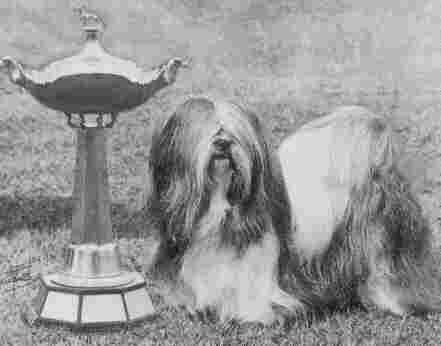
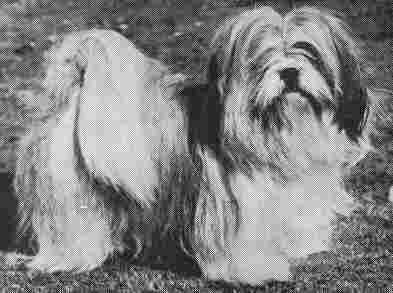
FRANCES SEFTON: Well, you can't really go into a breed without reading the standard, the official standard. When you first go into a breed you learn from the people who are already in it, through conversation and getting together with other people.
In England, it is probably quite different than anywhere else in the world. There aren't many championship shows (point shows), so you may be the only person in your area with that breed. You go to open shows, sanction matches and small shows and you have to compete with other breeds in variety classes.
You go to championship shows because it is there you will see other Lhasa people and you'll compete against other Lhasas. It's usually big entries and it is a social day, a learning day and quite different from showing at your local shows. You're competing in your breed, your breed is competitive. You're happy if you get a first place and your interest in the show usually ends at the end of the Lhasa Apso judging. When you want to go on a bit further and become competitive in the group, it would be nice to have the dog winning the group but really and truly, most of the interest of the people involved with the breed is at the breed level.
You are saturated with discussion, conversation, learning and knowledge at breed level. It's not east to create champions at specialties, you're up against all the top dogs. It's open competition. If you want to get the points you've got to beat everything that's there, as made up dogs (champions) compete in the classes.
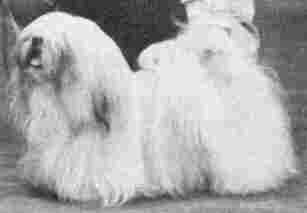
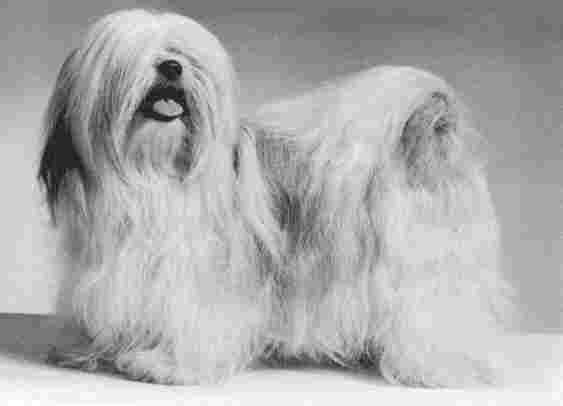
FRANCES: You show from the 6-9 month old class and upwards. The classes that you get at championship shows are not always the same. If it is a big entry, you get extra classes. You get novice, post graduate, graduate, all sorts of classes plus your open classes. Some of the classes are according to age, some on the qualifications depending upon how many wins your dog has had.
You put entries in those classes because people are taking out their young stock to try them out. They are not necessarily expecting their dogs to get the challenge points. They are there to see how their dogs shape up against the other youngsters.
Your line-up for the championship certificate is the first place getter in every one of those classes and there could be a lot of dogs in those line-ups. When you show in the breed you compete for a Challenge Certificate and a Reserve Challenge Certificate in both dogs and bitches. The CC dog meets the CC bitch and the Breed Of Breeds winner and Best of Opposite Sex is decided.
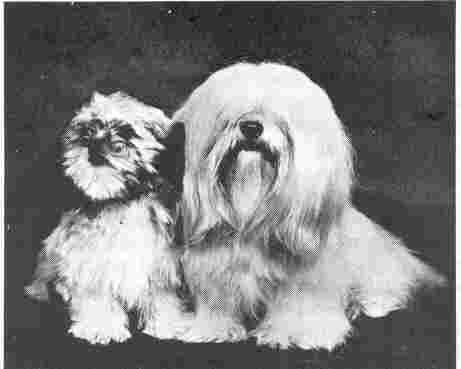
FRANCES: I would worry about the breeding point of view. I wouldn't show one that is badly lacking in pigment or which has a wry bite. There is a range of pigment. You've got the pigment which you often get on a light coloured dog which is just not quite so dense. You can have spotty patched nose pigment. Of course, if you've got a really light putty coloured nose then I certainly wouldn't show. I would be very worried about it from the breeding point of view. I think it's one of those things that are hard to get rid of if you don't do something about it when it starts to appear. As Thelma Morgan used to say in the old days, she was a great mine of information, one of the old breeders in England, she would say you need to use your dark haired dogs, your blacks and your greys. If you keep breeding golds to the golds, there is enough recessive colour genes in the breed to give you pigment problems and that it was best to introduce the dark-haired dogs or a dog with very intense black points, like a black mask, to restore pigment and keep your colour genes in good strength.
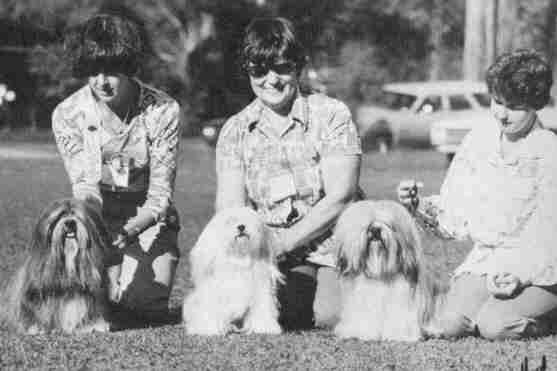
FRANCES: I think the system in Canada creates more interest for a lot of peple becaue you can get a champion from your regular classes. It's a system which suits here because you have so many breeds with small entries. In England, there are so few champioship shows but it is a small country with a lot of people, so you don't need the enticements of the Specials Class.
Some breeds have so many entries, you need a judge to do the dogs and another to do the bitches. Even then judging may go on until early evening. Group is scheduled for 5:00 p.m. If the breed has not been decided, then you don't compete in Group. If you make it through Breed, make it into Group and win, that's icing on the cake. It's not the reason you went to the show in th first place. So...going to breed shows, you are so saturated in your breed, you pick up a lot of information, you have discussions and that's where I learned about my breed.
Do you find the North American Lhasas similar to what you have shown and what you've been seeing?
FRANCES: A lot are fairly similar. It's just the odd one that you look at and you think,well, that's a bit exaggerated. I think there is more size here overall.
In your travels are you finding the Lhasa conforming to a single standard? What about coat texture?
FRANCES: Wherever you go in the world,there is variation as there is variation in the coat textures. It is the inherited coat texture that one has to select for. People that learn to master the wire and wooly coat can get some beautiful looking coats.They may not be correct mind you but they can look good in the ring.
FRANCES: I think people in Australia do their own thing but, I think because of their numbers, there is
a lot more breed discussion. They generally have a lot more to do with one another mainly because their numbers are less. In Canada, you've got people scattered all over the place, with big groups here and big groups there so perhaps you don't see one another quite so often. You've got dogs on the East coast, dogs on the West coast, and some in the middle.They may overlap to a certain extent but perhaps it is only at the National when they can all get together.
REPRINTED WITH PERMISSION OF THE INTERVIEWER
| INTERVIEW
DR. ELLEN BROWN |
ARTICLE
BARBARA RATLEDGE |
INTERVIEW
THE ROBERTS |
RETURN TO HOME PAGE |