On the seventeenth day of July 1936 a military coup led by General
Francisco Franco set off an age of trials and tribulations for the
Spanish people. The causes of this war delve upon some of the most
domineering ideas, ideals, and traditions that human beings have ever
associated themselves with. Every nation has its shortcomings, but the
Spain of 1875 to 1936 was a particularly volatile nation filled with
tremendous quantities of perplexing strife. Repetitive and bewildering
political instability was the initial cause of the turmoil in Spain. The
years of political instability brought about horrific economic times in
an already economically wretched nation. However, it would be social
upheaval, with an underlying current of foreign ideologies, that gave
Spain the mortal wound that brought Civil War.
A resounding majority of Spanish citizens living at the onset of the
civil war had been living in an unstable nation all their lives. From
monarchy, to monarchical dictatorship, to revolution and republic,
Spaniards had seen an entire lifetime of redundant political changes.
There is no doubt then, that continuous political instability and
inability is a clear cause of the Spanish Civil War. All sides
throughout the eras of political instability (1875 - 1936) implemented
obstinate and opposite reforms. However, it was all done with the
ultimate goal of modernizing the Spanish nation, while restoring the
Spanish spirit.
In 1868 the ruling queen of the House of Bourb�n, Isabel II, was forced
to abdicate the throne to a revolutionary coalition led by military
generals. Seven years later, after an unsuccessful king and an equally
unproductive republic, it would be the military declaring Alfonso XII,
son to Isabel, King of Spain. The House of Bourb�n officially ruled from
1874 to 1931, under Alfonso XII (1874-85) and Alfonso XIII (1886-1931).
Monarchy under this House can be divided into three segments: times of
'stability' (1874-1898), years of mounting opposition (1898-1923), and
rule under an appointed 'dictator' (1923-1931).
The initial years of monarchical rule (1875-1898) are traditionally
given the misleading title of 'stability' because the years previous to
and subsequent to them were far past respectable levels of stability.
The constitution of 1876 was based on the principle, through use of
local bosses, of forcing the populace to vote for the government chosen
by the monarchy. Shortly thereafter a deathblow was dealt to the years
of 'stability'. The Cuban independence movement caused Spain to lose its
remaining colonial empire. By the end of 1898 politicians and
intellectuals all over Spain had begun a new era of condemnation towards
the government that had erred in so many ways.
Tremendous anger was felt throughout Spain due to disappointment with
the governing body. This, fueled by the conflicting ideologies surfacing
in Russia and Italy, led to mounting opposition by various members of
Spanish society, namely members of the Radical Republican Party and the
tainted military.
Republicanism, a long forgotten experiment, had been reduced to nearly
irreconcilable levels. However, a vibrant and sharp organizer, Alejandro
Lerroux, led the old ideas to the surface of industrial Barcelona. He
formed the Radical Republican Party in 1908 with Socialist principles.
Lerroux's party was initially anti-clerical and contributed to the
burning of churches and convents during the "Tragic Week of 1909" in
Barcelona. Radical Republican ideals, regardless of their location on
the political spectrum, threatened monarchists and Church alike.
The military was also growing tired of the uninspired liberal and
conservative governments of the times. Social upheaval had reached a new
plateau by the early 1920's due to the battles waged between unions and
employers in the Spanish industrial centers. By 1923 chaos was rampant
all over the nation and many welcomed General Primo de Rivera's military
pronunciamento. De Rivera played on the wants of those fearful for
social harmony, while satisfying the seekers of autonomy in Catalonia
and the Basque Provinces. The General did, however, obtain unofficial
permission from Alfonso XIII, who was tired of politicians that were
powerless to create and maintain fruitful governments.
The General was a self-professed Spanish patriot whose only wish was to
deliver Spain from the depths of chaos to social order. General de
Rivera started a motivated public works projects with the aid of the UGT
(Uni�n General de Trabajadores), a Socialist Union, to increase
hydraulic power, irrigation, and road construction. Also, his economic
policy necessitated the use of protectionist policies, which endeared
him to industrialists. With military support from France he managed to
retake the entire protectorate in Morocco, thus bringing back prestige
to the harpooned military.
De Rivera's economic escapades did, in the end, resurface to haunt him.
When economic depression settled throughout Spain and the value of the
Peseta fell drastically, his enemies came out of the dark.. Catalan
regionalists harshly protested de Rivera because he had turned on them
by allowing an anti-Catalan crusade. Also, military generals lost
confidence in their dictator due to the attempt at diminishing the
rights of the artillery and engineer corps. Finally, the CNT
(Confederaci�n Nacional de Trabajo), a large anarchist union, cried out
because they had been suppressed during the days of public works
expansion. By January 28, 1930 King Alfonso had witnessed enough; made
clear by the forced resignation of de Rivera.
On August 17, 1930 at San Sebasti�n, a contingent of former monarchists,
Catalan politicians, and Republicans agreed to put an end to the
monarchy. These groups were unable to take over by force, however,
municipal elections in April 1931 clearly confirmed that the larger
towns and cities were in favor of a Republic. To avoid civil war,
Alfonso XIII relinquished the Spanish throne to the groups represented
in San Sebasti�n.
Provisional government status was taken by the coalition of left-wing
parties represented at San Sebasti�n. Together, they instituted an array
of reforms on the constitution reverberating with anti-clerical
sentiments. Church run education, what the left wing parties feared
most, was put at the forefront of the chopping block . Religious schools
of all sorts were dismantled and power over secondary schooling was
ripped from the Regular Church Orders. However, to the utmost chagrin of
Church supporters, this government did not react to the burning of
churches in May 1931. These deeds prescribed for the creation of a
Catholic-based party, Acci�n Popular, with clear intentions of reversing
all the Socialist reforms.
These years of political instability caused continuous economic
collapses and are direct causes of the civil war. Only one word is
needed to describe the overall economy of Spain in the times preceding
the Civil War - failure. Government was never able to balance its
numerous classes while the misfortune of geography brought more division
to its peoples. Many of those that felt exceedingly depressed played
their luck with the promises of powerful trade unions.
A disease to Spanish society was its inability to balance the various
masses of poor with the much smaller groups of middle and upper class
property owners. In all eras previous to the Civil War uncountable
amounts of poor laborers toiled in the fields with little sustenance.
However, the tiny population of 'rich' among Spanish society, who
employed the countless unskilled workers, inherited few difficulties.
The enormous working class in Spain was not entirely composed of
desperate rural laborers, but none of these 'subclasses' could have
been considered well off by any humane standards. Most important to the
Socialist government and anarchist unions were the masses of rural
laborers, numbering nearly one million. A slightly wealthier group was
the proprietors of small farms and small businesses, from rural and
industrial regions alike, numbering another million. This group was not
entirely in favor of the Socialist ideals that entailed increased wages.
Well off groups were always minute in comparison to the vast quantities
of poor. For example, two million worked the land in Spain while a mere
ten thousand owned half of these lands. This upper class came from three
different groups: successful farm owners, those who had purchased lands
from the Church in the 19th century, and nobles who obtained property
through inheritance. These groups were incredibly displeased at
Socialist sentiment that threatened to steal their territory from them.
They commonly sided with any political party, regardless of specific
ideals, as long as their territories were safeguarded from the threat of
Socialism.
Spanish geography encompassed by far the greatest contrast in
agricultural landscape in all of Europe. Geographic determinism, in this
case, would cause certain areas of Spain to flourish agriculturally or
industrially while allowing others to deteriorate into havens of despair.
Agriculture remained the most important economic activity in Spain, yet,
it reported the lowest yields in Western Europe. In many other countries
the majority of the population had already moved from rural to urban
settings by the 1920's, however, this was not the case in Spain.
Contrasting regional markets also presented continuous difficulties for
government and people alike. Southeastern Spain, particularly the Murcia
and Valencia regions, contained wonderfully cultivated areas sporting
cultures of olives and oranges. However, the lands just westward held
the desert-like domains of eastern Andalusia, where lowly peasants were
forced to seasonally emigrate to survive. Also, Catalonia was able to
engage in the export of wine to France from 1882 to 1892. The successful
areas contrasted heavily with the regions of Castille and Andalusia, in
central and southern Spain, thus causing superiority complexes that
would drive their continuous calls for autonomy.
Spain also lagged far behind its European neighbors in industrial
output. Industrialization was only possible in the most agriculturally
advanced regions of Spain and those regions where raw materials were
present. This limited Spain's industrial revolution to two regions,
Basque and Catalonia. The Basque metallurgical industry was based on
iron ore deposits found near Bilbao and during World War 1 Spain was
able to export this iron to England. Catalonia was an important European
textile center with factories in wool, cotton, and by 1930 light
industry and machine shops. These regions became increasingly important
to the Spanish economy, which caused the government to protect them with
the highest tariff walls in Europe. Catalan and Basque industrialists
were desperate for this protectionist policy; when the Liberal
government of 1922 threatened to reduce tariffs the two regions
immediately chose to support the military coup of General Primo de
Rivera. Varying levels of modernization in Spain allowed Catalan and
Basque nationalists to argue that the Madrid government, located in the
economically fragile region of Castille, was merely hampering their
prosperity and was no longer necessary.
One particular economic disaster brought about years of opposition
against the untrustworthy monarchical government (1898-1923). In 1895 a
colonial disaster was occurring in Spain. The Cuban independence
movement, fighting against the unreasonable economic policies of the
Spanish government, had begun. However, Spain would only face
tribulations when the United States became involved. Congress declared
in April 1898 that Spain must renounce all claims to Cuba. Days later a
sudden, and one-sided, war was launched. On December 10th of the same
year, Spanish representatives were negotiating the transfer of all its
remaining territories in the Americas and Western Pacific, including
Cuba, Puerto Rico, Guam, and the Philippines. The sudden loss of Spain's
vital colonial resources furthered the torment being suffered by the
Spanish economy, while providing oil to the fires of opposition.
From 1910 to the early twenties, Spain was a nation where union
activity had taken a turn for the worse. Desperation of the underpaid
and overworked groups in Catalonia and Andalusia was being expressed by
the members of the Anarcho-Syndicalist Union founded in 1910, the CNT.
This was an organization, amounting to 1,600,000 members by 1936, with
an ideology stating that capitalism, including state and Church, must be
overthrown and destroyed. The CNT staged many violent strikes in its
heyday; including the Barcelona strike of 1919, the largest in Spanish
history. Hired gangsters carried out numerous assassinations for both
the employers and workers, while opposing militiamen engaged in gun
battles on the streets of Barcelona. Antagonism was used by the CNT to
deal with all their enemies, causing much hatred to be expressed by
members of all sides.
Social aspects of civilian life were severely affected by political
instability and economic failure. By the days of the second republic,
opposing ideologies proved to be the cause of increased social upheaval;
mostly due to the touchy clashes between Socialist and religious
supporters. The desire for autonomy in Catalonia and the Basque was
always a tender political issue among regionalists. These fervent and
nationalistic issues brought about the final divisions in defining those
who would become friends, from those who would become foes.
Due to the continuous political and economic failures, the Spanish
masses became increasingly willing to consider the new views originating
in Russia, Italy, Germany, and France. Also, atrocities committed in
other European nations influenced the actions of left and right wing
parties alike. Socialists in Spain were placated with the thoughts of
the murder and imprisonment of their Italian and German counterparts,
while the right wing parties and monarchists feared a "red" revolution
like that in Russia.
Ever since republicanism and socialism gained fervent support throughout
Spain, clashes ensued between the supporters of the Church and the
forces of the left wing. Left wing causes attacked the Church and
religion from all sides, while the Church utterly opposed the moral
atrocities committed by those on the left.
Catholicism was a staple in Spanish society for hundreds of years. It
remained the main religion of the state throughout the monarchical years
and had its Bishops sitting on the Senate. The Regular Orders held
control over all educational facilities up to the secondary schools.
Nuns and monks worked without pay, while the rich provided supplementary
funds for all repairs and improvements to churches and schools. Due to
the attacks from Socialists and Anarchists alike the Church was forced
to "take up arms". They became increasingly involved in political
affairs with its representation coming from Catholics who were unwilling
to see their Church crumble under a dictatorship of the state.
The Socialists and various left-wing activists believed that the Church
was an organization that had 'blessed' the system they detested so much.
To them, the Church was a clear symbol of capitalism and greed that
would prevent them from distributing the wealth equitably among the
population. In their eyes, the Church was an unnecessary administration
that limited the minds of children in the education system. Article 26
of the Constitution of 1931 under the Provisional Government presented
several laws that discriminated against the Catholic Church and religion
in general. For example: powers of education were taken from the Regular
Order, all Jesuits were expelled from Spain, religious processions were
forbidden, and crosses were to be removed from the schools. The Spanish
Socialist government of the early 1930's was one that would not directly
involve itself in the obvious purging of the Church. However, it did not
keep the more intense Socialists and Anarchists from trying to cripple
the Church. The burning of churches in May 1931 went unnoticed by the state.
Longing for autonomy is a deep expression of regional nationalism and it
was an incredibly apparent social and political issue during the days of
verbal revolt against the monarchical government. The regions of
Catalonia and Basque were well known for their separatist tones.
However, they each had distinctive reasons for their aspiration of
statehood.
It was the Catalan region of Spain that attracted the most political
attention in the years previous to the civil war. Many factors are
involved in the ideas of Catalan regionalism, dating back to the
occupation of Catalonia by a Castilian king two centuries earlier.
Catalans believed they were treated as an appendage to the Spanish
monarchy. They believed that Catalans, as a people, were progressive and
modern, while the Spanish government was conservative and unable to
understand the true economics of the nation. Catalans spoke a different
language and held a unique literary culture. Catalans spoke badly of the
failing Castilian economy and often ridiculed it by comparing it to
their superior state of affairs. By 1901 the Lliga Regionalista, a party
dedicated to achieving autonomy in Catalonia, had been formed. The Lliga
chose to fight for its independence in unison with the politicians in
Madrid; a relationship that would return little to Catalans. Disobliging
behavior on Madrid's behalf returned few allies in Catalonia, while the
badgering Catalan sentiment did not entirely please Castilians, who were
repeatedly accused of having hammered together the nation through
military conquest. Catalans did, eventually, chose to side with the left
wing forces due to the strong unwillingness of the right wing groups to
grant them a unique autonomous status.
Basque independence had been a European issue for millennia. Since the
first time they were invaded they had been fighting intruders and
demanding autonomy. It was generally peasants who expressed the
philosophy of keeping foreigners from contaminating their "pure" race.
Basques maintained their own language throughout the centuries while the
extremists among them were not unwilling to use excessive measures to
protest their cause. Republican government, however, did not entirely
displease the Basques. The Socialists satisfied the demands of the
economically minded industrialists and even managed to grant the Basques
certain levels of autonomy. However, the right wing parties were heavily
disliked throughout the Basque Region because they were entirely opposed
to granting special autonomy related legislation.
The final years of the second republic directly determined the final
divisions of classes, political ideologies and religious associations
that would be brought into war. These years may be divided into three
eras: left wing government (October 1931 - September 1933), right-wing
government (September 1933 - February 1936), and the left wing Popular
Front government (February 1936 - July 1936).
In the election of June 1931 left-wing parties proved victorious, this
time with the Left Republicans and Socialists united. This second era of
leftist rule was dominated by social reforms. The leader of the UGT,
Largo Cabalero, was named minister of labor and he succeeded in
increasing wages and providing labor with a stronger position.
Government support of the UGT over the CNT caused increasingly militant
strikes to become commonplace in the industrial centers of Catalonia and
the Basque Provinces. Manuel Aza�a, the Spanish Premier, was able to
grant Catalonia certain autonomous privileges. Despite the apparent
successes of the left, all was not well for their cause. Still looking
down the throat of worldwide depression, unemployment was reaching
staggering levels. Catholic response was smoldering with emotion and a
strong united right wing was preparing for the coming elections.
Entering the elections of November 1933 the right was united. Most of
its support coming from Lerroux's Radical Republicans, now a
middle-class party, and the CEDA (Confederaci�n Espa�ola de Derechas
Aut�nomas). A major part of the CEDA, a conglomerate of catholic
parties, was Acci�n Popular. Right-wing nationalism triumphed on
Election Day and they immediately began the transition to 'normality'.
It was only when members from the CEDA, who Socialists believed was a
Fascist organization, officially take positions of power, did mayhem
commence. Immediately, Socialists demonstrated outrage by repetitive and
violent work stoppages. Also, councils were organized in the Asturias
Mountains to promote revolution; these groups were quickly dealt with by
the hellish military, led by General Francisco Franco. Fearing a similar
fate as their German counterparts, who had been massacred four months
earlier, left wing parties fought with a cohesive and resolute spirit
against the tyranny of so called 'Fascism'.
Public opinion had swayed barely in favor of the Socialist cause in the
elections of February 1936, due to the viciousness of the military and
instability within the ranks of the right wing parties. The winning
Popular Front was a near clone of the first Socialist government.
Conflicting ideologies were the basis of the engagements among the
parties and population, causing tremendous unrest throughout the nation.
By July of 1936 the nation was in sheer chaos and a triad of military
generals agreed to march on Madrid and overthrow the government. Alas,
civil war had begun.
Fierce divisions, in the end, brought war to Spain. Whether it was the
continuously unimpressive rule of weak unstable governments, the plight
of the poor against the greed of the wealthy, or even a conflict between
the forces of Church and state, there was no doubt that tremendous
dissent rippled throughout Spain. Moreover, the causes of the violent
disputes became more and more complicated, while drawing further and
further from issues understandable to a common civilian. Emotion then
took control of the masses, with logic and common sense trailing far
behind. Is it so unforeseeable then, that these individuals would not
have contemplated violence of the sort that pits brother against
brother, the simplest recourse imaginable?
This painting, clearly completed after the outcome of the Spanish Civil
War, gives a simplistic yet reasonable outlook of the issues that
divided Spain. General Francisco Franco, the victor, is portrayed as the
clear and "divine" savior of Nationalist (right wing) Spain. On the left
of the mural the socialist, proletariat, and militant Republican side is
presented. Many guns, artillery, and soldiers are presented as the
"evil" instigators of the war. However, the right wing bourgeois groups
are painted in a much more heavenly light. Here, the church,
middle-class property owners, and many (not all) unarmed soldiers are
made out to be innocent bystanders in the struggle.
On November 11, 1918 the armaments of war in continental Europe fell
silent. However, the Republic of France was not, in any way, in a state
of peace with its costly triumphs. The French felt more bitterness and
fear in the period after the war than at any other time in their
history. How could any form of well thought out peace return greater
tension than that felt before the war in question? France was in an
utterly horrible state of affairs due to German aggression. Their
economy was far from strong and they had a ravaged and demoralized
military. Previous to and during the war the Republic of France was able
to maintain allies with whom they could reassure their defense.
Subsequent to the Treaty of Versailles, France was left without any
permanent allies. France was, however, left with a potentially lethal
juggernaut of an enemy, within effortless striking range of their
territory. It is not always the victors who come out on the top of a
war. We must remember that the victor is only the less damaged of the
two combatants. All too often it is forgotten that the victor in war has
paid just as much for their triumph as the losers have for their failure.
Following Germany and Russia, France lost the greatest amount of
military personnel throughout the war. Half of the men between the ages
of 25 and 35 were killed in battle, giving a total of 1,357,800 army
personnel who were killed and died. For their tremendous losses all
France appropriated were the territories of Alsace, Lorraine, and the
coal-rich Saar valley. Germany had taken Alsace and Lorraine during the
Franco-Prussian war of 1870. France was merely regaining the lands they
had lost in a previous war. Territorially, France had come out on top,
but with regards to international influence they had lost more than
their fair share of power. Germany had already attacked France twice
since 1870 and did significant damage on both occasions. Germany's
population was half again that of France and had a much stronger economy
(even considering the reprimands). Germany, as an independent entity,
had managed to create a much more efficient nation than that of the French.
In the aftermath of World War 1 the French Republic was giving signs
that it was physically unable to cope with the strengths of their
eastern neighbors. Some semblance of influence was still held by the
French Republic. Georges Clemenceau, the Premier of France, was
unanimously elected as chairman of the peace conference and was a member
of the "Big Three". This gave him a respectable amount of responsibility
and power during the talks. However, on more than one occasion,
Clemenceau was unable to convince the United States and Great Britain of
the French prerogatives. All things considered the Republic of France
had become a mere fraction of the nation it once was. France had become
a nation tired of war and was no longer willing or able to expend the
tremendous resources it once had on its military affairs.
The enfeebled sense of French pride was clearly expressed in the
sentiment of the French premier at the time, Georges Clemenceau. France
was fanatically desperate to cripple Germany to the extent that it would
never again be able to bring about any form of harm to the French
populace. Clemenceau asked to have the entire Rhineland act as a piece
of land with the sole purpose of keeping anything German away from
France. The United States and Great Britain opposed this idea. This
single event shows us two separate things; France could no longer do
things of its own accord, and it demonstrates just how fearful the
French government was of Germany. Germany's army was limited to
unmanageable standards and the continuous fines and reprimands wounded
its economy. Yet, France was still unimaginably frightened by any German
presence.
In 1919 France had finally solved all their problems, or so they
thought. At that time France was given a confirmation by Woodrow Wilson
and David Lloyd George that the interests of France would be defended in
the event of an unprovoked German attack. The American Senate, however,
becoming increasingly uninterested in messy European politics, refused
to authorize the treaty with France. This made Wilson's signature
irrelevant. Upon the U.S. refusal Great Britain also declined on the
treaty.
This string of events left France high and dry, with no one left to turn
to. Here is where an entirely new problem arose. France was now left in
a desperate search for an ally with whom they could absolutely confirm
their defense. With one of the world's greatest power, the United
States, uninterested in the administration of the League, it became
difficult for the League to stand on its own two feet. Due to the actual
structure of the League, countries like France were once again forced to
make military alliances not unlike those of the pre-war era. France
sought stability in military alliances from a new and unusual source. It
turned to newly independent nations and nations that had been enlarged
throughout the Peace of Paris, also known as the "succession states". In
1921 and 1924 France made binding military alliances with Poland and
Czechoslovakia, respectively. While in the Swiss town of Locarno
representatives from seven European nations (Great Britain, France,
Belgium, Poland, Czechoslovakia, Italy, and Germany) drew up a treaty
known as the Security Pact. This pact of 1925 reassured the safety of
France in the event of an unprovoked German attack, this time coming
with the full support of five European powers. One would think that the
backing of these five European powers would at least deflate the fears
of France. However, the actions of the French government over the next
few years paint quite a different picture. The very next year France
signed a mutual defense treaty with Rumania and in 1927 they signed
another separate treaty with Yugoslavia. In each of the four individual
treaties France promised to lend money to their ally so that it may be
spent on munitions and various improvements. France was no longer the
great colonial power it once was. It had become a nation dependent on
the aid of independent foreigners. After all, where would France have
been during World War 1 without the aid of its allies?
The once tremendous nation of France was no more. Germany, in their
hostile behavior, scarred the very essence of French spirit. France and
its allies may be officially referred to as the victors of the war, but
the Republic of France did not in any way achieve a state of victory.
The very day the Treaty of Versailles was signed something truly
profound can be attributed to one of the men at the conference. "A great
moment, but I fear a peace without victory, just as we have had victory
without peace." He said as the German delegates left the room. This
character realized at that very moment in time that true peace was not
achieved that day, nor would Europeans see reliable peace any time in
the near future. This man was the Premier of France, Georges Clemenceau.
His nation at this period in time is more than a perfect example of just
how victory occurs without peace.
Iosif Vissarionovich Dzhugashvili would create for himself a name that
will never be forgotten, a name that surpasses time itself. Joseph
Stalin is best known for his purges and the brutal practices he
instituted from the late 1930's onward. As the leader of the Soviet
Union during the Second World War he was able to defend Soviet interests
from the tyranny of Hitler's fascism, while contemplating the long-term
picture in his dealings with his allies. This dictator, who is held
accountable for an unimaginable number of deaths, by having sacrificed
the lives of millions of Russians, won the war for the allies.
Ironically, Stalin gave millions upon millions throughout the world the
chance to live free lives.
On August 23, 1939 Viacheslav Molotov, the Soviet Foreign Minister,
signed a non-aggression pact with the Nazi government. These two powers
also secretly agreed to divide Poland. Stalin had no long-term
intentions of peace with the Germans; this treaty gave him the time and
distance he needed to prepare for the future German invasion. Operation
Barbarossa was initiated by Nazi Germany on June 22, 1941; catching
Joseph Stalin, the leader of the Soviet Union, slightly off guard
because he was not expecting the attack so soon. Initially, Stalin did
not believe the news coming from the western border of his colossal
nation. However, with the absolute confirmation of the transgression he
immediately took complete hold of the Soviet reigns, never to let go.
Stimulated by the most recent of contraventions Stalin optimistically
pronounced "The enemy will be beaten back all along the line."
In the years of the Soviet Union's involvement in World War Two no other
leader was as involved in his nation's war machine. Stalin manipulated
his highly populated nation as if its circumstance were being played on
an enormous chessboard. The leader of the Soviet Union was able to
dictate orders to all in his nation, to a harmful extent. Due to
Stalin's brutally repressive methods of punishment to those who failed,
high-ranking officers often feared making their own decisions. On more
than one occasion armies were unwilling to proceed due to the lack of
Stalin's personal authorization, allowing Stalin to entertain comments
such as, "Surely I shouldn't have to give my watch orders to keep
working?" This is a clear example of the unconstrained power in the
hands of this single man.
The Soviet Union maintained the greatest population in all of Europe;
Stalin would use this to both his own and to the advantage of his
allies. His nearly endless source of troops was forced by a strict
policy to fight to the death. Families of any Red Army soldiers captured
by the enemy were punished, regardless of the reason by which the
soldier was captured. Also, all soldiers were given an efficient, yet
ruthless, ultimatum. A soldier attempting retreat would have been
immediately killed by his own forces. Fortunately, repressive tactics of
this sort, with innate disregard for human life, brought victory to the
despotic leader of the Soviet Union.
Joseph Stalin maintained some of the most cleverly devised ways of
manipulating those in his surroundings, regardless of their nationality,
level of education, or societal position. Stalin was able to manipulate
the commoner, while also being able to influence the greatest of
statesmen. Shortly after Germany attacked the Soviet Union, Stalin
participated in a correspondence between himself, the Prime Minister of
Great Britain, Winston Churchill, and the President of the United
States, Franklin Roosevelt. Throughout all the messages sent by Stalin
in 1941 and 1942 the amount of occurrences where Stalin wrote in a
forthright, yet polite, manner could be counted on the fingers of one
hand. However, by late 1942 Stalin realized that the goals of the United
States and Great Britain did not entirely include the wellbeing of the
Soviet people; only the maintenance of the Soviet front was absolutely
imperative to the allies. With the correspondences of 1943 a new Stalin
emerged from beneath the writings. Now, he was unafraid to offer his
honest opinion to Roosevelt and Churchill, even donating a decent
criticism every now and again. On countless occasions Stalin expressed
his utter discontent over the inability of the allies to create a
western front so as to lessen the intensity of German attacks on the
eastern front. In an irritated tone Stalin sent a message to Roosevelt
on March 16, 1943 where he stated that, "I think that I must give a most
emphatic warning, in the interest of our common cause, of the grave
danger with which further delay in opening a second front in France is
fraught. That is why the vagueness of both your reply and Mr.
Churchill's as to the opening of a second front in France causes me
concern, which I cannot help expressing." Only months later at the
Tehran Conference of November 1943, Stalin had the opportunity to
discuss his issues with the other two leaders. Stalin once again pushed
for an immediate front in Western Europe and was once again told to
wait, this time until the early summer of 1944. Frustration and even
disbelief overcame the Soviet leader with this final delay. In numerous
instances Stalin used his correspondence between the allied leaders to
keep their actions under a scrutiny that was offered by no other, always
making sure that Soviet goals would be met as soon as humanly possible.
Stalin was able to preserve the faith of his people through the most
trying of times. The cities of Leningrad and Stalingrad were under siege
for years. Had these major metropolitan centers fallen, Nazi Germany
would have likely taken the remainder of Russia, along with its rich
mineral resources, to fuel its war machine. Great Britain and the United
States would have been alone and surrounded; forced to face German and
Japanese forces from all fronts, a task they were unwilling to attempt.
Fortunately, Stalin was able to project his objectives to the Soviet
people, giving them the confidence to fight with relentless passion in
the face of Fascism. By early 1945 the Soviet military machine, under
the complete control of Stalin, was more successful in continental
Europe than those of its allies. By enlisting fear in the hearts of the
Red Army, Stalin turned them into a fighting force that was able to
repel Nazi Germany all the way back to Berlin. In the Soviet's
counter-attack they took control of Poland, Romania, Bulgaria, and the
Balkans. Due to this overthrowing of Hitler's "Colonies" in Eastern
Europe, Stalin became the undertaker at the Nazi funeral in Berlin.
At the Yalta Conference of February 1945 the triad of allied leaders met
for the last time. Stalin, with his innate ability at negotiation, came
out as victor. The Soviet leader returned to Moscow with influence and
territorial concessions from much of Eastern Europe; including Eastern
Germany, Poland, Hungary, Romania, and Bulgaria. Stalin's human
sacrifices had paid off in exchange for the geographic muscularity of
the Soviet Union and he was far from ready to make any concessions with
his allies. On July 17, 1945 the three allied nations would meet once
again in Potsdam. However, on this occasion Stalin would not meet his
match. The President, Harry Truman, had little experience in
international affairs and had only been at the helm for a few months.
Better still, Clement Attlee, the Prime Minister fresh off the presses,
represented the interests of Great Britain. Is it any wonder then that
Stalin would be able to get away with murder at this conference? The
Soviet Union had already cleverly arranged for a communist government in
the nation of Poland, while also arranging to have all Germans within
the Soviet occupied lands expelled to Germany. Great Britain and the
United States did not even attempt to stand opposed to the possessive
stance of the Soviet government. Stalin would once again return to
Moscow without having even drawn a sweat.
Premier Stalin is categorically remembered for his purges of millions,
the lives spent in the defense of the Soviet Union, and his heartless
and difficult demeanor; rightly so. However, what would have become of
the world had another, weaker, Soviet leader been forced to draw swords
with Nazi Germany. It was Richard Nixon who said, "Each leader belongs
to a particular combination of time, place, and circumstance; leaders
and countries are not interchangeable." Unfortunately, in this instance,
it was only this tyrant that held enough insight to crush yet another
tyrant. Only Stalin had the innate instincts that had a chance to bring
Hitler's Germany to an end. Ironically, it was Stalin's curbing of the
Soviet people throughout World War 2 that gave many citizens outside the
Soviet Union the chance to live free and fulfilling lives.
In a time when one struggled to survive, when the reality was "every man for
himself", and despair was rampant throughout Europe, a few good men stood
out above the rest. Their work may not have been for good, but they fought
for what they believed in. They did not struggle they lived. They did not
protect themselves and only themselves, they fought for a country-their
country. They did not feel despair, they felt trust and optimism. Adolph
Hitler was one of them, so was Sir Winston Churchill. But Charles Andr�
Joseph Marie de Gualle surpassed them all in WWII.
When France did not react to Hitler's "aggressive moves", the eastern
alliance system fell apart and Britain became France's sole ally. Following
their aide, France signed the Munich Pact. In 1939 France joined Britain in
guaranteeing Poland help against the Germans. In September 1939 Germany
attacked Poland and France and Britain declared war on Germany. However
neither nation had a domineering army nor an imperative air force. It was
unrealistic to save the Poles from a swift defeat. On May 10th, 1940, the
Germans invaded France. The core of the German army attacked a weakly
defended position in the French line and on May 15th, broke through and
continued to the Channel coast. Most French troops were evacuated to
Britain, but they left behind all heavy machinery. On June 9th the Germans
continued their way across the country, the "roads becoming clogged with
fleeing refugees"; the French army disintegrated. France fell.
Born in 1890 in Lille France, Charles de Gualle grew up with his parents,
three brothers and sister. His father was an officer in the Franco-Prussian
War, and later became a teacher of philosophy, literature, and mathematics.
His mother was said to have come from a "literary and military family". It
was also written that Charles' childhood was one of militant life and
religiousness. De Gualle would later become a man of military, fighting in
World War I. A scholar, writing books on military tactics. A patriot,
stirring French patriotism during World War II. Last but not least, a
leader, restoring order in France. During World War I, de Gualle fought in
the Battle of Verdun (1916) and was wounded three times before Germans
captured him. After the war, he was "aide-de-camp" to Marshal Henri P�tain,
a French military and political leader who was also considered to a hero
during WWI. De Gualle also wrote three books on military tactics with his
knowledge and experience in WWI. Many ignored his written works. However,
unbeknownst to anyone, his books would be used by the Germans in WWII.
After the fall of France, de Gaulle, already given the title of brigadier
general, escaped to London. On June 17th, Marshal P�tain asked for a truce
with the Germans. With the Germans permission, he formed the Vichy
government in a German-occupied France in a territory not used by the
invaders. From 1940-1944, P�tain would be head of the Vichy government.
However, throughout those years, de Gualle would never recognize the
authority of Marshal P�tain, his former commander. De Gualle would not
forgive him for cooperating with the Germans. Charles de Gualle would
declare that France had "lost the battle, but not the war". In that same
year, de Gaulle formed "French National Committee in Exile" for any French
who also escaped to Britain. At the same time, de Gaulle was president of
"Free French". He called upon allied armies and French troops to come and
fight with Britain. "Soldiers of France, wherever you may be, arise!" His
broadcasts stirred French patriotism and kept French resistance alive. In
September 1940, de Gualle, Britain, and all those called upon attacked
Dakar, unsuccessfully. In 1941, de Gaulle and "his" men took control of
Madagascar. The very next year, in June of 1943, de Gaulle joined the
"French Committee of National Liberation" in Algiers. He was co-president
with General Henri Giraud. However, by the end of 1943, de Gualle had
managed to get Giraud out. In 1944, de Gualle moved the "FCNL" to London and
Paris, after France was liberated. The liberation of France was greatly
celebrated; de Gualle entered Paris August 26th, the day after Paris was
freed by the Americans. He "strolled down the Champs Elyse on liberation
day." Now a great orator, de Gualle made this speech after the deliverance
of France. "Paris, outraged Paris, Paris, broken Paris; martyred Paris, but
liberated Paris, liberated by the men, liberated by its people, with the
participation of the French army, with the support and participation of all
of France, that is to say, the true France, the eternal France!"
In September of 1944, the United States recognized the "FCNL" as government
of France. In November of 1945, de Gualle was the "provisional
premier-president". He aided the country to get back its feet. Two months
later, he resigned, as the French legislature did not agree with his
suggestions, such as to give the president more power. Through WWII, Charles
de Gualle was a busy man. He never gave up on France, even when he was not
in France. After WWII, a new political movement was made: "Rassemblement du
Peuple Fran�ais". De Gualle did this to reform the constitution. In 1951,
the "RPF" won the most number of seats in the French Assembly.
Unfortunately, it lost strength after the next elections and so de Gaulle
retired. In 1958,at the age of 67, General de Gualle was called upon to
stabilize the government and to deal with the Algerian war of independence.
He created the Fifth Republic himself as President. The government gave the
President the most power, and others even less then usual. In power, de
Gualle tried to build France up to be powerful and distinguished, also
working on the economy. Nevertheless, by 1968, de Gualle's government was
becoming more and more unpopular. In 1969, he was forced to retire. He died
one year later. His labor in WWII led him to twenty-five years of service to
his country. He had been given the honor and the trust from his fellow
countrymen to push France back on its feet. After all those years of
ministration, after giving his life to his country, he had the heart, the
courage, to resign.
Some say Charles de Gualle had great ambitions for France, and attempted to
dictate other countries. Others say he thrived on power. But he did save
France. His military tactics helped the Germans through their aggressions,
which is amazing to think about. He continuously put himself in the middle
of everything that happened to France. Political movement after
organization, he was there to head it or help it. His role in WWII was
phenomenal. He refused to give up on France; he would not surrender. Charles
de Gualle was one of the most influential people in World War II.
One of the countries that played an important role in World War Two was Japan. Japan made many mistakes that cost the country dearly when war came. Some of these mistakes were easily preventable while others could not have been easily averted. It should be known however, that Japan had no way of winning a prolonged war against the United States. There simply was no way unless the U.S. made more mistakes than the Japanese did.
Admiral Yamamoto, who planned the attack on Pearl Harbor, did not want Japan to go to war but when he saw there was no choice, he decided to come up with a plan. He had studied in the United States earlier and knew the potential of American factories. He decided that if Japan could strike severe enough blows against the United States early on in the war, the United Sates might settle for peace with Japan, in exchange for Japan giving up some of her newly captured territories. Earlier on in the late 1930's, Japan had angered the League of Nations (a precursor to the UN), when Japan had over ran parts of Northern China which Japan renamed Manchukuo. The Japanese committed a lot of mayhem in China, which were brought to the world's attention, but Japan continued expanding her territory in Northern China.
Although the U.S. condemned Japan for its actions, no embargoes were put upon Japan in the 1930's. Japan was a very resource poor country and required large amounts of oil and scrap metal to keep its factories working. The U.S. supplied large amounts of metal and oil to Japan. In July 1941, President Roosevelt announced a complete halt to the exportation of oil and scrap iron to Japan. This was brought about by the fact that Japan had moved into Indochina after the French surrendered to Germany halfway across the globe a year earlier. The government of occupied France, which was led by the Vichys (they collaborated with the German occupiers quite a lot), gave permission for Japan to move in. The United States felt threatened and announced the embargo.
The U.S. demanded that Japan move out of Indo China immediately or suffer the consequences. Japan did not want to lose face or newly gained territory or suffer a crippling shortage of raw materials. So Japan planned for war.
The U.S. also did not suffer from such severe cases of inter service rivalry the way Japan did. Japan's military was unique. Japan's military was rooted in the old samurai ways and derived some of its methods from more modern militaries like Britain's. As in most militaries, the army and navy often had disagreements about strategies and so forth. Japan's two services disagreed very often, which led to gross inefficiency. The army did not like assisting the navy and the navy did not like assisting the army. This rivalry would eventually lead to Japan's defeat. There were the navy and army merchant navies as well as the civilian merchant navy. They operated ships known as marus and used a form of the Japanese code known as JN-25 to communicate to other ships and to headquarters. Since the Americans had cracked the JN-25 code in early 1942, the marus were at risk from then on to U.S. submarine attacks. The marus reported back home about where they were at the moment and where they expected to be at noon every day. This information fell into the hands of the Americans who directed their submarines to sink these merchant ships. By 1944, many ships were not making the voyage to the home islands or the conquered territories because of the submarine menace and the failure to report the sightings of any submarines to rival merchant navies.
There are many examples of inter-service rivalry messing up Japan's plan for conquest the most prominent ones here. The army and navy were extremely competitive and wasteful. If the army built an airplane factory, the navy might see the act as a threat to its reputation and build an airplane factory to serve only the navy.
Another little thing that might have affected the outcome of the war was the fact that the two services did not like being anything like the other. It is said that when the army ordered screws from a certain supplier and the navy bought screws from the same supplier, the navy would ask that the screws would be different in some way. For an example, the army might have ordered right hand screws, and when the navy bought screws from the same supplier, they might order left hand screws so the navy would not get the same kind of screws as the army.
One important factor that led to Japan's defeat of the Pacific war is the fact that Japan never developed effective radar units that were superior or equal to the systems the Americans had. The Japanese did not start equipping ships with radar until after the battle of Midway in 1942. The Japanese radar units were inferior to the American systems for two reasons: Japan did not posses enough scientists to begin with for an effective program and, Japan's two services worked on radar separately. This was quite unwise since Japan didn't have enough scientists capable of developing radar to begin with. Had Japan's two services worked on radar together instead of separately, Japan's surface units could have been far more effective in later parts of the war than they were. After the Guadalcanal battle, most U.S. ships were equipped with radar units. Even during the battle for Guadalcanal, American ships were equipped with radar that enabled them to track the position of planes miles away beyond the horizon and detect Japanese ships and fire at them before the Japanese ships had a chance to fire.
The Japanese had to go to war with America and Britain since Japan's oil had been cut off and Japan's industries and military could not survive long with oil. So Japan decided to take over the South Pacific after first smashing the U.S. naval fleet at Pearl Harbor. They hoped the U.S. would negotiate a peace and end the war with Japan while allowing her to keep her conquered territories and ending the oil embargo against Japan. On December 7, 1941, Japanese planes took off their carriers armed with bombs and torpedoes to attack the U.S. fleet anchored at Pearl Harbor.
Another factor in Japan's defeat is very unique and Japan seems to be the only combatant nation that had such a problem with it. Although some might interpret suicide as brave and noble, it is also wasteful for senior commanders with years of experience to commit suicide after failing to attain their objectives. A famous example of suicide was when Captain Yanagimoto went down with the ship he commanded, the Soryu, after the aircraft carrier was hit numerous times by American planes at Midway. Although the act of killing oneself after defeat might make sense in certain situations, it is not very wise for men with over 20 years of experience in warfare and strategic decisions to kill themselves when they could save themselves to fight again.
It was not only the high-ranking commanders who believed in dying for their country to such a degree. Many American soldiers fighting in the Pacific have observed that the Japanese soldier would sooner die for his country than surrender. When the Japanese came up against stiff resistance, the soldiers would charge at the positions in a move that came to be known as the banzai charge. Although these charges rarely succeeded, they helped to boost morale back home by inspiring the nation with such futile acts. When banzai charges weren't made, the Japanese found greater losses could be inflicted upon the enemy. At the battles of Iwo Jima and Okinawa in 1945, the Japanese commanders forbade any banzai charges until the situation became very desperate. As a result, more Japanese men survived longer to offer more resistance than in previous battles thus surprising the American soldiers. Had the Japanese learned this lesson earlier, things might have been far more difficult for the American soldiers responsible for clearing away resistance on Japanese held islands.
Because of bad decision-making, plain bad luck, and numerical and material inferiority, the Japanese military lost the war against the U.S. and her allies. By August 15, 1945, when Emperor Hirohito's surrender speech was broadcast to the nation, many of Japan's cities lay in ruins from inflammable bombing attacks and the people of Japan were on the verge of starvation brought on by poor harvests and a U.S. blockade of the home islands. If the Japanese militarists had listened to Admiral Yamamoto and other knowledgeable men when they warned that the United States was a force to be reckoned with, the whole war might have been averted, a war which Japan had no chance of winning in the first place.
[An accounting of the unusually long period of peace after the Second World War and why it has continued into present day]
On the 28th of June 1919, Lloyd George, Giorgio Sonino, and Georges Clemenceau walked away from the treaty of Versailles with exactly everything that they wanted, money in reparations from the war, all blame falling on Germany and all the land that they could have hoped for. They even obtained a theater in which they could discuss important matters such as whether French coal or the coal from the Saar Coal fields in Germany burned better in their furnaces. A short twenty years later, Adolf Hitler showed them that neither would be burning in the boilers of British Battleships.
In 1945, Joseph Stalin, Harry Truman and Clement Atlee walk away with a much more complicated and much more interesting deal. In the few years to come, Britain, seriously crippled by enormous war debts would leave the spotlight once and for all as a major world power and that left the United States and the Soviet Union as the major policy makers in the creation of a new Europe that would not see a war such as the one that had just taken place ever again or at least until present day. These two nations would shape the destiny and the political structure of Germany together and in many ways separately. In fact it is most likely that the reason that a re-occurrence of the circumstances that surrounded the Nazi uprising in the 1930's did not occur in the 60's, 70's or 80's was because if the United States and the Soviet Union, hereafter referred to as 'the superpowers,' were too busy protecting themselves from one another. As a result they had no time to show any discriminatory treatment to Germany as had Britain and France in the 1920's.
The Cold War, born the eve of the end of the Second World War, brought about a new kind of conflict. This new war would be fought with technology. Nuclear Submarines and Intercontinental Ballistic Missiles would now carve out the borders of the new world. Spies would determine the outcome of Elections in countries, destabilize economies, and compromise the secrets and the security of armies of the world. The few conflicts that would be fought as a result of the Cold war, i.e.: the Korean War and the Vietnam War would not be fought directly. The superpowers would not oppose one another face to face, they would rather coerce their respective allies in puppet states into fighting their enemies. For example in the Korean War, a country where communism had spread: China along with North Korea instead of the Soviet Union would fight the United States in this conflict.
The reason that the period after the Second World War was so peaceful is that it was a deceitful peace. The political objectives of the superpowers unlike their predecessors, would be to assert and to protect their way of life through advancing their social, political, and economic systems from country to country in the world. This is not to say that there would be no traditional military confrontation at all anywhere in the world during this period, for we are reminded of Korea and Vietnam. However Korea was never really considered a war since it was actually approved as an "action" by the United Nations. There were many "actions" most that went ahead without approval by the United Nations that took place between 1945 and 1991. These were not genuine military actions in the sense that they were search and destroy missions but more in the sense that the forces involved were to enter a country suppress all resistance and to impose 'order' upon the population. Many acts of this type served to keep allies of either superpower from defecting to the other side or overthrowing them once they had done so. One such example would be in 1953, Soviet tanks were sent in to Germany to quash the anti-communist revolts and would three years later do the same in 1956 in Hungary again in 1968 in Czechoslovakia and 1979 in Afghanistan although this was more of an attempt to take full control of the country. The United States also preformed a similar action when it invaded Dominican Republic in 1965 and Grenada in 1983 the despite its failure to do the same in Cuba in 1961. The United States, because of its government's need to concern itself with public opinion, did not embark on as many military missions as the Soviet Union for fear of a backlash of public opinion against the American military. Instead of using brute force, it coerced people in the communist or left leaning countries that they felt were sympathetic to their cause into playing a role in re-establishing a more right to the center regime, by democratic means or any other options available.
Examples of this policy include Guatemala and Chile where the CIA spent eleven million dollars to prevent a left wing government from being elected. This measure failed and after spending an additional eight million dollars to destabilize the Chilean economy by paying the unions to go on strike, cause for a military coup seemed grounded� to some.
This same coup which American agents took part in is but a small example of the new kind of war that would account for the apparent lack of war. Because there were small 'actions' going on around the world all the time, the more important wars were being fought by spies and commandos, there is an apparent lack of war. To a person living in either of the superpower nations, restriction of the press would make the common individual quite incapable of knowing exactly all the facts involved in the political affairs of other countries in the third world and to a person living in these third world countries there isn't much they can do, being suppressed by those who are fighting over them.
Another reason that no 'apparent' major war took place in the long period after the Second World War is that the United States had successfully tested and used their 'super weapon' the atomic bomb in actual combat, having previously dropped two on Japan. In 1949, the Soviets broke the American monopoly on the atomic bomb having successfully tested their own and with the missile technology to carry the atomic payload, they as well as the Americans could now wipe one another off the face of the earth. It makes the most sense that the only war of any considerable consequence in a world controlled by two opposing blocks would be a war between the leaders of these two blocks, the superpowers, which of course meant, a nuclear holocaust would be the result of any world war. The closest that the world would ever come to that would be in 1962 when the Cuban missile crisis arose. The United States discovered that the USSR was planning to place missiles some possibly armed with a nuclear payload in Cuba, a short 90 miles from mainland USA. Fortunately, President John Kennedy was able to strike an eleventh hour deal on the eve of nuclear war with Nikita Khrushchev who agreed to remove Soviet missiles from Cuba on the condition that several months later, the United States remove its missiles from Turkey, (that it could not remove right away due to their being part of its contribution to NATO.) The tension would persist on until 1987 when Mikhail Gorbachev and Ronald Reagan would sign a historic entente whereby they would dispose of their medium and short-range land-based missiles, as well as to reduce their countries stockpiles of nuclear weapons.
In looking several decades back to 1945, it is hard to say that either one of these theories alone credits the lack of world war since the end of the Second World War but definitely a combination of the both. As to how the many of the smaller nations of the world avoided being dragged into a war it is most likely that they never waged war on one another because they were "kept in line" by the superpowers and some, to some extent feared the superpowers and felt that weakening their economies and militaries over land and resources was much too big a risk in the face of two extremely powerful countries with virtually unlimited financial capital, manpower and resources. As for why there were never any squabbles between the superpowers, there were. It just never came to the point where they fought it out directly nuke for nuke. They were too afraid of one another's retaliation in the event they decided to launch a nuclear strike, of their own mutual annihilation. The Second World War never ended, it just took a different name and form of conflict.
In command of two major American battle and the Philippine army in World War II, it's funny to think that Douglas MacArthur's greatest fear was his mother, leading him to lead a double life; one strictly with mother dearest and the other with a Felipino mistress (his mother disagreed on MacArthur and significant others). Either way, it is questionable if whether MacArthur would have had such an influence on the world without his mother, Mary Pinckney "Pinky" Hardy, but better known as just plain Pinky.
Pinky and his father Arthur MacArthur had absolutely the greatest influence on their remaining son ( brothers Arthur III died of Appendicitis and Malcolm died at four years old). "My mother put too much pressure on me," Douglas would say later on in his fatherhood. "Being number one is the loneliest job in the world, and I wouldn't wish it on any son of mine." Pinky locked Douglas in his room almost everyday so that he can study to be the best and he was, at the start of his academic life as well as the end, achieving 100% in practically each subject. She told him that he owed it to his father and herself. Douglas would go through life like this afterwards, always striving to be the best, where mediocrity is a foreign concept. Arthur MacArthur, a war hero, was greatly respected because of his great military skills and quick instinctual thinking. "A truly gifted soldier had no choice but to act on his own" Arthur said once to young Douglas. Douglas had a tough wrap to follow but surely he would outshine his father's achievements with is own.
He began his military career with West Point. He moved up fairly fast with his own achievements and the shameless string pulling letters his mother wrote. All the while, he devoted himself to his father and modeled himself after him. Sadly in 1912, his father died but in a way, Douglas had become his father. He inherited his valor, patriotism, fighting skills and an obsession with feeling like he could be better appreciated. He entered WWI with a motivation that came from only the death of his father. But still, in WWI, he failed to make a name for himself.
He began to demonstrate a very different approach to military methods. He was nonchalant about shells and refused to wear the army uniform like a helmet, gas mask and just a riding crop instead of an actual weapon. His attitude, his conceit and his military skills attracted attention, so much so as to leading him to the Army's youngest divisional commander ever at the age of 38. And after the war, he was the superintendent of West Point.
In 1922, to his horror, he would have to leave West Point. He was being appointed in the Philippines as commander of the Manila district. MacArthur was certain that General Pershing was doing this because of his former flame who was now MacArthur's new wife. MacArthur, to his surprise, enjoyed his three years in the Philipines but his new wife did not. They would get divorced 8 years later, his wife blaming his overbearing mother, Pinky.
Later on, he would achieve something his father never could; Army chief of staff in 1930 when he returned to Washington, back into his mother's house. Little did Pinky know, he had a mistress in hiding and a very stressful job. He had to bulk up the U.S. army ( USA ranked only 17 in size), as well as deal with the effects of the Great Depression. WW1 veterans sought compensation that he could not provide. Major Dwight D. Eisenhower came into picture at this point as his aide.
In 1935, where MacArthur would be 55, he proved to be an incompetent chief of staff, but quickly he gained an honorable status as he was invited by the Manuel Quezon, president of the Philipine Commonwealth, to become the military adviser. His mother came with him to Manila but fell ill and died five weeks later. Another female came into his life, Jean Faircloth, his second wife and his son, Arthur MacArthur IV helped fill that empty void left by his mother.
Shortly after his wedding in 1937, there was much talk about the Japanese coming to invade the Philippines. Military planners came up with War Plan Orange; if they were attacked, they would then flee to the Bataan Peninsula and Corregidor, heavily protected island at the entrance to Manila Bay. Then they would hold out until more Americans came to their rescue. All but one agreed with this plan: MacArthur.
" I don't think that the Philippines can defend themselves, I know they can" he said, perhaps being too over-confident. The truth was, was that the Philippine Army had never had real army training nor did they know how to hold a rifle. But that was okay though, they had time to train, by MacArthur's prediction, the Japanese would not attack before spring. Even more confident he was about , was that of his plan of 400,000 man army to ward the enemy off the beaches to avoid invasion. This plan seemed to put many American politicians off except Roosevelt who was also impressed with his quick moving attack on Indonesia. In effect, Roosevelt put MacArthur up on a higher position as commander of all U.S. forces in the Far East, commander of the Philippine Army and all the US army bases set up around and on the island.
MacArthur was sadly mistaken when he received a call on December 8th ,1941 when he was notified of Japan's attack on Pearl Harbor. Things were desperate and the speed of homeland USA was dangerously slow. The plan afterwards was to strike back at Formosa, the nearest Japanese base but authorization from MacArthur's chief of staff came too late. The planes, destined for Formosa, were then shortly destroyed nine hours later by Japanese warplanes.
Two weeks after Japan's devastating attack, 43,000 Japanese soldiers began setting up northwest of Manila. The desperate measures asked for War Plan Orange with a few of MacArthur's changes. MacArthur lead his American and Philippine troops into the jungle of the Bataan Peninsula to avoid a holding action. The next few weeks would be Hell; the jungle provided malaria, dysentery and hunger all the while fighting.
MacArthur led his troops in and out of Malinta tunnels as shelter from the bombs the Japanese dropped form their planes. People admire him for this smart way of traveling, others criticize him for not feeding his troops. MacArthur blamed American subordinates for the catastrophe but not once did her ever express any regret on his over-confidence or his lack of preparedness.
Back home, only MacArthur's name made the papers. Other American leaders were unmentioned. He was made sure he was awarded with the Medal of Honor and was relieved of his duties, awarded half a million dollars and told to flee to Australia. He was labeled a quitter but he did not let that discern him, he promised form Australia that he would return.
For the next several months, he put all the energy his tired spirit could give out into the liberation of the Philippine's to make good on USA's promise to be there for the Philippines. He had tired to liberate the Philippines but it had not been successful, instead there was more bloodshed. Eventually, before the atom bombs were dropped on Japan, Douglas was made the highest rank of the army: General of the Army and presided over the Japanese surrenders.
After the war ended, MacArthur helped Japan reinvent itself. No longer was Japan ruled by the emperor but merely symbolized by him. MacArthur asked the Japanese cabinet to change the constitution but the new constitution was deemed unfit because it was almost the same. He then asked his staff to write a new constitution for Japan guaranteeing civil liberties, equality of the sexes and more rights for the tenant. MacArthur did much for Japan leading them away from a feudal militarism to a peaceful democracy.
From here on, MacArthur's career would quickly go downhill. On June 25, 1950, North Korea attacked South Korea. MacArthur came up with a good plan that was successful, like the Japanese in WWII, MacArthur's troops spread and smashed the North Koreans; they were quickly on the run.
Intelligence told MacArthur that Chinese troops were massing in Manchuria and that if USA would cross into North Korea, China would intervene. MacArthur called their bluff and convinced USA President Truman so. The USA was obliterated by 33 Chinese divisions, 300 000 men. Again, MacArthur refused to accept any blame.
Instead, he blamed US intelligence. MacArthur developed more plans but Truman had become tired of his ramblings. This was the last straw.
Like every old soldier, they don't die but fade away. After his 52 years of military service, he couldn't have faded away at a better time. President Harry Truman relieved him of all his commands on April 11, 1951.
 This painting, clearly completed after the outcome of the Spanish Civil
War, gives a simplistic yet reasonable outlook of the issues that
divided Spain. General Francisco Franco, the victor, is portrayed as the
clear and "divine" savior of Nationalist (right wing) Spain. On the left
of the mural the socialist, proletariat, and militant Republican side is
presented. Many guns, artillery, and soldiers are presented as the
"evil" instigators of the war. However, the right wing bourgeois groups
are painted in a much more heavenly light. Here, the church,
middle-class property owners, and many (not all) unarmed soldiers are
made out to be innocent bystanders in the struggle.
This painting, clearly completed after the outcome of the Spanish Civil
War, gives a simplistic yet reasonable outlook of the issues that
divided Spain. General Francisco Franco, the victor, is portrayed as the
clear and "divine" savior of Nationalist (right wing) Spain. On the left
of the mural the socialist, proletariat, and militant Republican side is
presented. Many guns, artillery, and soldiers are presented as the
"evil" instigators of the war. However, the right wing bourgeois groups
are painted in a much more heavenly light. Here, the church,
middle-class property owners, and many (not all) unarmed soldiers are
made out to be innocent bystanders in the struggle.
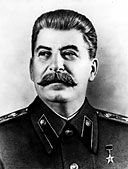 Iosif Vissarionovich Dzhugashvili would create for himself a name that
will never be forgotten, a name that surpasses time itself. Joseph
Stalin is best known for his purges and the brutal practices he
instituted from the late 1930's onward. As the leader of the Soviet
Union during the Second World War he was able to defend Soviet interests
from the tyranny of Hitler's fascism, while contemplating the long-term
picture in his dealings with his allies. This dictator, who is held
accountable for an unimaginable number of deaths, by having sacrificed
the lives of millions of Russians, won the war for the allies.
Ironically, Stalin gave millions upon millions throughout the world the
chance to live free lives.
Iosif Vissarionovich Dzhugashvili would create for himself a name that
will never be forgotten, a name that surpasses time itself. Joseph
Stalin is best known for his purges and the brutal practices he
instituted from the late 1930's onward. As the leader of the Soviet
Union during the Second World War he was able to defend Soviet interests
from the tyranny of Hitler's fascism, while contemplating the long-term
picture in his dealings with his allies. This dictator, who is held
accountable for an unimaginable number of deaths, by having sacrificed
the lives of millions of Russians, won the war for the allies.
Ironically, Stalin gave millions upon millions throughout the world the
chance to live free lives.
