EUROPEAN EXPLORATION AND DISCOVERY
1450 - 1650'S
NOTES BY TYLER WHITE, LHA '03
Before the explorers came to American the Amerindians lived here. Some believe the Amerindians came to North America from Asia 30,000 years ago by crossing the Bering Strait.
The Amerindians had two different life styles: Sedentary and Nomadic.
They all believed in a religion based on man's interaction with animals and nature. Some differences were:
Sedentary Nomadic
Tribes: Iroquois, Huron Algonkian
Area they lived in: Great Lakes & St. Lawrence Valley Canadian Shield
How they got food: Farming & fishing Hunting, fishing,
Gathering
Who ran society: Women (Matriarchy) Men (Patriarchy)
Housing: Longhouses Wigwams
During the 15th century Europeans began to explore southward and westward. There were several reasons for this increased exploration.
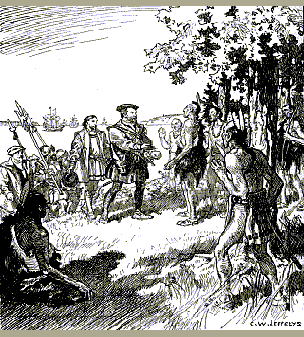
In 1534 the French king anxious to find a route to China sent Jacques Cartier on his first of three voyages.
Cartier's goals:
First voyage 1543: Cartier explored the shores of the gulf of St. Lawrence and planted a cross, claiming the land for France.
Second voyage 1535-1536: Cartier returned to the Gulf of St. Lawrence and continued up the St. Lawrence river visiting two Indian villages, Stadacona (Quebec City) and Hochelaga (Montreal). He spent the winter near Stadacona where 25 of his 110 men died of scurvy.
Third voyage 1541: Cartier returned to the St. Lawrence region to try and establish a settlement. After enduring another winter in New France the project was abandoned.
Although Cartier did not find a route to China he did accomplish:
The first important natural resource the French discovered in New France was fish but its importance was soon surpassed by fur.
The king of France wanted to set up a colony in New France. In order to pay for the expeditions he granted a trading monopoly to a fur trading company and in return the company promised to set up a colony. A monopoly gave the company exclusive rights to supply the furs, eliminating any competition and giving them total control over setting prices. The fur trading company in New France used a mercantilism trading system. Colonies exclusively traded with the mother country. Colonies supplied the raw materials to the mother country and its purchased finished products.
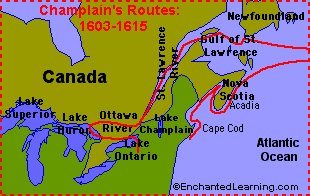
Samuel Champlain went to New France to set up a colony.
1605: He tried to build a settlement at Port Royal but it was abandoned.
1608: Champlain set up a permanent trading post near Stadacona (Quebec City)
1609: Champlain explored the region to find new sources of fur.
1613: Champlain explored the Ottawa Valley.
1615: Champlain explored Georgian Bay and Lake Ontario.
Champlain's Accomplishments:
The French and Amerindians were now frequently interacting and influenced each other's lives.
The Amerindians introduced the French to:
The French introduced the Amerindians to:
Many believe contact with the French led to the deterioration of Amerindians way of life.
In 1627 the trading company One Hundred Associates was founded.
Two types of colonies:
There were two different ideas at the time as to what type of colony should be built.
Trading Post vs Full Settlement
Purpose: Commercial - fur profits People to settle to become self-sufficient
Who wanted this type: Merchants & trading Company King, church, Champlain
Population: Small- traders, carpenters Large - farmers, merchants, soldiers, priests
Administrators.
Buildings: A few bunks, houses, warehouses Houses, stores, church, businesses, forts, church port
The fur trading company did not want settlers because they believed settlers would:
So the fur trade discouraged settlers from coming by emphasizing that the Amerindians were hostile and the climate was too harsh.