The Seigneurial System: 1623-1760
By Athar Mohammed, [LHA '03]
The government had a system for developing the land in New France, it was called the seigneurial system. A fairly large area of land was granted to a seigneur (landlord). The land he received was called a seigneury. The seigneur had to attract habitants (settlers) to come to develop farms on his seigneury. If successful, he made money from the dues paid by his farmers. It was a way for poor people to have food and a place of their own. In return they had to work hard and pay dues to the seigneur. The system had many adventages for the government. It did not cost much to operate. The land got developed in an orderly way. The population grew as the seigneuries expanded. The farms produced most of the food needed by the colony. The first seigneuries were granted in 1623. By 1663 there were 53 seigneuries. The system was abolished in 1854. Almost all the seigneuries boarded the St. Lawrence and the Richelieu rivers. The seigneur kept a large piece of the land for himself. The seigneur also had to agree to build a grist mill (wind mill) to grind the farmers ' grain. The land along the river was divided into lots. The lots were long and narrow in shape. The narrow end boarded the river. Once the community started to grow, a church was built. The church was the centre of many social activities. Here are some of the rights and duties of the seigneuries and habitants.
Seigneurs
Duties/Obligations Rights/Privileges
-Bring in settlers and clear land -Gets shares of the stuffs from the habitants
-Build Church on seigneury Habitants.
-Pay Church taxes -Gets the rent
-Grant concessions (farm lots) -Special privileges in Church
-Hold a court to settle minor disputes -Gets the biggest farm
-Right to repossess land, if not used.
Habitants
Duties/Obligations Rights/Privileges
-Clear trees from lots to grow crops -To be granted land by seigneur
-To give 3-4 days/year free labor to -To be protected by the seigneur
seigneur "corvee" -To keep his profits
-Pay Church taxes "tithe" -To sell his land or leave it to his
-Pay tax & Homage to seigneur family.
The Slow Economy Of New France:1665-1748
Jean Talon was the intendant of New France from 1665 to1668. He came back to New France from 1670 to 1672. Jean Talon improved farming by doing the following:
*granting more seigneuries
*bringing in more immigrants
*bringing over horses, sheeps, and cattles from France
*encouraging crops which could be sold. Flax being used to make linen. Hemp used for making ropes. Barley and hops were grown to brew beer.
Jean Talon also improved trade in New France by doing the following:
*hat making ( to use furs )
*ship-building and barrel-making ( to use wood )
*tanning ( to make leather for shoes )
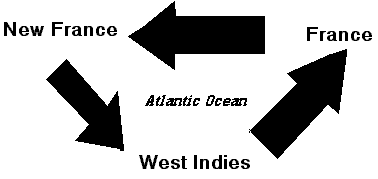
Jean Talon tried to encourage the "Triangular Trade". Ships arrived in New France on the first stop of their voyage with manufactured goods, cloths, metals, and liquor. They then loaded up timber, barrels, wheat, and fish for the second stop in West Indies. This increased exports from France. In West Indies the ship loaded up with, barrels of rum and molasses (liquid sugar), as well as sugar and tobacco back to France to complete their triangular journey.
Gilles Hocquart was the intendant of New France from 1731 to 1748. He also improved agriculture by:
*opening up more seigneuries
*increasing the amount of cultivated land
*exporting wheat to France in years when the harvest was good
Hocquart encouraged small industries such as:
*shipbuilding
*iron foundry near Trois-Rivieres
*hat making
*making tar (for ships)
Hocquart also promoted the fishing industry. French fishing boats increased from 400 to 8000. The economy of New France remained weak. The French government did little to help.
The Church : Social Services
4 Main Roles:
Additional Roles of the Parish Priest/Curé:
-[Parish is the division of Church; Tithe is a Church Tax in order to keep the Church]
-keep records of birth, death, marriage
-made legal contracts, advised people
-reported to intendant