Early French Settlement: 1608-1760
By Athur Mohammed [LHA '03]
The first missionaries came to Quebec in 1615. They hoped to convert the natives to Christianity. The first farmer, Louis Hebert, arrived in 1617. Samuel de Champlain died at Quebec on New Year 's Day 1635. Quebec was the first successful French settlement in North America. Samuel de Champlain is also known as, "Father of New France". In 1634 Champlain sent Laviolette to set up another post further west. The post was named Trois-Rivieres. It became an important fur-trading settlement. Back in France a group of religious people set up the Societe de Notre-Dame in 1639. Its members wanted to help to convert the Indians to Christianity. Jerome Le Royer was the leader of this group. They chose a site on a large island (Montreal). A party of settlers arrived from France in 1641. Their leader was Paul Chomedy, Sieur de Maisonneuve. In spring of 1642, Maisonneuve 's group went up the river to the chosen island. They named the new settlement Ville-Marie. Jeanne Mance set up the first hospital which was named Hotel-Dieu. Marguerite Bourgeoys opened the first tiny school. The founders of Ville-Marie had religious motives (reasons). Their mission was to convert the Iroquois to Christianity. The tiny settlement soon became an important centre for the fur trade. The fur-trading centre began to be called Montreal.
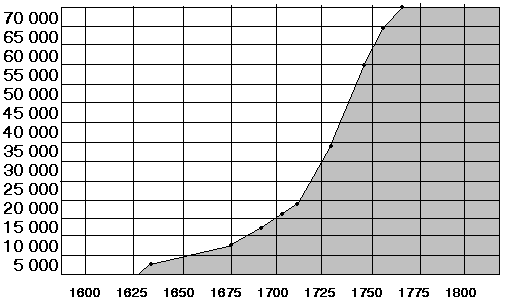
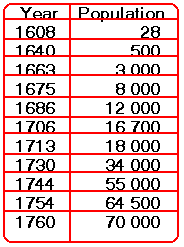
Immigrants are people who come to settle in a new land. Only about 10 000 immigrants came to New France in the 150 years between 1608 and 1760. New France failed to attract many new colonists from France. It was far away from France. The ocean voyage was uncomfortable and dangerous. People from France found the winters very cold and very long. There were always a threat of Indian attacks. The fur-trading companies brought over very few settlers. They did not want farmers to spoil the forests that were homes to the fur-bearing animals. The entire population on New France numbered 3 035 in 1663. There were only 9 single women aged 20 to 35 for 1 293 single men of all ages. In 1663 the king decided to take over control. Jean Talon was appointed to serve as intendant (administrator) from 1665 to 1672. He encouraged more people to immigrate to New France. During that period, the population of New France doubled.
The main types of immigrants of New France were:
*engages- Hired workers who agreed to come for three years. Nearly all were men.
*soldiers- They were offered land if they stayed at the end of their army service. Some 400 officers and men chose to stay. The officers were granted seigneuries and the men got farms.
*filles du roi- Between 1663 and 1673 some 770 women were sent over to relieve the shortage of women in the colony. They were mostly young orphan girls.
*minor criminals- Poachers, smugglers, tax dodgers. They came from France to avoid being sent to prison.
People were encouraged to marry young. Payments were made to couples who married at a young age. Fathers of unmarried girls aged 17 or over had to pay a fine. Unmarried men aged 21 or over had to pay fines also. They were not allowed to take part in the fur trade. Men were also encouraged to marry Amerindian women. Family allowences were paid to big families. A family with 10 living unmarried children got a year 's wage as a grant. Natural increase caused the population of New France to grow rapidly. The chart and the graph below gives more details.