1.2 SoE Reporting and Usability of Reports
One way to disclose information on the environment is to produce a state of the environment (SoE) report. The purpose of an SoE report is to present and communicate information to its audience, in order to help and influence the process of decision-making and change attitudes towards the environment. This leads to a very important question: who is the audience for an SoE report? The answer can be easily found at the very beginning of this chapter. If, according to the Stockholm Declaration (1972), "Man ... bears a solemn responsibility to protect and improve ...", and, the Rio Declaration (1992), Agenda 21 (Robinson 1993), and Aarhus Convention (1998) recognize the importance of public participation in assuming this responsibility, then the audience is everyone who makes decisions, does research, studies, or is simply curious to find out more about environmental problems. This also means that the needs of these various audiences will be different.
This provokes another question: how appropriate are SoE reports for their audience; in other words, how usable is the environmental information for all these people? First, it is worth mentioning that an SoE report, in its typical, printed, form usually contains several hundred pages, endless tables full of numbers, complicated graphs, and an enormous quantity of highly specialized text. Second, it is also necessary to understand that any reader, whether a specialist, a politician with perhaps no specialized environmental knowledge, a student investigating, or a citizen, only interested in what is happening in the environment, can easily become discouraged in this way. While the report is physically available, the information is not always usable for the audience. It seems unlikely that it will influence their way of thinking.
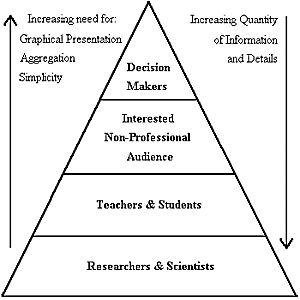
According to Simonett and Denisov (1998), despite large efforts put into SoE reporting, not much information reaches the audience in a "digestible format". One of the most important problems is that these reports are too large in volume; in other words, there is too much information presented. However, it has to be admitted that all this information is necessary. SoE reports are read by environmental experts, scientists, and researchers, who need specialized information and access to raw data. On the other hand, decision-makers do not need all this. They need very simple and straightforward information, which will help them decide what to do. Students and citizens need often more explanatory information (see Figure 1). It is, therefore, important to find out how to produce SoE reports so that they satisfy all these different needs.
This problem was recognized early on. Even Principle 19 of the Stockholm Declaration (1972) states that the mass media should play a very important role in providing information on the environment and in educating the public. The Aarhus Convention (1998) goes further, stressing "the importance of making use of the media and of electronic or other future means of communication". It also says that the information should be provided in a "transparent" and "effectively accessible" way through "electronic databases" and "telecommunication networks". The UNEP has also recognized this, and started an initiative for finding ways to present the SoE information in a more user-friendly way. The Norway Report on the Internet, developed by the UNEP/GRID Arendal, was the prototype for CEE reports (Simonett and Denisov 1998).
Figure 1. Pyramid of Users of SoE Reports. From: UNEP/DEIA 1996. Adapted. Back
In 1998, the GRID-Arendal has made a large contribution to SoE reporting and indicator harmonization by including almost all representatives of CEE/NIS countries into the process of producing the electronic SoE reports. This organization published the CD-ROM "Cookbook for the State of the Environment Reporting on the Internet", where the main trends in the field are summarized, and practical advice on how to prepare an SoE report on the Internet given. It contains the national SoE reports of majority of the CEE countries and NIS (UNEP/GRID-Arendal 1998).
However, this process has only just begun. Although we can see all the CEE reports (except that for Yugoslavia and Croatia) on the Web, it is still very difficult to compare them, because a common set of indicators has not yet been produced. In addition, the electronic versions of reports are often the exact copies of the printed ones, which means that the same content is available, this time on the computer. This does not solve the problem of usability. The Internet offers many possibilities to structure the information on the environment in a user-friendly way. Unfortunately, this potential has not been utilized in many cases.