ADAPTING YOUR HOME FOR WHEELCHAIR ACCESSIBILITY
One of the challenges we all face as our children grow is providing wheelchair accessibility to our home. Below you will find information that may be helpful in your decisions in your own particular case.
There are two areas that need to be considered - providing wheelchair access from outside and adaptations within your home.
The first thing you need to do is to analyze where the problem areas are. Are there steps to your home? Do you have a porch or balcony that can accomodate the wheelchair? Is there adequate room to maneuver the wheelchair - especially important if you need to negotiate a 90 degree turn to enter. Is the door opening wide enough to easily allow the chair to pass? Is there adequate lighting - a roof to shelter you from inclement weather?
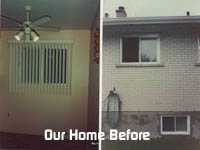
In our own situation, the main problem was that we had LOTS of stairs to deal with. There were cement stairs at street level that led to our walkway, as well as a flight of stairs leading to our front door. The only other entrance was via a small side door, which led to more stairs leading to the basement and to the kitchen, and through the garage, which is located under our house. We immediately discounted entry by the side entrance. The garage was equally impractical, as we would then have to install an interior elevator from the basement and for a myriad of reasons there was no room for it inside the house. That left the front door. The only possibility was to install an elevator lift. However, our front balcony is much too narrow to allow us to maneuver Joey's wheelchair. We felt there was no existing entrance well suited to our needs, and decided to create one that would be. And, we felt very strongly that we wanted to preserve the "normal" look of our home.
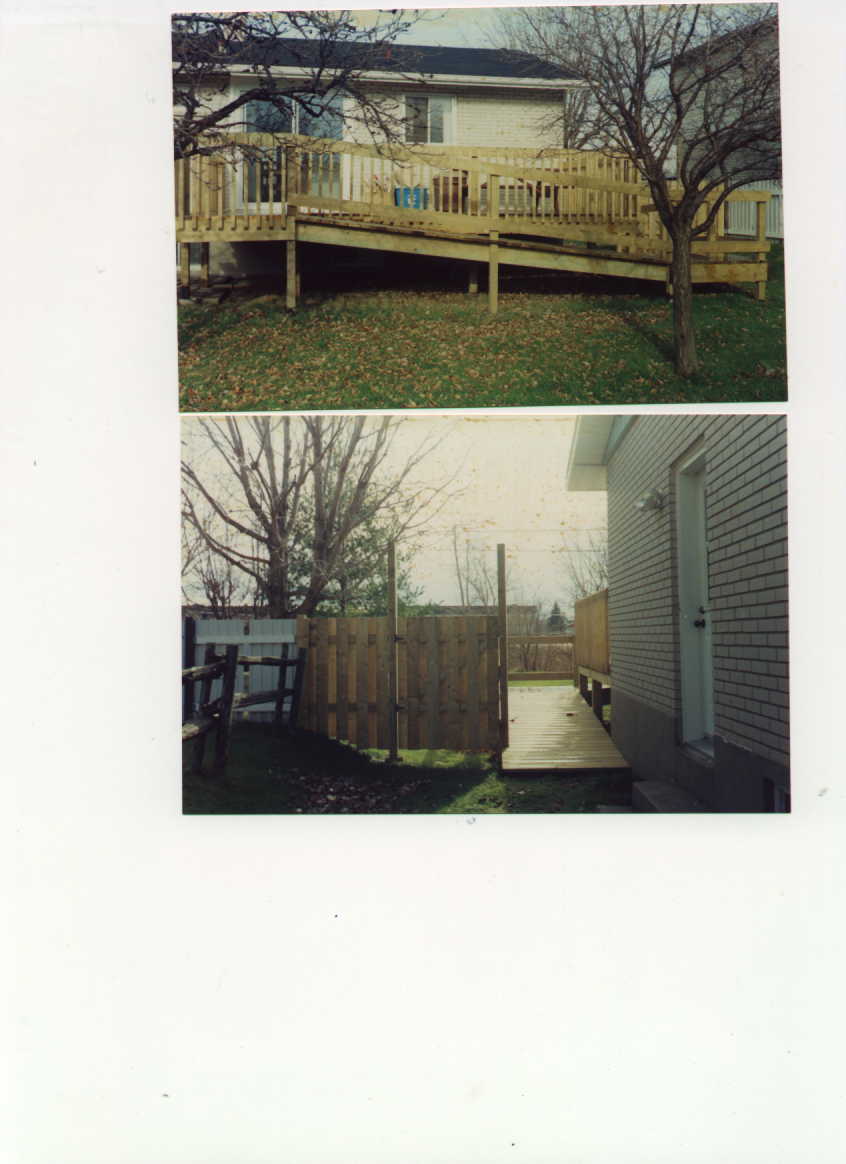
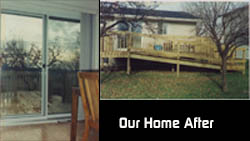
What we decided to do was to replace a small window located in our kitchen with a 7 foot wide patio door. From there, we built a large (10' wide x 20' long) wooden deck. On two sides of the deck we built a wooden ramp, which is easily removable should we ever wish to sell our house. By following two sides of the deck, it gave us ample length to allow for a gentle slope to facilitate pushing Joey in his wheelchair as he got older and heavier. The wooden ramp leads to a cement sidewalk, that follows the side of the house - then turns to the front. It joins up with the main walkway to the front door. As for the cement stairs which led to the street, we eliminated them, and replaced them by a gentle sloping cement walk.
Here are the "before and after" photos to give you an idea of what we did:
It is often difficult to figure out the proper slope and length of ramp needed for wheelchair accessibility. As well, it is wise to base your adaptations on the dimensions of an adult wheelchair. We found some very helpful charts in the book "The Complete Guide to Barrier-Free Housing". You may find them interesting and useful in your planning.
 Slope Chart For Ramps
Sample Ramp Configurations
MORE TO COME...