Authority
What does authority mean ? There are different types of authority and different definitions :
Philosophically it means superiority over others, based on either personal advantages or one's official duty, charge or agreement. The word originates from the latin word "auctoritas", which means in the Roman administration security in business and guardianship over a minor.
At that time the consuls or senators had the official responsibility to decide about who was allowed to trade and who was not. Furthermore they were in charge of the civilians and almost every social institution.
Today we distinguish between personal authority, authority in office or functional authority, authority of experts or authority of competence, and moral authority.
Personal authority only exists if some people being on the same level endow one out of their midst with authority. Because of his influence he can guide the others - but, this personal authority can be taken away by the others at any time, it is recallable.
Authority in office is not recallable by the dependents, but is based on an objective order of society. If society feels there should be education, there must be teachers to whom authority will be given. In order to prevent authoritarian structures, there must be democratic control of the authority given to some people and these people must justify what they are doing along certain rules.Functional authority is recallable if the position is not filled in a responsible way or if and when conditions change.
Authority of experts or of competence means the advantage of knowledge. The others must have the right to ask questions. But it is clear that the opinion of expert will be fundamental for all decisions in his field of competence..
In today´s society authority in office is not necessarily linked to an offical hierarchy.
Sometimes the functional authority is justified and increased by the personal authority of the person in power. He or she gives an example of knowledge, moral competence and human behavior.
Occasionally it happens that a person believes that he has more personal authority than the people arround him would like to give him. This can lead to a person losing his control and change to fanatism, while one cannot foresee his next action or ideas. This has then nothing to do with authority, but with authoritarian behavior, in extreme cases even with dictatorship,e.g. when Hitler ruled Germany.
Authority must not be excluded from the educational upbringing, since it is not possible to convey knowledge without authority. However, the high knowledge does not mean that teachers have necessarily higher moral authority than the students.
Teachers should not behave in an authoritative manner, because students can be educated and guided best if personal authority is added to the authority in office. If that is not the case, students will neither accept their teachers, nor will they take them serious.
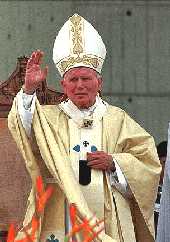
Moral authority is demonstrated by many people, not being necessarily in high offices. But there are high functions which should only be given to persons with highest moral authority, e.g. the Pope or an non-executive President of a country.
The Pope has no army, his power comes only out of his moral standards and his personal example for living. Even if someone doesn't agree with some rulings of the Pope, they have to accept the integrity of the Pope, his authority.
Therefore authority occurs in many different forms - it should however never be based on power and force, but on accepted superiority in a specific field.
Constantin Breitengross