
Authority
Definition
According to Webster´s Dictionary, Authority is the power to influence or command thought, opinion or behaviour.
Authority
Authority is an interesting and important subject for everyone who wishes to become a more effective leader. Those of us who aspire to more effective levels of personal and professional leadership need a clear understanding of what authority means practically, as well as literally.
Example
Authority is the legitimate power of a supervisor to direct subordinates to take action within the scope of the supervisor's position. Formal authority in an organization can be traced all the way back to the U.S. constitutional right to own property. The owner of an organization has the authority to make decisions. For example, entrepreneurial firms have an informal arrangement between the employees and center of decision-making authority, the owner.
What describes an authoritive person?
This person must be someone, that is just and fair to everybody. This person is honestly interested in his subordinates, wants the best for them. It has to be someone who can be trusted. The better an authority is at motivating people, the more he can get out of them.
An authority has to be capable of taking responsibility for his mistakes. An authority should never abuse his or her power.
Power
In addition to authority, supervisors have more personal sources of power to draw from to get things done. Everyone has power in one way or another and it is by exercising this power that organizations get things accomplished. Supervisors who achieve their targets independently possess strength. When these "strong" supervisors involve and incorporate others into their plans and activities they are using power, and in fact increasing the total amount of power available to focus on a particular situation or problem.
Involving employees in setting objectives and making decisions as it relates to their jobs empowers everyone, and results in greater job satisfaction and commitment, as well as increased productivity. Empowering employees provides them with greater autonomy and productivity.
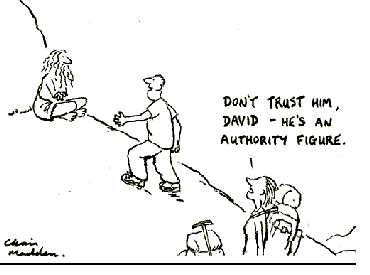
The picture shows the problem of people, who lost the trust in authoritative persons.
Example
A good example for an authority are teachers. They have to be authoritive. They cannot give good or bad grades because they like one student more than another. Being objectiv is part of every good authoritive teacher. Also a teacher has to be the "good soul" for his pupils. He has to be able to help students solving problems for exampel. Only when he does his job well, he´ll be called a good, but also authoritive leader – an accepted leader.
Summary
To say it clearly, authority is for the upbringing process indispensable. Without authority, there´s no upbringing and no progress possible. Moreover it´s necessary to notice that the concept of authority has not to be seen in a negative way. Rather it´s important to distinguish between an authoritarian and an authoritative behaviour. An authoritative behaviour is correct and desirable for example for a teacher. On the other hand authoritarian behaviour is unacceptable because it includes inadmissible and for honour hurtful actions of the authoritarian person. That can be a problem in many relationships.
Authority cannot be earned, it must be lent
Stefan Hörömpö
S1