"On the eighth day you shall hold a solemn gathering; you shall not work at your occupations". Numbers 29:35
"Shemini" means the eighth; in general, the number eight symbolizes perfection, as it does in the case of "brit milah," the covenant of circumcision. The brit is performed on the eighth day to "complete," as it were, or to instill the potential for perfection, in the human being.
"Atzeret" means "holding back," or that which is held back for the purpose of bringing it to its state of completion. Thus, the name "Shmini Atzeret" means the eighth day which is the additional day that brings the seven-day holiday of Sukkot to its state of perfection.
Shemini Atzeret is celebrated concurrently with Simhat Torah by most Reform Jews. Orthodox and Conservative Jews celebrate the holidays separately.



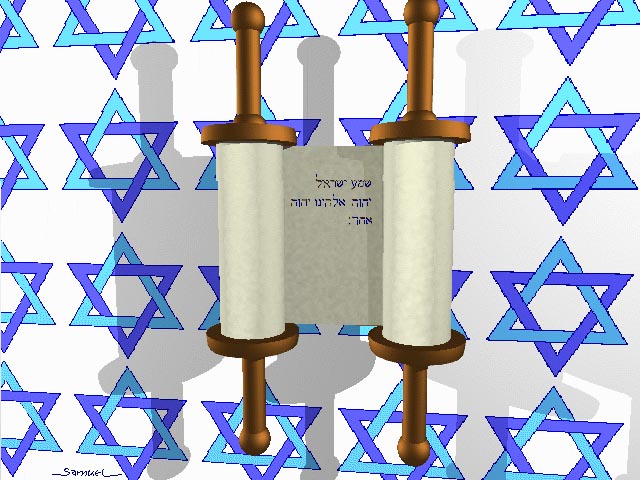

Sometime after the 11th century, Shemini Atzeret also came to be known as Simchat Torah, "Rejoicing of the Torah." In the Diaspora, this name was applied only to the second day of Shemini Atzeret.
The Basis
Although the name was not known in the talmudic period, the practice of reading the final portion of the Torah, Deuteronomy 33-34, on this day was set by the Talmud. From this practice, there gradually grew a tradition of a special, joyous celebration to mark that completion.
The basis for such a celebration is found in the Midrash which described Solomon as having made a special feast after he was granted wisdom. Said Rabbi Eleazar:
"From this we deduce that we make a feast to mark the conclusion of the Torah, for when G-d told Solomon, 'I have given you a wise and understanding heart like none who came before you or after you . . .' and he immediately made a feast for all his servants to celebrate the event, it is only proper to make a feast and celebrate when finishing the Torah."
The Development
While the tradition of added merriment on this last day of the holiday in honor of completing the Torah began during the ninth and tenth centuries of the common era, at the time of the Geonim, the name Simchat Torah came into use even later.
The custom of reading of the last portion of the Torah was set by the Talmud, but that of reading of the first chapter of Genesis was not introduced on Simchat Torah until sometime after the 12th century. The reasons given for this additional reading were:
1) to indicate that "just as we were privileged to witness its completion, so shall we be privileged to witness its beginning" and
2) to prevent Satan from accusing Israel that they were happy to finish the Torah (in the sense of getting it over with) and did not care to continue to read it.
Initially it was the custom for the same person who completed Deuteronomy to read the Genesis portion from memory without using a scroll, on account of the general rule that "two scrolls are not taken out for one reader."
Eventually the practice developed of calling two different persons, one for the reading of the last portion of Deuteronomy and one for the first portion of Genesis, and two different scrolls began to be used.
The Honor
Each of these ALIYOT (callings to the Torah) came to be regarded as great honors.
The people so honored were called HATANIM, Bridegrooms (of the Law). The one who presided over the completion of Deuteronomy was called HATAN TORAH, Bridegroom of the Torah. The one who presided over the beginning of Genesis was called HATAN BERESHIT, the Bridegroom of Genesis.
It became customary for the men so honored to sponsor a festive meal later in the day. In our own day, those so honored usually sponsor a special Kiddush following services.
Hakkafot
The ritual custom most closely identified with Simhat Torah is that of the hakkafot. Hakkafot is the term used to designate ceremonial processional circuits, whether in the synagogue or elsewhere.
On Simchat Torah, all the Torah scrolls are removed from the Ark, and carried around the central platform in seven hakkafot. This takes place during the evening service and also before the readings from the two Torah scrolls (described above) during the morning service. Hasidic practice in the Diaspora is to conduct hakkafot also at the evening service of the first day of Shemini Atzeret, as in Israel.
Origins
Although the custom of hakkafot on Simchat Torah is of rather late origin, dating from about the last third of the 16th century (in the city of Safed), the practice of hakkafot goes back much further.
Processional circuits are first mentioned in the Bible, as a build-up to the downfall of the walls of Jericho. There were seven circuits around Jericho; once a day for six days, and seven times on the seventh day.
The lulav (and aravot too) were carried around the Temple altar during the seven days of Sukkot; once a day during the first six days, and seven times on the seventh day (see above). From there developed the custom of hakkafot around the synagogue with the lulav and the etrog.
At traditional Jewish wedding ceremonies the custom of hakkafot is still to be seen in the circling by the bride around the bridegroom at the very start of the ceremony, usually seven circuits.
Three such circuits (Persian custom) can be said to symbolize the three-part passage from the Prophets which describes Israel's relationship to G-d in terms of an idyllic betrothal and marriage:
I will betroth you unto me forever;
I will betroth you unto me in righteousness and judgment, in loving-kindness and mercy;
I will betroth you unto me in faithfulness and you shall know the L-rd.
(see also weekday morning prayer for putting on tefillin).
Song and Circuit Dancing
In addition to the prescribed passages, it is commonplace for the congregation to join in the singing of many additional songs, generally verses from the Bible or the prayerbook that have been put to music.
It is also the practice in the more traditional congregations for the worshippers to join a circle and dance in between each circuit. Those holding Torah scrolls also join the dancing.
In the yeshivot, the schools of higher Jewish learning, and in those congregations where traditional youth predominates, the singing and dancing that accompany the hakkafot can last for many hours. It is sometimes even carried outdoors. The whirling bodies and the stomping feet, perhaps a performance of acrobatic feats by someone inside the dancing circle, all accompanied by continuous song, provide a scene of ecstatic joy.
Small children are generally given decorative flags or miniature scrolls and they too follow the Torah scrolls in the processions.
Special Blessing for Children
In addition to involving the children in the Torah procession, it also became customary to include them in the Torah reading which follows.
Although a child under the age of thirteen is not generally called to the Torah for an aliyah, on Simhat Torah there developed the custom of kol ha-ne'arim which means "all the children," and refers to the fact that all of the children in the congregation are called up collectively and given a joint aliyah.
A tallit is spread over the heads of the entire group and the blessings, led by one adult, are recited.
At the conclusion of the reading, the congregation invokes Jacob's blessing of Ephraim and Manasseh as a special blessing for the children.
"May the Angel who has redeemed me from all harm, bless the children. In them may my name be recalled, and the names of my fathers, Abraham and Isaac . . ."
Simchat Torah in Israel
In Jerusalem, it is now customary on Simchat Torah morning for some congregations to join together in a mass dancing procession through the city to the Western Wall.
Led by scrolls of the Torah carried under the canopies, literally thousands of people, young and old, eight and ten abreast, dance and sing their way to the Western Wall in a procession that stretches for as far as the eye can see.
The original custom of holding the hakkafot at the conclusion of Simchat Torah inspired the custom in Israel of carrying the Simchat Torah celebration also into the night after the holiday. Public gatherings with bands and music featuring hakkafot and singing and dancing are then held.
In one public square of Jerusalem, it is customary for the Chief Rabbis and high government officials to participate. At that celebration there is featured the varied practices of the different Jewish communities: Hasidic, Yemenite, Bukharan, native Israeli, etc. A different group is responsible for each of the hakkafot, doing it in their respective traditional dress and with their traditional melodies.
At one time, this was also the moment for identification with Soviet Jewry, who held their own extensive celebrations in Moscow, Leningrad and other major towns on this date.
Hakkafot also take place at Israel's army bases, and even men near frontline positions have been known to participate in them during quiet periods. In the midst of the Yom Kippur War which lasted till after Sukkot, television crews recorded scenes of the Chief Rabbi of Israel, Shlomo Goren, visiting forward army bases, having brought with him a small Torah scroll, and of men joining him in some traditional dancing with the Torah.