Elizabeth Huff The Enquirer
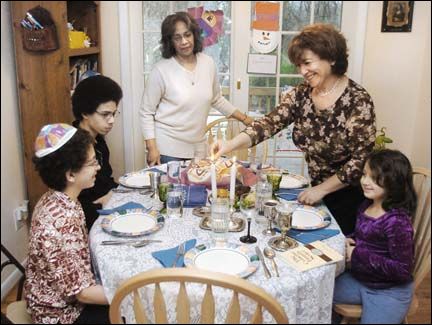
Ahuva Sadeh shouts from the kitchen, correcting her son's pronunciation of Hebrew, while boiling
eggs for Passover dinner.
Monday at sundown began the eight-day Jewish holiday that celebrates the escape from slavery in
Egypt thousands of years ago.
The dinner is called Seder, and it is a celebration of freedom, Ahuva said. And in her home, it's a
casually disordered affair full of laughter.
Ahuva was born in Israel and moved to Colorado a decade ago. Her son, Yinon, 14, and her
daughter Adi, 6, have grown up in the faith. Yet it was only Ahuva's second time to lead Seder.
Her grandmother used to lead the large family gathering. But since the Sadehs moved to Battle
Creek about a year ago, they have celebrated with friends.
"Everybody has different traditions," she said, explaining some confusion over where to drop the
wine representing the 10 plagues that God sent to the Egyptians, while sparing the Hebrew slaves.
Laughing, Ahuva said her mother used to throw a bowl full of wine out the back door and in the
direction of the Egypt.
They decided to put 10 droplets on their plates instead.
For her visitors Dian Cantrell, and her 14-year-old son Lowyn Cantrell, Passover also is a
celebration of their newfound faith. They converted to Judaism fewer than two years ago.
"I felt drawn to what I believe is home," Dian said.
The celebration of freedom is especially important, she said. Her ancestors are Native American,
European and African. She has found personal freedom from an unhappy marriage, calling herself
"happily divorced."
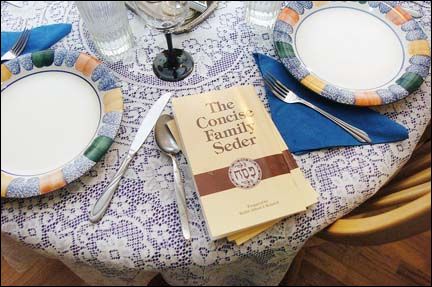
Using "The Concise Family Seder," Dian asked Ahuva's daughter, Adi, what's different about this
dinner than what they usually eat.
"We don't eat hot dogs?" Adi offered.
"We eat bitt ..." Dian began to whisper.
"Bitter herbs?" she tried again.
Symbolic foods are placed around a Seder plate; for example, parsley and horseradish that
represent the bitterness of slavery.
During the holiday, Jews are supposed to refrain from eating breads made with yeast. During their
departure from Egypt, they did not have the time to wait for dough to rise. A hard cracker called
matzah is eaten instead.
The Jews suffered a lot to escape slavery. The newly-freed Israelites roamed the desert in search
of a homeland.
With her voice breaking softly over the undulating notes, Ahuva sang a song she translated as
saying, "next year we'll be free."
"It's up to us to tell the story of Exodus," she said. "It's our privilege to tell."
.
Originally published April 1 , 2007